
This page offers a year-long series (announced here) for reading through the Gospel lectionary according to the Byzantine liturgical cycle. Each Sunday, images of the appointed Gospel reading are presented as they appear in a Greek lectionary manuscript. Through this approach, readers encounter the Gospel text in a way that closely reflects how it has been received, preserved, and proclaimed within the rhythms of ecclesial worship for centuries.
The readings are drawn from L434 (Athens, National Library of Greece, EBE 68), a twelfth-century Gospel lectionary manuscript written on parchment. Reading the biblical text from this source connects us to the historical continuity of the Church’s proclamation—the same Gospel that has been read aloud within the same liturgical context for hundreds of years. This manuscript was digitized by CSNTM, and full images are available through the CSNTM database and the National Library of Greece.
Through this series, we invite readers to encounter the richness of lectionary reading by engaging the text directly in its manuscript form—the way these words have been handed down for centuries and shared by generations of the faithful.
For those who prefer to read the day’s lesson in English or the modern Greek lectionary, you can find these directly on the links below that take you to the website of the Greek Orthodox Archdiocese of America.
Week 1: Easter – The Holy and Great Sunday of Pascha (John 1:1-17)
While September 1st marks the beginning of the church year in the Orthodox calendar, the true center and culmination of the church’s worship is Pascha, the feast of the resurrection of Christ. This day begins the Johannine period of readings, the first of four periods encountered in the annual cycle of readings.
Pascha is the preeminent feast of the Byzantine Church and the heart of the liturgical year. The entire cycle through Lent and Holy Week leads up to Pascha with anticipation—and from it, all the weeks that follow take their shape. For this reason, the Gospel proclaimed at Pascha is not only a celebration of the resurrection of Christ but also the beginning of the annual cycle of Gospel readings.
In the Byzantine tradition, the paschal Gospel is John 1:1–17—“In the beginning was the Word…”—a fitting proclamation of both the triumph over death and the dawning of the new creation.
Read the full text on the images below.


For those who prefer, you can read the passage in English or Greek here.
The celebration of Pascha extends far beyond a single day into Bright Week, inaugurating a fifty-day season of sustained Easter joy that culminates in Pentecost. Throughout this week, Paschal hymns resound, festal meals are shared, and fasting is set aside.
The doors of the iconostasis—the screen of icons separating the nave from the altar—remain open. This happens only during this time of the year and symbolizes the stone rolled away from Christ’s tomb and the opening of the gates of heaven.
During this week, the reality of the resurrection is so deeply interwoven into the public worship that there can be no doubt in the minds of those celebrating: what has taken place on Pascha has transformed the world and humanity, now and forevermore.
We begin this week, as the Church does, with the proclamation:
Χριστὸς ἀνέστη!
Ἀληθῶς ἀνέστη!
Week 2: The First Sunday after Pascha: Thomas Sunday (John 20:19–31)
In the liturgical calendar of the Orthodox Church, the first Sunday after Pascha is known as Thomas Sunday, named for the appointed Gospel lectionary reading. This Sunday follows Bright Week and continues the celebration of the new life brought forth by Christ’s resurrection. Although Bright Week has concluded, the church does not return to ordinary time but remains in the joy of the resurrection, continuing to proclaim the renewal of the world and of humanity through the risen Christ.
In the Byzantine tradition, the Gospel reading for Thomas Sunday is John 20:19–31. In this passage, the risen Christ appears to His disciples and later reveals Himself to the Apostle Thomas, inviting him to behold and touch the marks of the crucifixion.
Read the full text in the images below.


For those who prefer, you can read the passage in English or Greek here.
While the Apostle Thomas is often remembered as doubting or faithless, this passage actually reveals the depth of his faith. Face to face with the risen Christ, he reaches out and examines the wounds of the cross, and utters one of the most theologically significant confessions in the New Testament:
Ὁ κύριός μου καὶ ὁ θεός μου
“My Lord and my God”
John 20:28b
In this moment, Thomas does not merely acknowledge the resurrection intellectually; he addresses Jesus with the very name of God, θεός, in a profound confession of faith that reveals the mystery of the Incarnation—recognizing that the One who stands before him is God made flesh.
For nearly two millennia, the church has echoed this same confession in the kontakion for Thomas Sunday, a liturgical hymn that reflects on this Gospel encounter:
Thomas examined Your life-giving side with his probing right hand, O Christ our God. As You entered, though the doors were closed, he cried out to You, with the other Apostles: “You are my Lord and my God.”
(Kontakion for Thomas Sunday)
Week 3: The Second Sunday After Pascha, the Sunday of the Myrrh Bearing Women (Mark 15:43–16:8)
The second Sunday after Pascha is known as the Sunday of the Myrrh-Bearing Women. The Gospel reading appointed for this day is Mark 15:43–16:8, a passage that ends strikingly with ἐφοβοῦντο γάρ (“for they were afraid”) at 16:8, which many regard as the original ending of Mark.
In this passage, Joseph of Arimathea boldly approaches Pilate and asks for the body of Jesus, then lays it in a tomb. After the Sabbath, Mary Magdalene, Mary the mother of James, and Salome bring spices to anoint the body (myrrh is not specifically mentioned in this passage). When they arrive, they encounter a young man dressed in white who announces that Jesus has been raised and instructs them to tell the disciples. However, the passage ends with the women fleeing in fear and astonishment, saying nothing to anyone, “for they were afraid.”
Read the full text in the images below.


For those who prefer, you can read the passage in English or Greek here.
This abrupt and paradoxical ending has been the subject of extensive interpretation. While Mark 16:8 emphasizes silence and fear, the broader Gospel tradition makes clear that the women did in fact proclaim the Resurrection. The Church reads these accounts together, so that fear is not their final state; rather, they become the first witnesses and proclaimers of the Resurrection. In this sense, the role of women—despite their marginal social status in the ancient world—becomes central to the Gospel proclamation.
This the only instance in the Johannine period of the lectionary where the Sunday Gospel reading during liturgy is not taken from John, but a connection to John is not totally absent. Today also commemorates Nicodemus, who, according to John 19:39, brought myrrh for Jesus’ burial together with Joseph of Arimathea. Since Nicodemus appears only in John’s Gospel, this commemoration subtly links the day back to the Johannine tradition.
In addition to the women named in Mark, tradition expands the group of Myrrh-Bearers to include others such as Mary the wife of Cleophas, Joanna, Salome, Susanna, and Mary and Martha, the sisters of Lazarus. In other traditions, like Georgian and Armenian, Mark 16 is read on Easter Sunday itself, highlighting its importance in early Christian memory.
Thus, this Sunday functions as a collective remembrance of those who witnessed both the burial of Christ and the discovery of the empty tomb. It emphasizes not only the events themselves, but also a transformation: fear gives way to proclamation, and those once on the margins become central bearers of the Resurrection message.
Week 4: The Third Sunday After Pascha, the Sunday of the Paralytic (John 5:1-15)
The Gospel reading for today’s Divine Liturgy commemorates Jesus’ healing of a man who had been sick for thirty-eight years. This miracle is recorded in the Gospel of John 5:1–15.
John describes how Jesus went up to Jerusalem, near the Sheep Gate, where there was a pool (called Bethesda in Aramaic), surrounded by five roofed colonnades. Many sick, blind, lame, and paralyzed people gathered there, hoping for healing. According to the tradition, the water would be stirred, and the first person to enter the pool would be healed.
There Jesus encounters a man who had been sick for thirty-eight long years. The text does not actually use the word “paralytic” here, παραλυτικός, but describes him as being “in sickness” or “in weakness” — ἐν τῇ ἀσθενείᾳ. Nevertheless, the Church remembers him as the Paralytic.
Christ approaches this man and asks, “Do you want to be made well?” (John 5:6). The man answers that he has no one to place him into the pool when the water is stirred. His response reveals not only his physical condition, but also his isolation and helplessness: he has waited for healing for many years in vain.
Remarkably, Jesus does not come simply to help him enter the pool. He shows up as the true source of healing. With a word, He commands him: “Rise, take up your bed and walk” (John 5:8). Immediately, the man is made well, takes up his bed, and walks.
Later, Jesus finds the healed man in the Temple and says to him, “See, you are well! Sin no more, that nothing worse may happen to you,” echoing his words to the Samaritan woman in John 4:4-23 (which is read today in the Georgian tradition).
The Synoptic Gospels also record Christ healing a paralytic in Matt. 9:1ff.; Mark 2:1ff.; and Luke 5:17ff. While these passages describe a different healing event from John 5, Christ’s words are very similar: “Rise, take up your bed, and go to your house.” In all these accounts, Jesus heals by His word and reveals His divine authority over sickness, sin, and the brokenness of the human condition.
Read the full text in the images below.


For those who prefer, you can read the passage in English or Greek here.
The Apostolos reading for today, Acts 9:32-42, is thematically connected to this passage in John. In Acts, Peter (in the name of Jesus) heals the paralytic Aeneas, and then raises Tabitha from the dead.
Kontakion for the Paralytic:
As of old Thou didst raise the paralytic, O Lord, by Thy Divine presence, raise my soul which is paralysed grievously by all manner of sins and unseemly deeds, that being saved, I may cry out: O compassionate Christ, glory be to Thy power.
Week 5: The Fourth Sunday after Pascha: Sunday of the Samaritan Woman (John 4:5–42)
On the Fourth Sunday after Pascha, the Church commemorates Christ’s encounter with the Samaritan woman at Jacob’s well. The theme of water, already prominent in the Sunday of the Paralytic, continues in this Gospel reading. The woman comes to the well seeking ordinary water to fulfill a basic human need. Yet Jesus transforms this quotidian encounter into a revelatory moment. At Jacob’s well, He reveals Himself as the giver of “living water.” Unlike the water drawn from the well, which satisfies only temporarily, the water Jesus gives becomes “a spring of water welling up to eternal life” (John 4:14).
While the well is literal in this Sunday’s Gospel reading, the “living water” becomes a powerful Paschal image. Through the mystery of the Resurrection, divine life is opened once and for all to those who thirst. This passage stands among the great Gospel readings of the Paschal season because it reveals that resurrection life can break open the limits of what seems possible and cross rigid boundaries of ethnicity, gender, and religion.
The Samaritan woman is an outsider in many respects, dwelling on the margins both socially and religiously: she is Samaritan, female, morally compromised, and cut off from the liturgical life of the Jewish community. Yet Jesus engages her in an extended conversation, discloses the truth of her life with striking directness, and teaches her what it means to worship “in spirit and truth.” Most remarkably, He reveals Himself to her openly as the Messiah: “I who speak to you am He” (John 4:26).
Read the full Gospel text in the images below.


For those who prefer, you can read the passage in English or Greek here.
In the Orthodox tradition, the woman at the well is not left anonymous. She is remembered as St. Photini or Photina, a name derived from the Greek φῶς, meaning “light” or “enlightened one.” After her encounter with Christ, she leaves her water jar behind and returns to the city to bear witness. Her testimony draws others to Christ, and many come to believe because of her words. In St. Photini we see a profound Paschal reversal. Everything is turned upside down: the shamed woman becomes enlightened; the outsider becomes an evangelist; the one who came to draw ordinary water becomes a bearer of the living water of the Resurrection. Later tradition remembers her as an bold apostolic witness who brought her family to faith, including her sisters and sons, and who ultimately suffered martyrdom under Nero.
The significance of the encounter between Jesus and the Samaritan woman is visualized in numerous Byzantine lectionaries. Here, we see two examples of its appearance in lectionary miniatures.
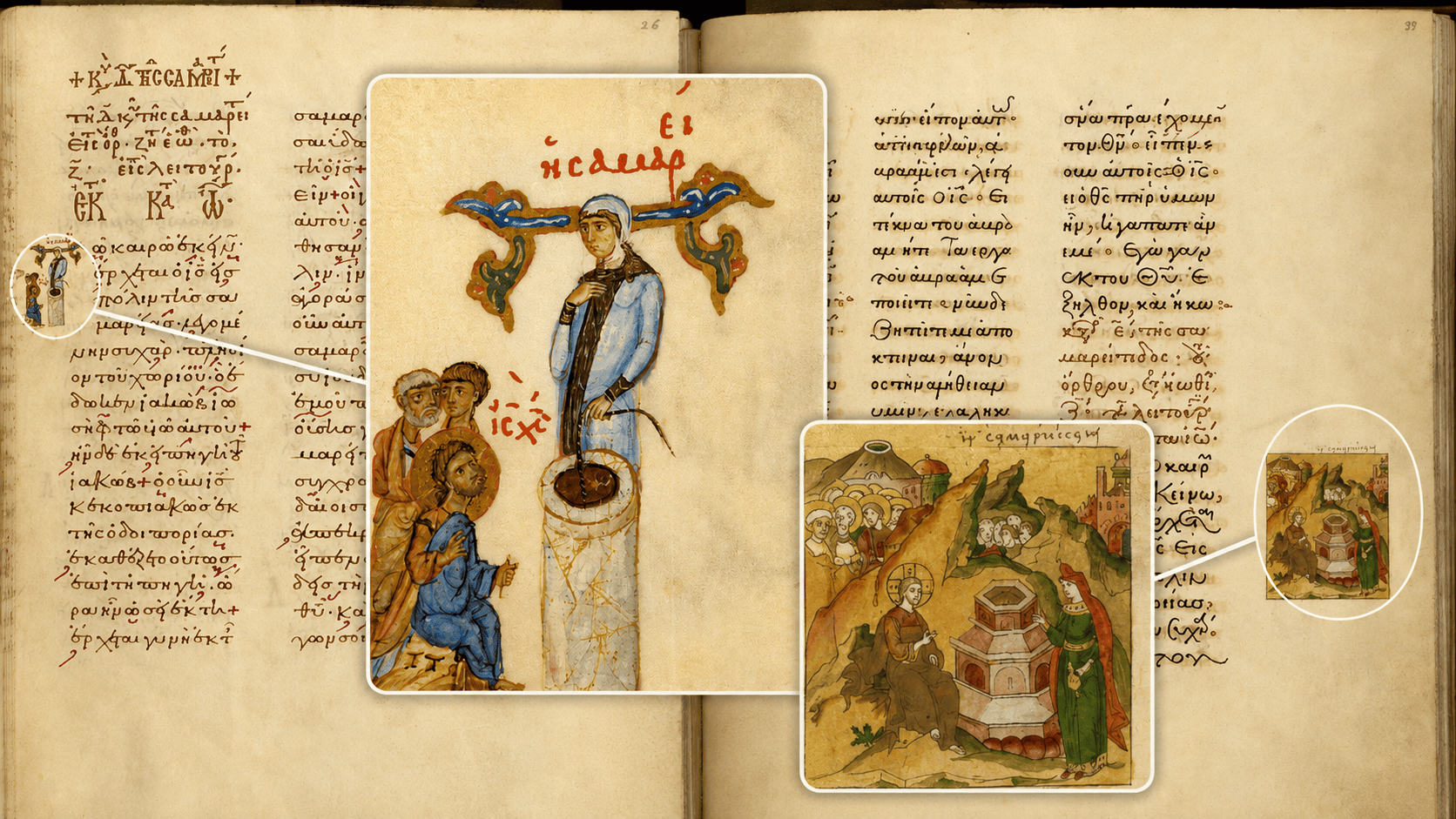
In L381 (at The Morgan Library and Museum), an 11th-century Gospel lectionary, Christ is depicted seated beside the well with His right hand raised in a gesture of blessing, accompanied by the inscription IC XC (Jesus Christ). Across from him stands the Samaritan woman, identified in writing above her. Her figure is incorporated into an enlarged initial Tau.
In L1029 (at Walters Art Museum), dated 1594, the miniature depicts the same scene from John’s Gospel. The Slavonic inscription above the image reads “Sunday of the Samaritan Woman,” identifying the liturgical feast to which the image belongs rather than simply naming the Gospel story itself.
Week 6: The Fifth Sunday after Pascha: Sunday of the Blind Man (John 9:1–38)
As the season of Pascha draws toward the Feast of the Ascension this week (celebrated 40 days after Easter), the themes that have unfolded throughout the Paschal Gospel readings continue to resound: healing, water, restoration, illumination, and new life in the risen Christ. On this fifth Sunday after Pascha, the Church commemorates Christ’s healing of the man born blind in John 9:1–38.
The focal point of this Sunday is the theme of light. In the Gospel itself, Christ declares, “As long as I am in the world, I am the light of the world” (John 9:5). The story of the blind man dramatically reveals the victory of light over darkness, as Jesus imparts both physical sight and spiritual illumination. Jesus encounters a man who has been excluded from the world not only by physical blindness, but also by the assumptions of those around him, who regard his condition as evidence of sin or divine punishment. Christ immediately overturns this logic: “Neither this man nor his parents sinned,” He declares, “but that the works of God should be revealed in him” (John 9:3).
He then spits on the ground, forms clay, and places it upon the man’s eyes before sending him to wash in the Pool of Siloam. The Church Fathers often interpreted this act through the lens of Genesis, where God fashions Adam from the dust of the earth. For example, John Chrysostom, in his Homilies on the Gospel of John (Homily 56), writes that Christ “wished to show that He was the Creator, Who in the beginning used clay for the formation of man.” In this way, the healing of the man born blind is revealed not merely as an act of restoration, but as a work of new creation.
Read the full Gospel text in the images below.


For those who prefer, you can read the passage in English or Greek here.
After the man washes, his physical sight is restored, but the illumination in this Sunday’s Gospel unfolds more gradually. The blind man does not immediately understand who Jesus is. At first, he describes Him simply as “the man called Jesus” (John 9:11). Later, he calls Him “a prophet” (9:17), and then one who is “from God” (9:33). Finally, after Christ reveals Himself directly, the man confesses his faith and worships Him, saying: “Lord, I believe” (9:38).
The irony of the passage is striking: the man born blind comes to see the truth, while the religious authorities, certain of their own moral rectitude, fail to recognize the Light of the world standing before them. As Augustine observes in Tractate 44, those “who think they see, and seek not the physician, may abide in their blindness.” The Gospel reveals that the greatest blindness is not the inability to see, but the refusal to recognize the presence of God in our midst.
The Sunday of the Blind Man stands at the threshold between Pascha and Ascension. Christ has revealed Himself as the Light of the world; yet soon He will ascend to the Father, entrusting His disciples to carry that light into the world.
Kontakion for the Blind Man:
To thee I come, O Christ, blinded in my soul’s eyes, like the man blind from his birth, crying unto thee in repentance, Thou art the Light of transcendent radiance to those who are in darkness.
Week 7: The Sixth Sunday after Pascha: Sunday of the Fathers of the First Ecumenical Council (Nicaea): John 17:1-13
Today is known as the Sunday of the Fathers of the First Ecumenical Council, or the Sunday of Nicaea. It commemorates the bishops, traditionally remembered as numbering 318, who gathered at Nicaea in 325 during the reign of Emperor Constantine.
This was the first of the seven great ecumenical councils. Its central concern was the Arian controversy: the question of how the Son is related to the Father. The Council confessed that the Son is truly God, “of one essence with the Father,” giving us the Nicene Creed. The form of the Creed most familiar to us today was completed later at the Council of Constantinople in 381. The Council of Nicaea also addressed the date of Easter, since differences in its celebration had already arisen among Christians.
In Historia Ecclesiastica by Socrates Scholasticus the dates of May 20 to July 25 are given for the council. Thus, today’s commemoration falls near the beginning of the Council.
The Gospel reading from John 17:1–13 links eternal life, knowledge of God, and the unity of Jesus’ followers. Before His death, Jesus asks the Father to be glorified and to give eternal life to those whom the Father has given Him. He says, “This is eternal life, that they may know you, the only true God, and Jesus Christ whom you have sent” (John 17:3).
This knowledge of God is not merely information about God, but communion with God through Christ. Later in the passage, Jesus asks the Father to keep the disciples, “so that they may be one, just as we are one” (John 17:11), showing the close connection between knowing God and unity among Christ’s followers.
This makes the association of this Sunday’s Gospel reading with Nicaea especially fitting. The Council was not simply debating abstract language about God but guarding the Church’s confession of who Christ is. The controversy centered on whether the Son is truly ὁμοούσιος, “of one essence,” with the Father.
If eternal life is knowing the Father and Jesus Christ whom He sent, then knowing the Son rightly belongs to eternal life itself. Only the true Son can truly reveal the Father; only the One who shares the Father’s life can give life everlasting.
The unity for which Jesus prays is grounded in the unity of the Father and the Son. In this sense, the theology of Nicaea is not abstract speculation, but is rooted in the words of Jesus Himself. The Council is remembered in that same spirit: truth and orthodox confession are essential because they serve the worship and unity of the Church.
Read the full Gospel text in the image below.

For those who prefer, you can read the passage in English or Greek here.
This connection between knowledge, confession, and unity is dramatized in the liturgy for this Sunday. As the Church prepares to hear the Gospel, the priest prays:
Master, lover of mankind, make pure the light of Your divine knowledge, and open the eyes of our mind that we may comprehend the proclamations of Your Gospels.
The prayer asks not only for understanding, but for illumination: that the eyes of the heart may be opened to receive the life revealed in Christ. This movement from knowledge to confession continues during Holy Communion. As the consecrated bread is lifted up before the faithful, the priest proclaims:
The Holy Things for the Holy.
The choir responds:
One is Holy, one is Lord: Jesus Christ, to the glory of God the Father. Amen.
The liturgy binds together knowledge, unity, and eternal life: in hearing and confessing who Christ is—the giver of eternal life—the faithful are gathered into one faith and receive the life of the risen Lord whom they proclaim. This unity appears most vividly in the fraction, when the priest breaks the consecrated bread before Communion. Though the bread is divided, Christ himself remains undivided, drawing the Church into the unity for which he prays: “that they may be one just as we are one” (John 17:11).
The Eucharist is therefore not merely an act of personal devotion, but the sacramental mystery of unity. The congregation confesses and partakes of one Christ, remaining many persons while being gathered into one Body. As the faithful await Pentecost, they wait in this same unity, held together by one confession of faith, gathered around the risen and ascended Christ, in great anticipation of the coming of the Holy Spirit.
Week 8: The Seventh Sunday after Pascha: Holy Pentecost: The Descent of the Holy Spirit upon the Disciples: John 7:37–52; 8:12
Today is Holy Pentecost, the fiftieth day after Pascha, when the Church commemorates the descent of the Holy Spirit. With this Sunday, the Paschal season comes to its close, as does the Johannine period of Gospel readings.
Throughout the Paschal season, the Gospel readings have drawn heavily from John, beginning with the Prologue and unfolding with the themes of resurrection, water, healing, illumination, confession, and unity. At Pentecost, these threads come together in Christ’s words about living water and light.
The appointed Gospel reading is John 7:37–52; 8:12. The setting of this passage is not Pentecost itself, but the Feast of Tabernacles. On the last day of this feast, Jesus stands and proclaims “If anyone thirsts, let him come to Me and drink. He who believes in Me, as the Scripture has said, ‘Out of his heart shall flow rivers of living water’” (John 7:37–38).
The evangelist clarifies that Jesus is talking about the Spirit, whom those who believed in Christ were to receive. This illuminates why the passage is especially fitting for Pentecost: it presents Jesus’ own promise of the Spirit, even before that promise is fulfilled in Acts.
The image of water has appeared throughout the Sunday readings these last weeks. Jesus speaks of living water to the Samaritan woman. He heals the paralytic near the pool. He sends the blind man to wash in the Pool of Siloam. But in the reading for today that image is revealed in its fullness: the living water is the gift of the Holy Spirit, poured out through the risen Christ.
One notable feature of this lection is that it moves directly from John 7:52 to 8:12, passing over the Pericope Adulterae, the story of the woman caught in adultery in John 7:53–8:11. This omission does not mean that the Byzantine tradition simply rejected the passage, since the story continued to circulate widely. Its transmission history, however, is complex, as numerous continuous-text Gospel manuscripts actually mark the passage with asterisks, marginal notes, or other signs of textual uncertainty. Some scholars have suggested that because the Pentecost reading skips from John 7:52 directly to 8:12, this may have been one factor contributing over time to wider uncertainty about the passage’s status within the Gospel text.
This shift from the theme of living water to that of light is especially fitting For Pentecost. Jesus’ promise of the Spirit flows into His declaration: “I am the light of the world. He who follows Me shall not walk in darkness, but have the light of life” (John 8:12).
In L 434, the scribe gives the end of the pericope a distinctive look on the page, arranging it in a tapered form, giving visual weight to the end of the first period, the Johannine period, of the Church calendar.
Read the full Gospel text in the images below.


For those who prefer, you can read the passage in English or Greek here.
Pentecost is usually remembered for fire, as reflected in this Sunday’s Apostolos reading from Acts 2:1–11, where the Holy Spirit descends upon the disciples and tongues “as of fire” come to rest upon them. But today’s Gospel reading starts first with water. The Spirit who descends in Acts in wind and fire is the same Spirit whom Christ promises in John as bestowing life-giving water.
The Orthodox celebration of Pentecost carries this imagery of water and fire into the preparation for communion. Shortly before, the priest pours boiling hot water into the chalice, making the sign of the cross, a liturgical act called the zeon. As the water is added, the words of the liturgy describe the “fervor of faith, full of the Holy Spirit.” While this rite is not unique to Pentecost and belongs to the Divine Liturgy, on Pentecost this symbolism becomes especially vivid. St. Nicholas Cabasilas sees in the zeon the descent of the Holy Spirit upon the Church as water warmed by fire enters the chalice. Together, these elements reveal the mystery of Pentecost: the living water promised by Christ in John and the fire that descended in Acts are two biblical images for one and the same—the gift of the Holy Spirit poured out upon the Church.
Period 2: The First Sunday after Pentecost: Sunday of All Saints (Matt 10:32-33; 37-38; 19:27-30)
The reading today is taken from two different episodes in Matthew. The first is when Jesus gives instructions to His disciples as He sends them out with His authority. In 10:32-33, Jesus admonishes His disciples to confess (or acknowledge, from ὁμολογέω) Him, and at the same time He acknowledges a special relationship between Himself and His Father in heaven: “Whoever, then, confesses me before people, I will acknowledge before my Father in heaven. But whoever denies me before people, I will deny him also before my Father in heaven.” To confess Christ before others is to bear witness to Him and his Father, in word, deed, and, when necessary, through suffering.
Interestingly, the lectionary reading omits the verses that immediately follow, 10:34-36, where Jesus declares that He has not come to bring peace but a sword, and that loyalty to Him may even divide families. While the reason for this omission is not clear (although it is read on the third Friday after Pentecost), it may reflect an intended emphasis on the confessional aspect of the surrounding textual context rather than focusing on the potential violent aspects of these verses.
Continuing in verse 37, Jesus makes it clear that nothing should stand in the way of following Him, not even family. The image and violent implications of “carrying a cross” in verse 38 (the first mention of a cross in Matthew) would have been familiar in that historical context, carrying violent and shameful associations with Roman execution. Yet in the light of Jesus’ suffering and resurrection, the symbol of the cross becomes instead the path to eternal life.
The theme of discipleship continues in the four verses in this lection taken from chapter 19. Here, in verse 27, Peter asks Jesus what is left for His followers after they have given everything up for Him, essentially wanting to know what reward awaits those who have renounced earthly security for the sake of the kingdom. Jesus responds (verse 28), saying that, in the new age (παλιγγενεσία, the same word is used to indicate the new world after the great flood, but here it refers to a coming messianic age), each of His 12 disciples will sit on (earthly) thrones.
In the next verse (29), Jesus expands the reward to anyone who has sacrificed something for Him. To these, they will receive eternal life. The lection concludes with Jesus emphasizing that one’s standing in the present age does not correspond to their standing in the age to coming. Explaining this great reversal, he says, “Many who are first will be last, and the last first.”
In the Byzantine lectionary, individual lections do not often skip across large portions of the biblical text, as is done today. This indicates that the selection of text is thematically linked; Jesus’ words in chapter 10 about acknowledging him before the Father and the costliness of this path connect seamlessly to his words to Peter about the rewards for following him. This makes this reading especially fitting for the Sunday of All Saints, as saints are those who confessed Christ not only with their lips, but through sacrifice, suffering, and faithful endurance. Many held little honor in the eyes of the world: they were poor, ridiculed, persecuted, and rejected for the sake of the Gospel. Yet in them, the cost of discipleship is revealed most clearly, as is the great reversal of the kingdom. Those who seemed last in this age, because they bore the cross with Christ, will be revealed as first in the life of the age to come.
Read the full Gospel text in the images below.


For those who prefer, you can read the passage in English or Greek here.
This week begins the period of readings in the Byzantine lectionary taken from the Gospel of Matthew. After 11 weeks, the weekday readings will then be taken from the Gospel of Mark, while the Saturday-Sunday readings will continue with Matthew. This period started on Monday, the Day of the Holy Spirit, following Pentecost Sunday, pictured in the image above. It goes until Elevation of the Cross (September 14th), which then begins the Lukan period. It is common practice in lectionaries that from this week on (after the Monday reading for the Day of the Holy Spirit), only Saturday and Sunday readings are given, which is also the case for L434.
The Sunday of All Saints honors all those who have borne faithful witness to Christ, including the martyrs and confessors of the Church. Thus, its placement immediately after Pentecost is significant. Having celebrated the descent of the Holy Spirit upon the Apostles, the Church now celebrates the fruit of the Spirit in all the saints, those who have followed Christ in every generation, past, present, and future.
Period 2: Second Sunday after Pentecost (Matt 4:18-23)
The Gospel reading for this Sunday recounts the calling of Jesus’ first disciples. As He walks beside the Sea of Galilee, Jesus sees two brothers, Simon Peter and Andrew, casting a net into the sea, “for they were fishermen” (Matt 4:18). He calls them with words that have echoed throughout Christian history: “Follow me, and I will make you fishers of people” (Matt 4:19). Immediately they leave their nets and follow Him. Continuing along the shore, Jesus encounters another pair of brothers, James and John, the sons of Zebedee. They are in a boat with their father mending their nets. Jesus calls them as well, and they immediately leave both their boat and their father to become His disciples.
The reading concludes with Matthew 4:23, which summarizes the beginning of Jesus’ public ministry: “And Jesus went about all Galilee, teaching in their synagogues and preaching the gospel of the kingdom and healing every disease and every sickness among the people.” This verse serves as a fitting conclusion to the calling of the disciples, linking their vocation to the ministry they will soon share. Modern editions of the New Testament often begin the following section with verse 23, but in the Byzantine lectionary tradition it forms the conclusion of this reading.
Read the full Gospel text in the images below.


For those who prefer, you can read the passage in English or Greek here.
This week also marks the beginning of the Apostles’ Fast, which commenced on Monday and continues until the Feast of Saints Peter and Paul on June 29. Together with Great Lent and the Nativity Fast, it was one of the three major fasting periods of the early Church and were traditionally paralleled with the three periods during which Moses fasted before God on Mount Sinai (Exod 24:18; Exod 32, described in Deut 9:18; Exod 34:28). Today, the Church celebrates four major fasts, which includes these three and the Dormition Fast, which was a later development.
Today’s Gospel reading gives the fast a more immediate focus by returning to the beginning of the Apostles’ calling. Before Peter, Andrew, James, and John are known as Apostles, they are fishermen beside the Sea of Galilee.
The timing is especially fitting after Pentecost. Having received the Holy Spirit, the Apostles are now prepared to carry the Gospel to the ends of the earth. The Church therefore turns its attention from the descent of the Spirit to the missionary work that follows. The calling of Peter, Andrew, James, and John reminds us of the beginning of that apostolic mission, when ordinary fishermen first heard Christ’s invitation and abandoned everything to follow His call.
Byzantine hymnography frequently reflects on the disciples’ immediate response to Christ’s call. The Apostles left behind not only their fishing nets but their former way of life, exchanging the work of catching fish for the mission of gathering people into the Church. The hymns of the Apostles’ feasts often return to this image, praising Peter, Andrew, James, and John for their readiness to follow Christ without hesitation. Their bold witness remains a powerful model for Christians, especially during the Apostles’ Fast, when the faithful are called to deepen their commitment to the Gospel, reorder their lives around Christ, and seek first the Kingdom of God.
Period 2: Third Sunday after Pentecost (Matt 6:22-33)
The Gospel reading for the Third Sunday after Pentecost is taken from the Sermon on the Mount. Although parts of the Sermon have been read on weekdays following Pentecost, this is the first time any part of this sermon is read at liturgy on Sunday.
This passage is located in the middle of this famous sermon and moves in a clear direction: how inner perception shapes the whole spiritual life. Jesus begins with the image: “The eye is the lamp of the body…”
In Matthew 6:22–23, the “eye” is not simply physical sight, but how a person inwardly perceives and organizes reality. The Greek ἁπλοῦς, usually translated as “sound” in this passage, means at its basic level “single” or “undivided,” suggesting an inner life that is unified and single-minded. If an eye is “unsound,” it is not healthy and will not see as it should. The logic of the passage follows from this: the condition of the “eye” determines whether the whole person is filled with light or darkness. The contrast is about good versus bad eyesight but about whether a person’s attention and desires are centered toward one direction or pulled apart into competing ones.
John Chrysostom, makes this point in his Homily 20 on Matthew, reading the “eye” in this passage as the governing faculty of the soul. He emphasized that Jesus is using a metaphor for the inner life. The “eye” signifies the mind or guiding faculty through which someone takes in and makes sense of reality. If that inner center is sound, the whole person will be ordered and clear; if it is distorted, everything else is affected. In that sense, the passage is not merely about outward behavior but about the fundamental orientation of the person toward the kingdom of God.
For many early Christian writers, the eye signifies the ruling faculty of the soul. A person whose inner intention is directed wholly toward God becomes illuminated; conversely, a divided mind plunges the entire person into darkness. Spiritual blindness is therefore not intellectual ignorance but disorder in the heart. The contrast between light and darkness describes two ways of life: one ordered toward God, the other toward competing desires.
The next section develops the same point in a different way. Jesus moves from the metaphor of vision to the metaphor of slavery: divided attention becomes divided allegiance. “No one can serve two masters… you cannot serve God and mammon” (Matt 6:24). Jesus stresses that the human heart is not made for divided ultimate loyalties; whatever is treated as ultimate inevitably becomes a master.
Clement of Alexandria broadened the principle beyond money. In the Stromata he argues that Christians cannot “serve two masters, pleasure and God.” The conflict is fundamentally between competing loves.
The final movement of the passage turns to worry about food, clothing, and daily needs (Matt. 6:25–34) as Jesus highlights the way material concerns can become central and all-absorbing. He points to the birds and lilies as examples of life sustained by trust in God’s providential care rather than anxiety or control. In this context, the command “do not be anxious” follows the same logic as earlier in the passage: anxiety arises from a divided heart and a divided way of seeing and valuing reality, and where the heart is unified toward God, material concerns no longer occupy the center of life.
Read the full Gospel text in the images below.


For those who prefer, you can read the passage in English or Greek here.
This reading, placed early in the Pentecost season, speaks to a central struggle of the Christian life: purity of heart, single-minded devotion to God, and freedom from anxiety. The Gospel culminates in Christ’s command: “Seek first the Kingdom of God and His righteousness, and all these things shall be added unto you” (Matt 6:33).
Similar themes appear in Luke, where we also find the sayings “your eye is the lamp of your body” (Luke 11:34), “no slave can serve two masters” (Luke 16:13), and “do not be anxious about your life… seek his kingdom” (Luke 12:22–31).
Period 2: Fourth Sunday after Pentecost (Matt 8:5-13)
In today’s reading, Matthew 8:5–13, Jesus heals the servant of a centurion (ἑκατόνταρχος), a Roman officer traditionally associated with command over about one hundred soldiers. The setting is Capernaum, a town on the Sea of Galilee.
In the story, the centurion approaches Jesus and begs Him to heal his servant, who is lying at home paralyzed and suffering terribly. When Jesus says that He will come and heal him, the centurion answers: “Lord, I am not worthy that you should come under my roof. But only speak the word, and my servant will be healed” (Matt 8:7–8). He is humble enough to consider himself unworthy to receive Christ into his home, yet he fully trusts that Jesus’ word alone is enough. Theophylact of Ohrid, in his Explanation of the Holy Gospel According to St. Matthew, draws attention to precisely this point. The centurion does not bring his servant to Jesus because he believes that Christ can heal him “even from a distance.” He understands that Jesus need only to speak, and sickness must obey. For Theophylact, this is what makes the centurion’s faith so remarkable: although he is a Gentile, he recognizes the authority of Christ’s word more clearly than many in Israel.
Upon Jesus hearing this, Matthew writes that Jesus is “amazed” or “marvels” (ἐθαύμασεν) at the centurion’s faith. This is one of the rare places in the Gospels where Jesus is said to marvel. Here in Matt 8:10, it is used positively: Jesus marvels at the faith of the Gentile centurion. In Mark 6:6, by contrast, Jesus marvels at the unbelief of those in his own hometown. The contrast is striking. A Roman officer, an outsider, recognizes Jesus’ authority with remarkable clarity.
Jesus then proclaims, using an oft-repeated phrase, “truly I say to you” (ἀμὴν λέγω ὑμῖν), that he has found no one in Israel with such faith (Matt 8:10).
The next two verses, Matt 8:11–12, widen the significance of the scene: many will come “from east and west” and recline with Abraham, Isaac, and Jacob in the kingdom of heaven. The centurion thus becomes one of the earliest signs in Matthew’s Gospel that Gentiles, too, will be gathered into the kingdom. The actual healing of the centurion’s servant in verse 13 is described very briefly: Jesus says, “Go; let it be done for you according to your faith,” and the servant is healed “at that very hour” The focus, then, is not only Jesus’ power to heal, but the completeness of his authority: he need only speak the word. It is a Roman officer and a Gentile who recognizes this reality before many others do.
Read the full Gospel text in the image below.

For those who prefer, you can read the passage in English or Greek here.
The centurion’s confession is also echoed in the prayers said before receiving Communion. His words, “Lord, I am not worthy that You should enter under my roof,” are taken up in the Horologion, a service book containing the fixed prayers of the Church’s daily cycle. In the Service of Preparation for Holy Communion, in a prayer attributed to John Chrysostom, the believer prays:
Lord my God, I know that I am not worthy or sufficient that You should come under the roof of the house of my soul, for all is desolate and fallen, and You do not have within me a place fit to lay Your head.
Here the centurion’s house becomes an image of the soul. In Matthew, he confesses his unworthiness for Christ to enter his home; in the Eucharistic prayer, the believer makes that same confession before receiving Christ in Holy Communion. The Gospel scene is therefore not only remembered as an event from Jesus’ ministry but becomes part of the believer’s own posture toward Christ: humble enough to confess unworthiness, yet bold enough to trust in his mercy. Like the centurion, the believer asks that the Lord who healed by his word would also enter and heal the soul.
Period 2: Fifth Sunday after Pentecost (Matt 8:28-9:1)
The Gospel reading for the Fifth Sunday after Pentecost recounts Jesus’ encounter with two demon-possessed men in the region of the Gergesenes. The scene is brief but dramatic. The men come out from the tombs, “so fierce that no one would pass that way.” Immediately the demons recognize Jesus saying: “What have you to do with us, O Son of God? Have you come here to torment us before the time?” (Matt 8:29).
This confession is one of the striking features of the passage. The demons know who Jesus is, and they also know that their own judgment is coming. In this way, the episode looks ahead to the final defeat of demonic powers. The emphasis here is not placed particularly on the healing of the two men, but on the authority of Christ and the recognition of His identity, even by the demons.
Matthew makes Jesus’ power the centerpiece of the story. All He has to say is the imperative “ὑπάγετε” (Go!) (Matt 8:32). With that single command, the demons leave the men and enter the herd of pigs at a distance. No other words are spoken by Jesus in this episode. The power of Christ’s one word is enough.
The pigs would have been immediately recognizable to Matthew’s Jewish readers as unclean animals, and their presence signals a Gentile setting for the story. After hearing what has happened, the townspeople come out to meet Jesus, but rather than welcoming him, they beg him to leave their region (Matt 8:34). It is not yet time for the mission to the Gentiles, but even here we see Christ’s authority reaching beyond Israel’s borders. In Matt 9:1, the reading closes with Jesus getting into a boat and crossing back over to his own city.
Read the full Gospel text in the image below.

For those who prefer, you can read the passage in English or Greek here.
Matt 8:28 contains an interesting textual variant concerning the location of Jesus’ encounter with the demoniacs. The manuscript tradition preserves three main readings:
Γαδαρηνῶν—Gadarenes
Γερασηνῶν—Gerasenes
Γεργεσηνῶν—Gergesenes
Our lectionary, L434, reads Γεργεσηνῶν (Gergesenes). This is also the reading attested by the majority of witnesses, along with several early translations, including Bohairic Coptic, Armenian, Ethiopic, Slavonic, and Gothic versions. In other words, L434 preserves the form that became dominant in Byzantine and later traditions.
The reading Γερασηνῶν (Gerasenes) is attested by only one Greek New Testament manuscript, in a correction of 892, though it is better represented in the Latin and Sahidic Coptic traditions. Since this is also the reading found in the parallel accounts in Mark 5:1 and Luke 8:26, its presence in witnesses of Matthew may reflect harmonization with those passages. Geographically, however, Gerasa was much farther from the Sea of Galilee.
Only a few Greek witnesses attest Γαδαρηνῶν (Gadarenes), including some of the earliest, 03 and 04, as well as later witnesses 1010 and L253.
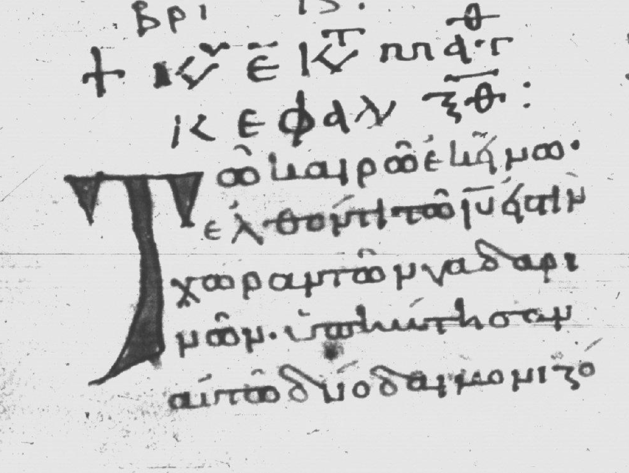
Despite its limited Greek attestation, Γαδαρηνῶν (Gadarenes) is supported by some of the earliest and best Greek manuscripts. Gadara was located about five miles southeast of the Sea of Galilee, which at first seems unlikely for the scene in Matthew. Yet both Josephus and archaeological evidence suggest that Gadara’s territory actually extended to the lake itself. Josephus states that Gadara bordered the Sea of Galilee, while coins minted by the city often depicted ships, reflecting its association with the lake.
The history of Γεργεσηνῶν (Gergesenes) is especially interesting because of Origen. In his Commentary on the Gospel of John, Origen discusses the textual problem. He rejected both Gadarenes and Gerasenes on geographical grounds and preferred Gergesenes because of a local tradition identifying it as the place where the swine plunged into the sea. It has sometimes been said that Origen himself introduced Γεργεσηνῶν into the textual tradition, but that remains uncertain. Nevertheless, Origen appears to know all three variants, which suggests that each of these readings are older than their earliest surviving manuscripts.
For readers of L434, however, the story takes place in the region of the Gergesenes. This single word gives us a glimpse into the much older history of scribal copying, ancient geography, and biblical interpretation. Yet, no matter the name of the location, the focus of this passage remains the same: even in Gentile territory, Christ’s authority is unmistakable, and with a single word, “Go,” the demons obey.
Period 2: Sixth Sunday after Pentecost (Matt 9:1-8)
The Gospel reading for the Sixth Sunday after Pentecost is Matthew 9:1–8, the healing of the paralytic in what Matthew calls Jesus’ “own city,” traditionally identified as Capernaum. Matthew’s version is considerably shorter than the parallel accounts in Mark 2:1–12 and Luke 5:17–26. He says nothing about the crowded house, the opening in the roof, or the four men who carried the paralyzed man. Instead, he moves almost immediately to the encounter itself: “And behold, they brought to Him a paralytic, lying on his bed” (Matt 9:2). Matthew’s brevity places the focus not on how the man reaches Jesus, but on what happens once he is brought before Him.
The phrase “seeing their faith”—ἰδὼν ὁ Ἰησοῦς τὴν πίστιν αὐτῶν—emphasizes that paralytic cannot come to Jesus on his own; he must be carried by others. Although these people remain unnamed and say nothing, their faith is made visible through their actions. Jesus then turns to the suffering man and says, “Take heart, my son; your sins are forgiven” (Matt 9:2). (Instead of “my son,” the Greek τέκνον could also be rendered “child.”) Before saying anything about the man’s physical condition, Jesus declares that his sins forgiven. Matthew does not say that the paralysis was caused by a particular sin. Rather, the order of Jesus’ words shifts the central question from His ability to heal to His authority to forgive.
The scribes understand the claim being made and accuse Jesus inwardly of blasphemy. Knowing their thoughts, Jesus responds by asking, “Which is easier, to say, ‘Your sins are forgiven,’ or to say, ‘Rise and walk’?” (Matt 9:5). Either statement is easy to pronounce, but only one can be immediately tested by those watching. Jesus commands the paralytic to rise “so that you may know that the Son of Man has authority on earth to forgive sins” (Matt 9:6). The term “authority” (ἐξουσία) could also be translated as “power.” The healing is not simply another display of miraculous power; it publicly confirms Jesus’ claim to forgive sins.
The bed is more than a detail in the story; it becomes the visible sign of the man’s restoration. At the beginning, he lies helpless upon it and must be carried to Jesus by others. At the end, Jesus commands him to rise, take up the very bed that once carried him, and takes it home himself. What had signified his paralysis now becomes evidence of his healing. The reversal is both physical and social: the man who entered the scene dependent upon the faith and strength of others leaves under his own power. Yet the healing remains framed by the response of the community. It begins with the faith of those who bring him to Jesus and ends with the crowds glorifying God: “When the crowds saw it, they were afraid, and they glorified God, who had given such authority to men” (Matt 9:8). The man’s restored body thus becomes a public testimony to the divine authority at work in Jesus.
Read the full Gospel text in the image below.

For those who prefer, you can read the passage in English or Greek here.
An interesting feature of today’s lection is that it continues from where the previous Sunday left off (Matt 8:28–9:1). A continuous sequence of readings is rare for Sundays, though common for weekday readings.
Today’s reading also opens with the final verse from the previous Sunday, Matt 9:1. For the previous Sunday, it completes the account by telling us that Jesus left the region of the Gergesenes and crossed back over the water. In the reading today, it returns Him to “His own city” and supplies the setting in which the paralytic is brought before Him.
There are, however, slight differences between the two renderings of the verse. The one for today adds the introductory formula commonly attached to the beginning of Gospel lections: τῷ καιρῷ ἐκείνῳ (“at that time”). In the reading for today, context also has to be added. Last Sunday, Jesus is not named in 9:1 because it is clear who “he” refers to in “he crossed to the other side.” Therefore, 9:1 for today reads “Jesus crossed to the other side.”
Such “verse overlaps” are common in weekday readings in the Byzantine lectionary cycle, but they occur less often between successive Sunday lections. Another example in the Matthean Sunday cycle is Matt 14:22. The verse concludes the feeding of the five thousand on the eighth Sunday of Matthew (Matt 14:14–22) and is then used again as the beginning of Christ’s walking on the water on the ninth Sunday (Matt 14:22–34). In each case, the same verse is used first to conclude one episode and then to establish the setting for the next.
This repetition offers a small but revealing example of how the material form of a lectionary shapes the biblical text it transmits. Because Gospel lectionaries arrange passages according to the liturgical year, the same verse may be copied more than once, on different folios and within different lections. This has practical implications for textual criticism; when indexing a reading, it is not enough merely to identify the biblical verse; the lection in which it appears—and thus its particular place within the liturgical calendar—should also be recorded.
Period 2: Seventh Sunday after Pentecost (Matt 9:27-35)
The Gospel reading for the Seventh Sunday after Pentecost recounts the healing of two blind men and a man who could not speak. As Jesus departs, two blind men follow Him, crying out, “Have mercy on us, Son of David!” (Matt 9:27). Matthew uses the verb for following a teacher or becoming a disciple, ἀκολουθέω, but here it simply means “to follow after” Him. Although the men cannot yet see Jesus, they are already following Him and recognize something unique about His identity.
They are also the first characters in Matthew to address Jesus directly with the Messianic title, “Son of David.” Matthew introduced Jesus with this title in the opening verse of the Gospel (Matt 1:1), but here the confession comes from two men who are physically blind, creating an irony that becomes clearer at the end of the passage: the blind men recognize the Messiah, while the sighted Pharisees witness Jesus’ work and attribute it to demons (9:34).
The two healings together may also recall Isaiah’s description of the coming salvation of God: “Then the eyes of the blind shall be opened … and the tongue of the mute shall sing” (Isa 35:5–6). Matthew presents these signs in the same order. The eyes of the blind men are opened in 9:30, and then the mute man speaks in 9:33. The miracles are therefore not simply isolated acts of healing but could also be understood as the restoration promised by the prophets. Later, when John the Baptist asks whether Jesus is the one they have been waiting for, Jesus points to the fact that “the blind receive their sight” as evidence of His messianic identity (Matt 11:4–5).
The blind men follow Jesus until He goes “into the house” (εἰς τὴν οἰκίαν). The precise house is not identified but could refer to Jesus’ home in Capernaum or perhaps to the house already mentioned in Matt 9:10. The passage also does not tell us whether the men had been blind from birth or had previously been able to see.
Inside the house, Jesus asks them, “Do you believe that I am able to do this?” They answer, “Yes, Lord” (9:28). He then touches their eyes and says, “According to your faith, let it be done to you,” and their eyes are opened (9:29–30).
John Chrysostom observes that the blind men believe through hearing alone, while others who possess sight witness the miracles and still refuse to believe. He also draws attention to the exact wording of Jesus’ question. Jesus does not ask whether they believe He can pray to the Father for their healing, but whether they believe that He Himself is able to do it. Chrysostom sees a progression in their confession: they first call Him “Son of David,” but inside the house they call Him “Lord” (Homily 32 on the Gospel of Matthew).
Jesus sternly commands the men not to tell anyone, but they go out and spread His fame throughout the region. Chrysostom describes them as becoming “preachers and evangelists” after experiencing this life-changing healing.
As they leave, another man is brought to Jesus. Matthew describes him as demon-possessed and κωφόν. The adjective κωφός can mean both deaf or mute, but Matt 9:33 makes the intended sense clear: when the demon is expelled, “the mute man spoke.” “Mute” or “unable to speak” therefore communicates the meaning better in modern English than the KJV’s potentially misleading word “dumb.”
There is an important contrast between the two healings. The blind men are able to cry out, follow Jesus, and confess their faith. The mute man cannot ask for anything and must be brought to Jesus by others.
Theophylact specifically comments on this difference. Because the man’s tongue had been bound, he was unable to call upon Jesus. Christ therefore does not demand a spoken confession of faith from him but heals him immediately. One person comes to Christ crying for mercy; another cannot speak and is carried by others. Christ receives both (The Explanation of the Holy Gospel According to St. Matthew).
Read the full Gospel text in the image below.

For those who prefer, you can read the passage in English or Greek here.
After the healing, the crowds declare, “Never has anything like this been seen in Israel” (9:33). The Pharisees do not deny that Jesus has performed an extraordinary act. Instead, they dispute where His authority comes from: “By the ruler of demons He casts out demons” (9:34).
A few textual witnesses omit Matt 9:34 entirely. Among the surviving Greek manuscripts, the significant witness that omits it is the fifth-century Codex Bezae (known as 05). The Old Syriac Sinaitic manuscript also lacks the verse, and Westcott and Hort put the verse in brackets in their 1881 edition of the Greek New Testament. The verse appears in Codex Sinaiticus, Codex Vaticanus, and almost all other authorities as well as English translations (except for the REB).
The reading concludes with Matt 9:35: “Jesus went about all the cities and villages, teaching in their synagogues, proclaiming the Gospel of the Kingdom, and healing every disease and every infirmity.”
This verse closely echoes Matt 4:23. Together, the two verses frame the Sermon on the Mount in chapters 5–7 and the series of miracles in chapters 8–9. What Matt 4:23 announces at the beginning of this section, Matt 9:35 now gathers into a single summary: in Jesus’ teaching, proclamation, and healing, the Kingdom has become visible.
That healing presence of the Kingdom is also reflected in the prayer of the blind men: Ἐλέησον ἡμᾶς, “Have mercy on us” (9:27). A form of these words is found in Orthodox worship in the oft-repeated Κύριε, ἐλέησον, “Lord, have mercy.” Echoed by the faithful for centuries, it is not only a plea for forgiveness, but an appeal to God’s compassionate and healing mercy—a mercy that draws near to human suffering and makes the broken whole again.
Period 2: Eighth Sunday after Pentecost (Matt 14:14-22)
The Gospel reading for the Eighth Sunday after Pentecost recounts the feeding of the five thousand. It is the only miracle from Jesus’ public ministry narrated in all four Gospels, which suggests how central the story was to the earliest Christian memory of Jesus. After hearing of the death of John the Baptist, Jesus withdraws by boat to a deserted place by Himself, but the crowds learn where He has gone and follow Him on foot from the surrounding towns. When He comes ashore, He finds a great multitude waiting for Him.
Matthew writes that Jesus “had compassion on them and healed their sick” (14:14). The verb ἐσπλαγχνίσθη describes a deep, visceral compassion. Even though the crowd has interrupted His attempt to withdraw, He does not treat them as an inconvenience but begins to meet their needs. First, He heals those who are sick among them, and then, as evening approaches, He attends to their hunger.
The disciples recognize that the people will soon need food. Their instinct is to see the situation in terms of scarcity, and their solution is to send the people away “so that they may go into the villages and buy food for themselves” (14:15). The passage makes the limits of the disciples’ imagination clear. Although they have witnessed Jesus healing the sick, they have not yet grasped that His authority might also extend to bread, hunger, and material needs. Their faith remains limited by what they believe is possible in that deserted place.
Jesus reverses the logic of their suggestion: “They do not need to go away; you give them something to eat” (14:16). When they answer that they have only five loaves and two fish, Jesus tells them, “Bring them here to Me” (14:17–18). The five loaves and two fish are clearly inadequate, but Jesus takes what they have brought to Him, looks toward heaven, blesses and breaks the loaves, and gives them to the disciples, who distribute them to the people (14:19).
The scene recalls Israel’s experience of being fed with manna in the wilderness in Exodus 16, but an closer parallel is the account of Elisha feeding one hundred men with twenty loaves of bread. There too, a servant questions how so little food can be given to so many people, and there too, the people eat and have some left over (2 Kgs 4:42–44). Matthew’s account follows the same pattern on a far greater scale.
Origen sees more in this passage than the satisfaction of physical hunger. He notes several times that what the crowd receives is the “loaves of blessing of Jesus.” Jesus does not dismiss the people until they have eaten the bread He has blessed.
Chrysostom draws particular attention to the disciples’ role. The bread passes through their hands so that they themselves become witnesses of the miracle: “their own hands bearing them witness.” The same hands that presented five loaves later gather twelve full baskets.
Matthew says that “they all ate and were satisfied” (14:20). The twelve baskets make the abundance of the miracle strikingly clear. Jesus does not simply provide enough to meet the immediate need; He gives more than the crowd can consume. Even after everyone has eaten and been satisfied, the fragments remain as visible evidence that His provision has exceeded what was required. Matthew adds that the five thousand counted only the men, “besides women and children” (14:21), so even the traditional name of the miracle understates the size of the crowd.
The disciples begin the episode convinced that nothing can be done except to send the people away. They end it carrying baskets brimming with the remnants of the miracle. What had appeared to be an impossible shortage has become an abundance greater than the crowd could consume.
Read the full Gospel text in the image below.

For those who prefer, you can read the passage in English or Greek here.
The sequence of actions in Matthew 14:19 is especially significant for later Christian worship. Jesus takes the loaves, looks up to heaven, blesses, breaks, and gives them to the disciples. The Greek text follows the sequence λαβὼν … εὐλόγησεν … κλάσας ἔδωκεν: having taken, He blessed; having broken, He gave. A very similar sequence appears later in the account of the Mystical Supper in Matthew 26:26, although the syntax differs slightly: λαβὼν … εὐλογήσας ἔκλασεν … δοὺς. The same actions recur: Jesus takes the bread, blesses it, breaks it, and gives it to His disciples. What takes place in the feeding of the multitude is therefore echoed, in important ways, in the Eucharist.
In this sense, the passage prepares the disciples—and the reader—for what comes later. When Jesus takes bread again on the night before His Passion, the pattern is already familiar: the bread is placed in His hands, blessed, broken, and given to His disciples. Matthew’s repeated language makes it difficult to read the two meals as entirely unrelated.
In the Divine Liturgy, the priest recalls that Christ “took bread in His holy, pure, and blameless hands.” He then gave it to His disciples as His Body. The liturgy thus preserves the same fundamental movement: Christ takes, blesses, breaks, and gives.
The connection becomes clearer in John’s Gospel, where the feeding of the 5,000 is followed by Christ’s teaching that He is the Bread of Life (John 6:1–59). Some early Christian authors interpreted this discourse explicitly in relation to the Eucharist. Cyril of Alexandria writes that through the “mystical Blessing” the faithful receive Christ Himself, whose holy Body gives life because it is united to the life-giving Word. John Chrysostom likewise understands Christ’s command to eat His flesh and drink His blood as referring to “the Mysteries,” insisting that His words are not merely an enigma or parable.
This does not mean that the physical hunger of the crowd is unimportant or merely symbolic, but the miracle also points beyond that. The One who provides bread in the wilderness will later place bread into the hands of His disciples and identify it with His own Body. In the Eucharist, Christ does not simply repeat the earlier gift on a greater scale. He gives his very self to sustain the Church, not only for an evening, but unto eternal life.
The Church also preserves the memory of this miracle in the Artoklasia, the “breaking of bread,” a brief service of thanksgiving commonly celebrated during festal Vespers or on other special occasions. Five loaves are blessed together with wheat, wine, and oil, and the prayer addresses Christ as the One “who in the wilderness blessed the five loaves and from them satisfied five thousand men.” It then asks Him to multiply the gifts throughout the city and the world and to sanctify those who partake of them, bringing the abundance of this miracle into the worship of the Church.
Period 2: Ninth Sunday after Pentecost (Matt 14:22-34)
The Gospel reading for the Ninth Sunday after Pentecost picks up, in canonical sequence, where the previous Sunday left off, after the feeding of the five thousand. Jesus commands the disciples to enter the boat and go ahead of Him while He dismisses the crowds. Afterward, He goes up the mountain alone to pray.
As evening comes, Jesus remains on the mountain while the disciples struggle at sea. Their boat is “beaten by the waves,” because the wind is against them (14:24). Matthew describes the boat as βασανιζόμενον, literally “being tormented,” by the waves.
During the fourth watch of the night (just before dawn), Jesus, walking on the water, comes toward the disciples. They do not recognize Him and cry out in fear, believing that they have seen a ghost. Jesus immediately answers, “Take heart, it is I; have no fear” (14:27).
The words ἐγώ εἰμι (“it is I”) come across rather formal in English, but it should be understood as something like “it’s me.” The action of walking on water is reminiscent of the Greek text of Job, where God is the one who “walks on the sea as on firm ground” (Job 9:8). Jesus approaches the disciples by doing what Scripture attributes to God’s authority over the waters.
Peter responds, “Lord, if it is you, bid me come to you on the water” (14:28). His request is not simply to perform a miracle or display extraordinary power; he wants to cross the water because Jesus is on the other side of it. Jesus answers with a single word: “Come” (Matt 14:29).
Peter leaves the boat and begins walking on the water, but when he turns his attention toward the strong wind beating around him, he becomes afraid and begins to sink. He cries out in panic, “Lord, save me” (14:30), and Jesus immediately reaches out His hand and catches him.
Jesus calls Peter ὀλιγόπιστε, “man of little faith,” and asks, “Why did you doubt?” (14:31). Peter had enough faith to obey Christ’s command and leave the boat, but that faith wavered when he saw the magnitude of the wind.
The verb translated “doubt,” διστάζω, can also mean to hesitate or waver. It occurs only twice in the entire New Testament, both times in Matthew. The other occurrence comes near the end of the Gospel, when the disciples encounter the risen Christ in Galilee: “When they saw him, they worshiped him; but some doubted” (28:17). The parallel is striking. In both scenes, the disciples recognize Christ and respond to Him, yet their faith is not entirely free from uncertainty. Peter has enough faith to leave the boat and walk toward Jesus, just as the disciples in Galilee worship the risen Christ, but in each case faith is riddled with hesitation. Matthew therefore does not present doubt as a perfect attainment or simply the polar opposite of faith. The disciples’ faith is genuine, but it is still wavering and incomplete.
After Jesus takes hold of Peter, they enter the boat and the wind ceases to howl. Those in the boat worship Jesus and confess, “Truly you are the Son of God” (14:33).
Their confession can be seen as a response to the question raised during the earlier calming of the storm: “What sort of man is this, that even the winds and the sea obey him?” (Matt 8:27). The One who treads upon the sea, takes hold of Peter as he begins to sink, and silences the wind is none other than the incarnate Son of God.
Read the full Gospel text in the image below.

For those who prefer, you can read the passage in English or Greek here.
The boat in today’s reading also serve as an image of the gathered Church in early Christianity. The Apostolic Constitutions, a collection of instructions on Christian worship, discipline, and church organization compiled around the late fourth century, compares a Christian assembly to a large ship. The bishop is its commander, the deacons are its mariners, and the members of the congregation are its passengers. It directs that the church building should be long, with its head toward the east, “like a ship” (Apostolic Constitutions 2.57).
A similar image appears in an early-fourth-century sarcophagus fragment now in the Vatican Museum. Christ is shown at the helm of a ship, while the Evangelists serve as its rowers, moving the vessel forward through their proclamation.

Although the Apostolic Constitutions is not necessarily interpreting Matthew 14 directly, its imagery shows how early Christians could understand the ship as an image of the gathered Church. In today’s reading, those within the boat pass together from fear to recognition. Once Christ enters the boat and the violent wind falls silent, their terror gives way to worship and a common confession: “Truly you are the Son of God” (14:33).
Peter’s brief prayer continues to find an echo in the Small Litany, which is repeated at several points during the Divine Liturgy. The deacon or priest petitions, “Help us, save us, have mercy on us, and protect us, O God, by Your grace,” and the people respond, “Lord, have mercy.” Peter’s singular cry, “Lord, save me” (14:30), is thus taken up as the prayer of the gathered Church.
Peter does not overcome the raging sea by mastering his fear or simply conjuring up a stronger faith. Jesus meets him in the midst of his fragile wavering, reaching out His hand and catching him as he begins to falter. For believers, the experience of faith continues to unfold in much the same way: not through mastering the waters alone, but within the “boat” of the Church, where fragile faith is sustained by Christ’s presence and fear gives way to prayer, worship, and confession.
Period 2: Tenth Sunday after Pentecost (Matt 17:14–23)
The Gospel reading for the Tenth Sunday after Pentecost begins immediately after the Transfiguration. Jesus has descended from the mountain with Peter, James, and John and returns to the other disciples, where a man approaches Him, kneels down, and asks for help for his son.
His request begins with words that are immediately familiar from Christian worship: Κύριε, ἐλέησόν μου τὸν υἱόν, “Lord, have mercy on my son”, (17:15). Depending on the translation, the father describes the boy as an “epileptic”, or “demented”, or even as a “lunatic” because the Greek σεληνιάζεται is derived from σελήνη, meaning “moon.” Though “epileptic” is technically the more accurate rendering, it does not convey the father’s distress as he sees the boy suffering severely and repeatedly falling into fire and water. The father says he brought the boy to His disciples, but they were unable to help. So now he brings him to Jesus.
The same incident appears in considerably greater detail in Mark 9:14–29 and Luke 9:37–43. Mark describes the boy’s convulsions and records the extended exchange between Jesus and the father, including the well-known cry, “I believe; help my unbelief.” Matthew omits almost all of this in his much shorter account, placing the emphasis instead on the failure of the disciples: “I brought him to your disciples, but they could not heal him” (17:16).
Jesus responds, “O faithless and perverse generation, how long shall I be with you?” The language recalls Deuteronomy 32, where Israel is described as a “crooked and perverse generation.” He then commands that the boy be brought to Him. In verse 18, Jesus expels the demon and the boy was healed immediately.
The disciples wait until they are alone with Jesus before asking him the rather obvious question: “Why could we not cast it out?” Depending on which manuscripts are followed, Jesus’ answer in verse 20 is different. The disciples either did not have enough faith (ὀλιγοπιστίαν) or they had no faith (ἀπιστίαν). Our manuscript, L434, along with most others reads ἀπιστίαν. Below is an example of the reading, ὀλιγοπιστίαν, in a different manuscript, L2211, a 10th century Greek-Arabic lectionary from St. Catherine’s Monastery on Sinai.

In both renderings, Jesus gives the disciples a fitting comparison. If they had faith only the size of one of the smallest seeds known back then, the mustard seed, they could tell a mountain to move, and it would move.
The lection concludes rather abruptly with verses 22–23, another prediction of Christ’s Passion. Jesus tells the disciples that the Son of Man will be betrayed, killed, and raised on the third day, and ἐλυπήθησαν σφόδρα (“they will become exceedingly sorrowful”). Matthew tends to place these predictions of suffering alongside displays of Christ’s power. Here, immediately after Jesus succeeds to drive out the demon where the disciples had failed, He tells them that He is about to be handed over and killed. The miracle and the prediction of his suffering therefore stand directly beside one another.
Read the full Gospel text in the images below.
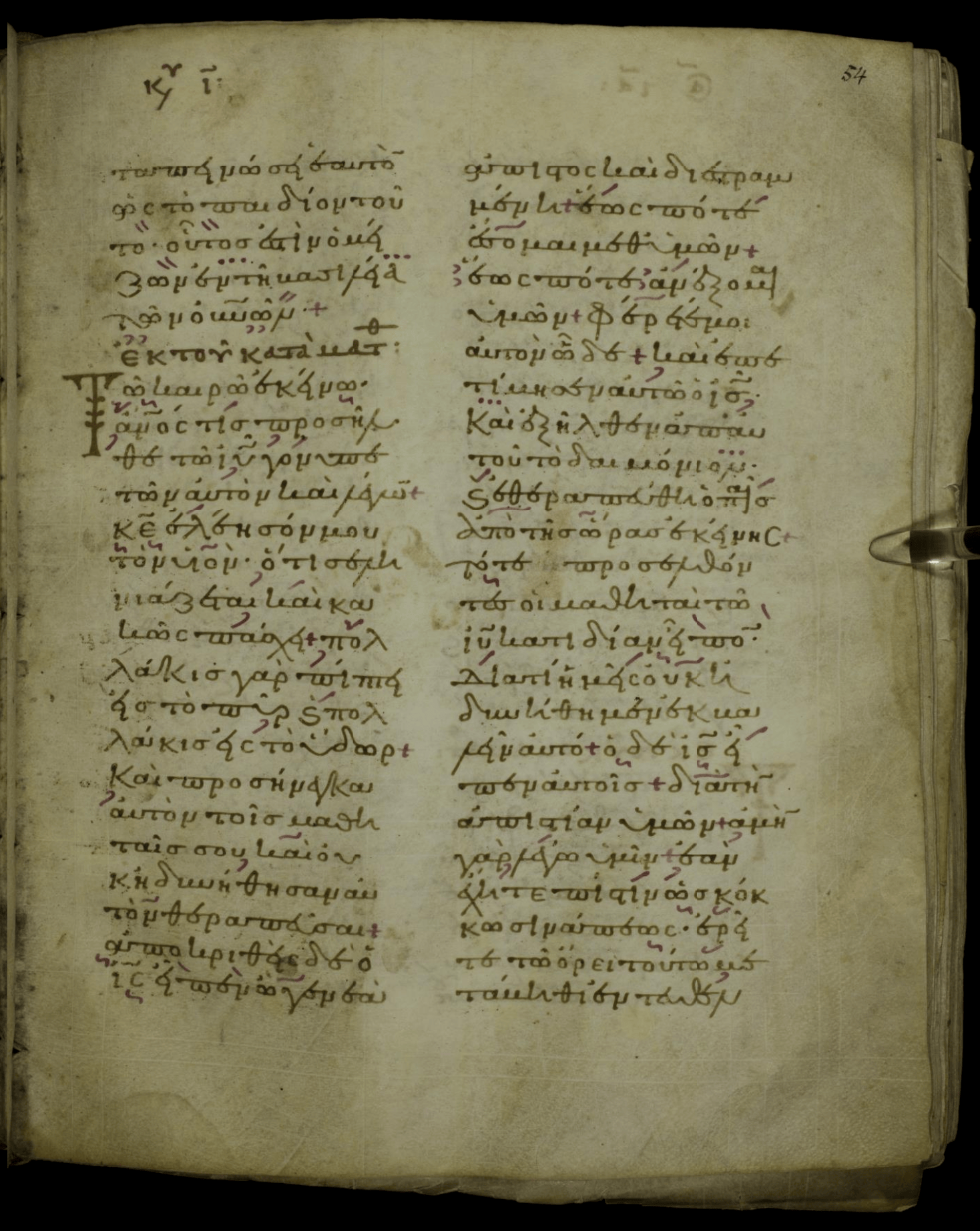
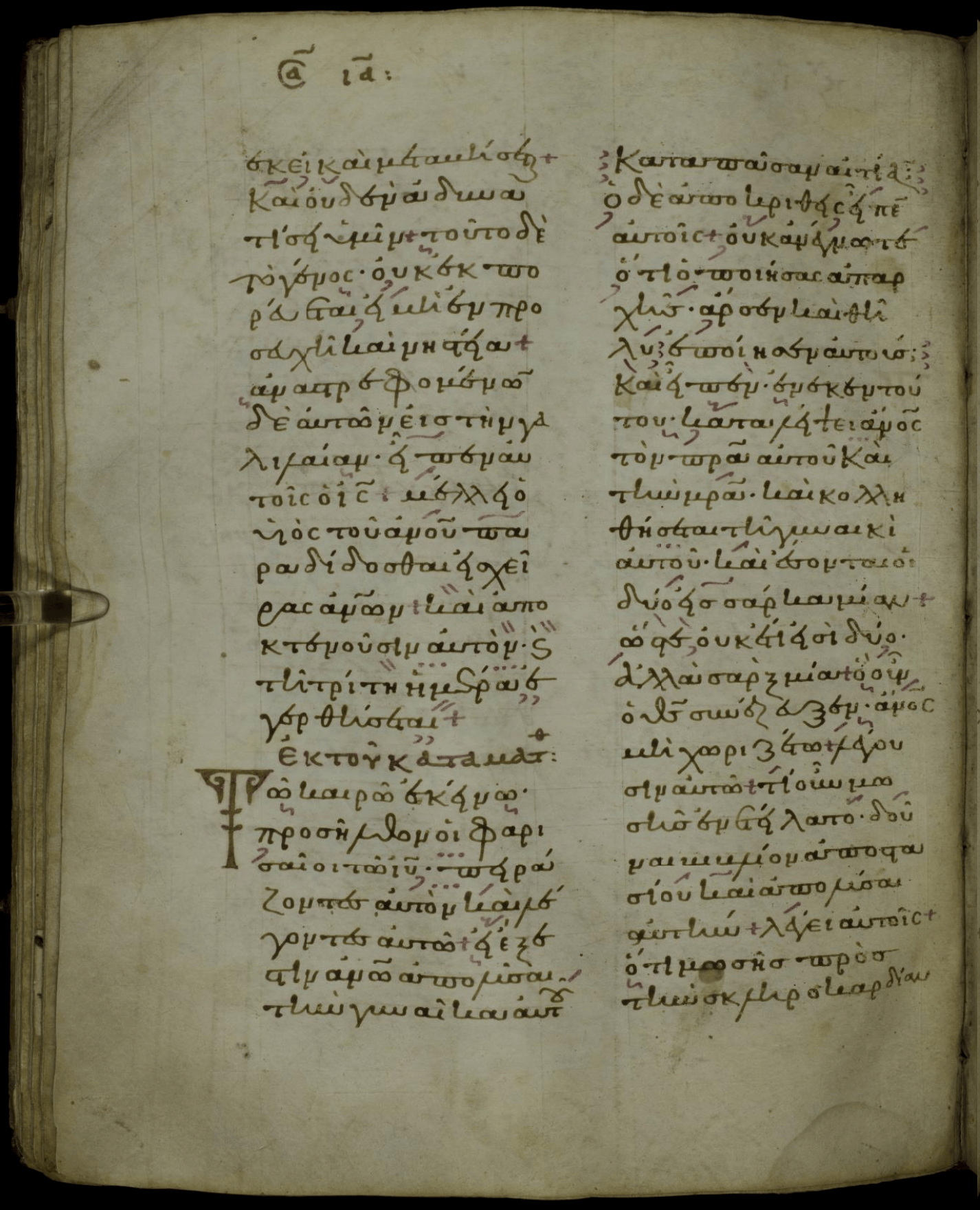
For those who prefer, you can read the passage in English or Greek here.
One particularly interesting feature of today’s lection is Matthew 17:21, which most modern translations do not include:
Τοῦτο δὲ τὸ γένος οὐκ ἐκπορεύεται εἰ μὴ ἐν προσευχῇ καὶ νηστείᾳ.
“But this kind does not go out except by prayer and fasting.”
While the verse was prevalent in the Byzantine tradition and remains part of the Gospel reading used in the Orthodox Church, it is absent from the main text of most modern translations and critical editions.
Origen, writing in the third century, discusses the verse in his Commentary on Matthew, giving it a demonstrably early history. John Chrysostom likewise knew the verse in the late fourth century. In his homily on this passage, he treats prayer and fasting as Jesus’ answer to the disciples’ failure and spends considerable time discussing why the two belong together.
The earliest Greek manuscripts, however, Codex Vaticanus and Codex Sinaiticus, do not include it. Below is an image of Codex Vaticanus where the verse is absent.

With early evidence on both sides, however, it remains more likely that such an explanatory verse would have been added later than omitted. The verse is therefore best understood as a later addition to Matthew, likely arising when a scribe recalled the parallel account in Mark 9:29 and harmonized Matthew’s text with it.
Matthew 17:21 therefore provides a useful example of the difference between textual history and reception history. Its place in the earliest recoverable text of Matthew remains disputed, particularly because of the close parallel in Mark. Its reception within the Church, however, is much easier to trace: the verse was already known to early Christian writers, became firmly established in the Byzantine textual tradition, and was transmitted through Byzantine lectionary use as part of the Gospel reading, a place it continues to hold in the Orthodox lectionary today.
Period 2: Eleventh Sunday after Pentecost (Matt 18:23–35)
The Gospel reading for the Eleventh Sunday after Pentecost is Matthew 18:23–35, the Parable of the Unforgiving Servant. It is also the first parable we have encountered in the Sunday Gospel readings of this lectionary cycle.
The reading follows Peter’s question, “Lord, how often will my brother sin against me, and I forgive him? Up to seven times?” Jesus replies, “I do not say to you up to seven times, but up to seventy times seven” (18:21–22). In our reading for today, Jesus responds with a parable. He describes a king who decides to settle accounts with his servants. One servant owes him ten thousand talents, a sum deliberately beyond any realistic possibility of repayment. If we use the usual reckoning of a talent as approximately 6,000 denarii, the two debts in the parable differ by roughly 600,000 to one. Unable to pay, the servant falls down and says, “Lord, have patience with me,” promising, “I will repay you everything” (18:26). The king gives him considerably more than additional time. Matthew says that he is “moved with compassion,” releases him and cancels the debt altogether (18:27).
The verb ἀφίημι can describe cancelling a financial debt but is also the word Matthew employs for forgiveness. The same term appears explicitly in the Lord’s Prayer (Matt 6:12): ἄφες ἡμῖν τὰ ὀφειλήματα ἡμῶν, ὡς καὶ ἡμεῖς ἀφίεμεν τοῖς ὀφειλέταις ἡμῶν (forgive us our debts, as we forgive our debtors).
The servant who has just had his own debt graciously cancelled then proceeds to go out and find a fellow servant who owes him 100 denarii. This was a sizable sum, as Matthew states in 20:2 that one denarius is the wage for a day’s work in the vineyard. The contrast in the parable, then, is not between a substantial debt and a trivial one, but between an extensive debt and one that was effectively unpayable.
The confrontation then becomes violent: the first servant seizes the man and begins choking him, demanding repayment. The second servant falls down and makes a plea for patience, echoing the same plea that the first servant had just made to the king. This time, however, the request is refused.
The master eventually learns what has happened and summons the first servant again, saying, “I forgave you all that debt because you begged me” (18:32). His next question makes the contrast explicit: “Should you not also have had mercy on your fellow servant, as I had mercy on you?” (18:33). The servant has received mercy but refuses to extend it to another. The master then hands him over to the tormentors until the debt is paid (18:34)—an especially severe ending given that the debt was far beyond his ability to repay.
The parable ends by moving from the story itself back to Peter’s question about forgiveness. Jesus warns that the same judgment awaits anyone who refuses to forgive another: “So also my heavenly Father will do to you, if each of you does not forgive his brother from your hearts” (18:35). The final phrase, “from your hearts” (ἀπὸ τῶν καρδιῶν ὑμῶν) makes emphatic that forgiveness is not simply an outward act of cancelling what is owed; it must penetrate the heart itself.
Read the full Gospel text in the images below.


For those who prefer, you can read the passage in English or Greek here.
Early Christian commentators were interested in an uncomfortable detail of the parable: the master has already cancelled the servant’s debt, but after the servant’s treatment of his fellow debtor, that debt is demanded again. Origen takes this quite seriously. He argues that God can call back what has already been forgiven when the person who received forgiveness refuses it to another; he connects this directly with the final words of the parable, saying that there should remain “not the least remembrance” of the wrong, but that the “whole heart” should forgive (Commentary on Matthew14.6).
Chrysostom reads the passage in the same theological way, but he does not leave its financial language as a metaphor. He turns from the 10,000 talents to the economic practices of his own day, condemning usury and describing agricultural workers burdened by heavy payments, debt, overseers, and the threat of imprisonment. When he reaches the servant seizing his fellow debtor, Chrysostom turns the comparison toward real economic behavior: “Hear, you who do these things for money.” For Chrysostom, then, the parable concerned not only sins and grievances between people, but also how Christians treat actual debtors. (Homily 61 on Matthew §§2–4.)
There is an interesting final echo in the hymns appointed for this Sunday. When the servant falls before the master, he makes the impossible promise, “I will repay you everything” (Matt 18:26). Among the Mode 2 Resurrectional hymns sung with the Beatitudes at the Divine Liturgy, however, the Church sings, Τὸν Σταυρόν σοι προσάγομεν, εἰς πταισμάτων συγχώρησιν, ὃν ὑπὲρ ἡμῶν κατεδέξω, φιλάνθρωπε: “We present You the Cross, O Lord, for the forgiveness of our transgressions, which You accepted on our behalf.” The hymn is not a commentary on Matthew 18, but heard in the same Liturgy it creates a striking contrast. The servant promises to repay a debt he could never possibly repay; the hymn points instead to the Cross as the basis of forgiveness.
Period 2: Twelfth Sunday after Pentecost (Matt 19:16–26)
The Gospel reading for the Twelfth Sunday after Pentecost is Matthew 19:16–26, the encounter between Jesus and the rich young man.
He is often called the “rich young ruler,” although no single Gospel describes him with all three words. Matthew calls him a νεανίσκος, a “young man” while Luke calls him an ἄρχων, a “ruler” (Luke 18:18). Mark simply describes a man who runs up and kneels before Jesus (Mark 10:17), and all three accounts make clear that he is wealthy.
The Byzantine lectionary tradition actually introduces him more fully than the continuous text of Matthew. Matthew 19:16 normally begins, “And behold, someone came to Him and said….” In the lectionary, however, the reading begins, “At that time, a certain young man came to Jesus, kneeling before Him and saying….” The description “young man” comes from later in Matthew itself, while the detail that he kneels also appears in Mark’s account.
There is also a significant textual difference at the beginning of the conversation. Most Greek manuscripts, including the Byzantine tradition used in the Orthodox lectionary, have the man address Jesus as “Good Teacher”, followed by Jesus’ reply, “Why do you call me good? No one is good except One, God” (Matt 19:16–17). Codex Sinaiticus, Vaticanus and Bezae instead read, “Teacher, what good thing shall I do?” followed by, “Why do you ask me about what is good? One is good.” The Byzantine reading agrees closely with the parallel accounts in Mark and Luke, where the man likewise says “Good Teacher” and Jesus replies, “Why do you call me good?” (Mark 10:17–18; Luke 18:18–19). This makes harmonization with the parallel accounts one plausible explanation for the Byzantine reading.
When the young man asks which commandments Jesus means, Jesus names those concerned primarily with one’s obligations toward other people: do not murder, commit adultery, steal, or bear false witness, and honor your father and mother (Matt 19:18–19). He then adds Leviticus 19:18, “You shall love your neighbor as yourself.” The young man replies, “All these I have kept from my youth. What do I still lack?” (19:20). His question is quite direct: τί ἔτι ὑστερῶ;, “What do I still lack?” Jesus’ answer presses the claim further: “If you wish to be τέλειος (perfect, or complete), go, sell what you possess and give to the poor, and you will have treasure in heaven; and come, follow Me” (19:21). The same adjective appears earlier in the Sermon on the Mount: “You therefore shall be perfect, as your heavenly Father is perfect” (Matt 5:48). The movement is important. The young man claims to have fulfilled the commandments concerning his neighbor, and Jesus then asks what that love means for the possessions he still holds. Even so, selling and giving are not the final commands; the sequence ends with “come, follow Me.”
Matthew does not tell us that the man argues or openly refuses. He simply goes away λυπούμενος (sorrowful), because he had many possessions (Matt 19:22). Jesus then tells the disciples that it is difficult for a rich person to enter the Kingdom of Heaven and follows with the famous image: “It is easier for a camel to pass through the eye of a needle than for a rich man to enter the Kingdom of God” (19:23–24).
The disciples respond with great astonishment: “Who then can be saved?” Jesus answers, “With men this is impossible, but with God all things are possible” (Matt 19:25–26).
Read the full Gospel text in the images below.


For those who prefer, you can read the passage in English or Greek here.
One of the most familiar images in this week’s Gospel also has an unusual textual history. The great majority of Greek manuscripts read κάμηλον, “camel,” in Matthew 19:24, and this remains the reading of both the Byzantine text and modern critical editions. A small number of witnesses instead have κάμιλον, understood as a thick rope or cable. The variant occurs in continuous-text manuscripts including 174, 579, and 1424, as well as several Greek Gospel lectionaries, and also appears outside the Greek tradition, particularly in Armenian witnesses. The manuscript evidence nevertheless weighs heavily in favor of κάμηλος, “camel.”

The rope interpretation itself is much older than these few manuscripts suggest. Cyril of Alexandria, commenting on Matthew 19:24, still writes κάμηλος, “camel,” but explains it as the thick rope sailors used with their anchors; the same interpretation later appears in Byzantine commentators such as Theophylact of Ohrid and Euthymios Zigabenos. Significantly, they are interpreting the ordinary word κάμηλος, not necessarily reading the alternative spelling κάμιλος. By the Byzantine period, η and ι had come to be pronounced alike, a development known as iotacism, so κάμηλος and κάμιλος would also have sounded the same when read aloud. That made interchange between the two spellings relatively easy in copying. Only in a small number of later manuscripts does κάμιλος, “rope,” appear explicitly in the biblical text.
The “rope” interpretation changes the object, but it does not really make Jesus’ saying easier. A heavy ship’s rope can no more pass through the eye of a needle than a camel can. The disciples recognize the impossibility and ask, “Who then can be saved?” (Matt 19:25). Jesus’ answer brings the reading back to the young man’s original question. Eternal life is not finally something he can secure by finding one more thing to accomplish or one more possession to surrender: “With men this is impossible, but with God all things are possible” (19:26).
Period 2: Thirteenth Sunday after Pentecost (Matt 21:33–42)
The Gospel reading for the Thirteenth Sunday after Pentecost is Matthew 21:33–42, the Parable of the Wicked Tenants.
The passage comes during Jesus’ final days in Jerusalem. After His entrance into the city and the cleansing of the Temple, the chief priests and elders challenge Him: “By what authority are you doing these things?” (Matt 21:23). The exchange leads into a series of parables, including the one appointed for this Sunday.
The opening of the parable closely echoes Isaiah’s Song of the Vineyard (Isa 5:1–7). Here, the vineyard is described as furnished with a φραγμός (fence or hedge), a πύργος (tower), and προλήνιον ὤρυξα ἐν αὐτῷ (a winepress dug in it). Matthew 21:33 draws on the same imagery: the landowner plants a vineyard, surrounds it with a fence, digs a winepress, and builds a tower.
But the parable takes Isaiah’s story in a different direction. In Isaiah, the vineyard itself fails to produce what its owner expects. In Matthew, the problem lies with the γεωργοί, the tenant farmers: when the time for the harvest comes, those entrusted with the vineyard refuse to give the owner what is his (21:34).
The language of καρπός (fruit) continues as the story unfolds. When “the season of the fruits” arrives, the landowner sends his servants “to receive his fruits” (21:34). Instead, the tenants turn violent, beating one servant, killing another, and stoning a third. More servants are sent and receive the same brutal treatment (21:35–36).
The pattern would have been familiar from Israel’s history: God repeatedly sent prophets who were rejected. In the parable, the owner likewise sends his servants. Finally he sends his son, saying, “They will respect my son” (21:37). The tenants recognize him as ὁ κληρονόμος (the heir), and decide to kill him so that they might seize the inheritance (21:38–39).
The fate of the owner’s son now points toward Jesus’ own rejection and death.
Jesus then asks His hearers to pronounce judgment themselves: “When therefore the lord of the vineyard comes, what will he do to those tenants?” (21:40). Their answer is unusually forceful in Greek: κακοὺς κακῶς ἀπολέσει αὐτούς.
The pairing of κακοὺς and κακῶς gives the sentence a sharp play on words: “He will bring those wicked men to a wicked end” (21:41). The vineyard will then be entrusted to others who will return its fruits at the proper times.
Jesus concludes the parable by quoting Psalm 117:22–23 in the Septuagint (Psalm 118:22–23 in the Hebrew Bible and most English Bibles):
“The stone which the builders rejected
has become the cornerstone;
this was the Lord’s doing,
and it is marvelous in our eyes”
(Matt 21:42)
Read the full Gospel text in the image below.

For those who prefer, you can read the passage in English or Greek here.
One particularly interesting feature of today’s lection is where it ends. The appointed reading concludes at Matthew 21:42, with the quotation about the rejected stone, although the episode actually continues for several verses. In Matthew 21:43, Jesus adds: “Therefore I tell you, the Kingdom of God will be taken away from you and given to a people producing its fruits.”
That final word, καρπούς, “fruits,” returns to a theme that has run through the parable from the beginning. Again and again, the owner seeks the fruit of the vineyard from those entrusted with its care, and again and again they refuse him. In verse 43, Jesus carries that image forward: the Kingdom of God will be given to a people who will produce its fruits.
Matthew then identifies Jesus’ immediate opponents: “When the chief priests and the Pharisees heard His parables, they knew that He was speaking about them” (Matt 21:45). They want to arrest Him but fear the crowds, who regard Him as a prophet (Matt 21:46).
While Isaiah identifies the vineyard with Israel (Isa 5:7), in Matthew the judgment falls particularly on the γεωργοί, those entrusted with its care.. The chief priests and Pharisees recognize themselves in the parable, while the crowds remain distinct from them (21:45–46). The passage therefore should not be read as a general condemnation of the Jewish people as a whole. Its immediate judgment falls on those entrusted with the vineyard who refuse to give the owner what is his.
It is not clear why the Sunday lection ends at verse 42 rather than continuing through these verses (although, interestingly, Matthew 21:43–46 is appointed separately for the 10th Thursday after Pentecost). Today’s reading leaves the hearers with the image of the rejected stone rather than with Matthew’s identification of Jesus’ opponents. The force of the parable can therefore be heard beyond its immediate setting of the chief priests and Pharisees in Jerusalem, posing the same question to those who hear the Gospel now: how will they receive the Son, and what will they do with what God has entrusted to them?
Period 2: Fourteenth Sunday after Pentecost (Matt 22:2–14)
The Gospel reading for this Sunday is Matthew 22:2–14, the Parable of the Wedding Feast.
It follows directly on last week’s parable of the wicked tenants. Jesus is still in Jerusalem, still being challenged by the chief priests and elders, and He answers them the same way He has been, with a parable. This time He compares the Kingdom of Heaven to a king who prepares a wedding feast for his son.
What stands out in the Greek is how insistently the passage returns to the language of calling. The king sends his servants καλέσαι τοὺς κεκλημένους, “to call those who had been called,” or “to invite those who had been invited” (22:3). These aren’t people hearing about the wedding for the first time; they already knew. The servants are simply sent to tell them the feast is ready. And still, they don’t want to come.
So the king tries again, and the invitation gets more urgent: “Behold, I have prepared my dinner, my oxen and fattened animals have been slaughtered, and everything is ready; come to the wedding” (22:4). Some guests just shrug it off, Matthew calls them ἀμελήσαντες, “indifferent,” treating the whole thing as no concern of theirs. One goes back to his field, another to his business. Others turn violent, seizing the king’s servants, mistreating them, killing them (22:5–6).
In the space of a few verses, the response devolves from refusal into indifference into outright violence. The king answers in kind as he destroys the murderers and burns their city and then tells his servants, “The wedding is ready, but those who were invited were not worthy” (22:8).
The servants head out into the streets and gather whoever they can find, πονηρούς τε καὶ ἀγαθούς, “both bad and good” (22:10). The point isn’t that the first guests get replaced by a more deserving crowd, it’s that the invitation simply keeps expanding until the hall is full of people gathered from the roads.
Then the story gets more complicated. When the king comes in to look over the guests, he spots someone without a wedding garment. He asks, “Friend, how did you come in here without having a wedding garment?” (22:12). The word ἑταῖρε, “friend,” occurs only three times in the New Testament, all in Matthew and all in moments of confrontation. In addition to this passage, the landowner calls the complaining worker “friend” in the Parable of the Laborers in the Vineyard (20:13), and Jesus uses the same word when Judas arrives to betray Him (26:50). The guest has no answer. The text tells us that he is then bound and cast “into the outer darkness,” where there will be “weeping and gnashing of teeth” (22:13).
The story closes the language that has run through the entire parable, πολλοὶ γάρ εἰσι κλητοί, ὀλίγοι δὲ ἐκλεκτοί, “For many are called, but few are chosen” (22:14).
That word κλητοί, “called,” pulls together everyone the story has mentioned: the first guests, who were called and refused; the servants, sent out to call in anyone they could find; and the crowd that finally fills the hall.
It is striking that bad and good alike have been pulled in off the street, but when the man without a wedding garment shows up, he complicates the picture. Being invited, it turns out, isn’t the same as being ready. One set of guests refuses the invitation outright; this man accepts it, walks into the feast, and still isn’t prepared when the king arrives.
Jesus’ parable highlights two different kinds of failures, refusing to come, and coming unready, and behind both of them is the king, who keeps sending his servants out no matter how many times he’s turned down, defied, or attacked, until the hall is finally full.
Read the full Gospel text in the images below.


For those who prefer, you can read the passage in English or Greek here.
One particularly interesting feature of today’s lection becomes visible when it is placed beside last Sunday’s reading, which concluded at Matt 21:42, with Jesus’ quotation about the stone the builders rejected. In the continuous text of Matthew, the episode continues with Matthew identifying those who recognize themselves in His parables: “When the chief priests and the Pharisees heard His parables, they knew that He was speaking about them. They want to arrest Him, but fear the crowds, who regard Him as a prophet” (21:45–46).
Matt 22:1 is the verse that actually joins the Parable of the Wicked Tenants to the Parable of the Wedding Feast:
Καὶ ἀποκριθεὶς ὁ Ἰησοῦς πάλιν εἶπεν ἐν παραβολαῖς αὐτοῖς λέγων
“And Jesus answered and spoke to them again in parables, saying”
Jesus is still addressing those who have just recognized themselves in the previous parable.
Today’s lection omits this verse. In its place stands the customary liturgical formula used to introduce parables:
Εἶπεν ὁ Κύριος τὴν παραβολὴν ταύτην
“The Lord said this parable”
The substitution is minor, but it subtly reshape its horizon of address. Once the pronoun αὐτοῖς (“to them”) is removed (since Matt 22:1 is not included in today’s lection), the parable is no longer addressed to a specific, identifiable audience, i.e., the chief priests and Pharisees who had just understood the previous parable to concern them. Its address widens and now the parable itself is structured entirely around the language of calling: the pronoun disappears, but the summons remains.
The question posed by the parable is therefore no longer only why the first guests refused the king’s invitation. The lectionary reading extends that question to everyone who hears it, which is, perhaps, the point of the parable’s own closing line: many are called, but few are chosen.
Period 2: Sunday before Elevation of the Cross (John 3:13-17)
The Gospel reading for this Sunday is John 3:13–17, appointed for the Sunday before the Elevation of the Holy Cross (September 14).
The reading comes from Jesus’ conversation with Nicodemus. In the preceding verses, Jesus has spoken about “heavenly things.” Verse 13 explains why the Son of Man is able to speak about these thing: “No one has ascended into heaven except the one who descended from heaven, the Son of Man who is in heaven.”
The verse emphasizes that the Son can reveal the things of God because he comes from God. What follows, however, demonstrates that his descent from heaven leads toward something more than revelation; it leads toward his death.
Jesus explains this by turning to a strange episode from Israel’s journey through the wilderness in Numbers 21:
“And as Moses lifted up the serpent in the wilderness, so must the Son of Man be lifted up.”
After the Israelites speak against God and Moses, “fiery serpents” enter the camp, and many of the people die from their bites. God instructs Moses to make an image of a serpent and set it upon a pole, so that those who had been bitten could look upon it and live (21:6–9).
John takes this episode and uses it as a pattern for what will happen to Jesus. As the serpent was raised up in the wilderness, so the Son of Man must be raised up.
The Greek word ὑψόω can mean both “to lift up” and “to exalt.” In John 3:14, the immediate reference is to the Crucifixion. This becomes explicit later in the Gospel, when Jesus says, “And I, when I am lifted up from the earth, will draw all people to myself” (12:32). John then explains that Jesus said this “to show by what kind of death He was going to die” (12:33).
The language carries a deliberate tension: Jesus is physically lifted up on the Cross, but the same word can also suggest exaltation. What appears to be humiliation becomes, in John’s Gospel, the place where His identity and glory are revealed.
Verse 15 develops the comparison with Numbers further: the Son of Man is lifted up “so that everyone who believes in him may have eternal life.” In the wilderness, those who looked upon the bronze serpent were delivered from death. John takes that earlier episode and gives it a new significance. The lives that were preserved in Numbers become a pattern for the eternal life given through Christ.
This leads directly into John 3:16:
“For God so loved the world that he gave His only Son, that everyone who believes in Him should not perish but have eternal life.”
In this context, John 3:16 presents the lifting up of the Son as the disclosure of God’s own character. The Cross is not merely the means by which salvation happens; it reveals what divine love looks like.
The connection of verse 16, that the Son is “given,” with verses 14–15, which described the Son as being “lifted up,” tells us the very form that this love takes. That giving includes the whole mission of the Son, who descends from heaven and is sent into the world, but in the immediate context it culminates in the Cross. The Crucifixion is thus not simply the place where salvation is accomplished. It is the place where the character of God is made visible.
The Cross reveals both the seriousness of the world’s condition and the character of the God who acts to save it. What is disclosed in the lifting up of the Son is not only the fate of Jesus, but the self-giving love of God.
Verse 17 develops the same point in terms of the Son’s mission:
“For God did not send His Son into the world to condemn the world, but that the world through Him might be saved.”
The language moves from God “giving” the Son in verse 16 to God “sending” him in verse 17. In both cases the initiative comes from God. The purpose of the Son’s coming is presented not as condemnation, but as salvation.
Taken together, the passage moves from the Son’s heavenly origin, to His being lifted up, and from His lifting up to the life and salvation of the world. Interestingly, the Cross stands at the heart and center of the passage even though the word itself never appears.
That makes John 3:13–17 particularly fitting for the Sunday before the Elevation of the Holy Cross. Before the Cross is raised before the congregation, the Gospel interprets what that elevation means: the Son of Man is lifted up so that those who believe in him might have life.
Read the full Gospel text in the image below.

For those who prefer, you can read the passage in English or Greek here.
September 14, the feast of the Elevation, or Exaltation, of the Cross, is one of the major feasts of the Orthodox Church. Its historical origins are connected with Jerusalem and the veneration of the Cross in the fourth century. Church tradition associates the feast especially with Helen’s discovery of the Cross of Christ and with the dedication of the Church of the Resurrection, the Holy Sepulcher, in Jerusalem in 335. The church was dedicated on September 13, and the following day became associated with the public display and veneration of the Cross. The later Byzantine celebration also incorporated the memory of the Cross being returned to Jerusalem in the seventh century after its removal by the Persians.
On September 14, John 19:6–11, 13–20, 25–28, 30–35 is read. On the Sunday before September 14, John 3:13–17 is read, while on the Sunday after September 14, Mark 8:34–9:1 is read. These readings interrupt the sequence of Matthean pericopes. After the Sunday following the feast, the regular cycle moves into Luke.
The Byzantine lectionary follows two calendar systems. The synaxarion contains the movable cycle of readings organized around Pascha, while the menologion contains readings associated with the fixed calendar. September 14 belongs to the fixed calendar.
The Matthean period is flexible, since more pericopes are appointed than can necessarily be read during a given year. Its length depends on the date of Easter: when Easter falls early, the Matthean period is longer; when Easter falls late, it is shorter. The transition from the Matthean to the following Lukan period is based around September 14.
The lectionary itself does not provide all of the instructions necessary for determining how many weeks the Matthean period lasts. This information is provided in another liturgical book, the Typikon, which gives the broader rules governing the arrangement of the services throughout the year. Among other things, it regulates how different liturgical cycles are combined and what happens when observances coincide. Determining what is actually read on a particular day sometimes requires more than consulting the Gospel lectionary alone.
L434 provides an interesting illustration of this arrangement. The reading for the Sunday before the Elevation of the Cross, John 3:13–17, is found in the menologion section of the manuscript on fols. 159v–160r. The reading for September 14 is found immediately following on fols. 160r–161v. In L434. Some lectionaries, including that of the Greek Orthodox Archdiocese of America, end the September 14 reading at John 19:30, while others, including that of the Orthodox Church in America, continue through verse 35.
Even though today is still the Matthean period, the pericope from the Gospel of John is deliberate, placing this reading immediately before the feast of the Elevation of the Cross so that the Church hears Christ speak of being “lifted up” before the Cross itself is elevated on September 14. The Gospel prepares the congregation to see the feast more deeply: the Cross that is raised before them is the sign of the Son whom God has given for the life of the world. In John, the Cross is not only the instrument of Christ’s death, but the place where the character of God’s love is disclosed. What is heard in the Gospel on Sunday is then made visible in the feast that follows.
Period 2: Sunday after Elevation of the Cross (Mark 8:34–9:1)
This Sunday’s Gospel reading is Mark 8:34–9:1, appointed for the Sunday after September 14, the feast of the Elevation of the Cross.
In the lectio continua, this passage comes after Peter’s confession that Jesus is the Christ (Mark 8:29), and after Jesus teaches the disciples that the Son of Man must suffer, be rejected, be killed, and rise again (8:31). Peter then objects, and Jesus responds, “Get behind me, Satan” (8:33).
Today’s lection is closely connected with that exchange. Jesus calls the crowd together with His disciples and says:
“If anyone wishes to come after me, let him deny himself and take up his cross and follow me” (8:34).
There is a noticeable repetition in the Greek. Jesus has just told Peter, ὕπαγε ὀπίσω μου, “get behind me” (8:33). Then, in the very next verse, He speaks of anyone who wants to come ὀπίσω μου, “after me” or “behind me” (8:34). The wording ties the two sayings together. Peter has resisted the path Jesus says He must take, but Jesus makes clear that discipleship means getting behind Him and following Him on that very path.
Jesus then expands on what this kind of discipleship entails through a series of paradoxes:
“For whoever wishes to save his life will lose it; but whoever loses his life for my sake and the Gospel’s will save it” (8:35).
The word translated “life” (ψυχή) can also mean “soul” and, more broadly, the person or self. That range of meaning fits the passage well, since the same ψυχή can be either saved or lost. Jesus then pushes the paradox further: “For what will it profit a person if he gains the whole world and loses his life?” (8:36). The two are set against each other in the strongest possible terms. Even the greatest imaginable gain, “the whole world,” cannot make up for the loss of one’s life.
Mark adds words that do not appear in the Synoptic parallels in Matthew 16:25 or Luke 9:24: the disciple loses his life not only “for my sake,” but also “for the sake of the Gospel” (8:35). The wording closely joins allegiance to Jesus with allegiance to the message about Him. Discipleship, in other words, is not only a matter of following Jesus personally, but also of standing with the Gospel that bears witness to Him, even when that allegiance is costly.
That connection carries into the warning that follows. Jesus moves from speaking about losing one’s life for His sake and the Gospel to the danger of being ashamed of “me and my words” (8:38). The parallel is significant: loyalty to Jesus cannot be separated from loyalty to what He says. Conversely, to shrink back from His words is to shrink back from Him. Jesus therefore warns that whoever is ashamed of Him and His words, “the Son of Man also will be ashamed of him when He comes in the glory of His Father with the holy angels” (8:38).
Today’s lection continues one verse into what modern Bibles number as chapter 9
“Truly I say to you, there are some standing here who will not taste death until they see the Kingdom of God having come in power” (9:1).
This saying has been interpreted in several ways. The Transfiguration is a natural point of reference, since Mark places it only six days later and Peter, James, and John are given a glimpse of Jesus in glory (9:2–8). The saying has also been connected with the Resurrection, Pentecost, and the wider manifestation of the Kingdom. Mark does not say precisely what it means for those standing there to “see the Kingdom of God having come in power.” What is clear, however, is the movement of the passage. Jesus has spoken of suffering, rejection, and the cross, but the final verses look beyond these to glory and power: the Son of Man will come “in the glory of His Father with the holy angels” and some standing there will see “the Kingdom of God having come in power.”
Mark 9:1 is therefore a particularly significant ending to the lection. Peter has resisted Jesus’ teaching that the Son of Man must suffer, be rejected, and be killed, but Jesus does not replace suffering with a more obviously triumphant picture of Messiahship. Instead, He calls His disciples to follow Him on the same costly path: “let him deny himself and take up his cross and follow me.” Only then does the passage speak of glory and of the Kingdom coming in power. The Cross and the Kingdom are therefore not presented as alternatives, as though suffering belonged to failure and the Kingdom to victory. Rather, the path of suffering is the path that leads to glory. The promise of the Kingdom does not displace the call to take up the cross; it follows from it. The reading that begins with the command to take up the cross thus ends with the Kingdom of God having come in power.
Read the full Gospel text in the image below.

For those who prefer, you can read the passage in English or Greek here.
There is an interesting comparison elsewhere in L434. Fol. 169v begins the appointed reading for the November 5 commemoration of the martyrs Galaction and Episteme with Mark 8:34–38; 10:29–31. Both were third-century martyrs, traditionally associated with the persecution under Emperor Decius around AD 250–251.
While lectionaries frequently reuse the same biblical material on more than one occasion, they can also combine and frame that material differently according to the ecclesial context in which it is read. The November 5 lection, for example, does not include Mark 9:1, as this Sunday’s reading does but moves instead from Mark 8:38 to 10:29–31. This choice for a commemoration of martyrs is particularly fitting as Jesus speaks of taking up the cross (8:34), losing one’s life “for my sake and for the sake of the Gospel” (8:35), and not being ashamed of Him or His words (8:38).
The addition of Mark 10:29–31 reinforces these themes:
“I tell you the truth, there is no one who has left home or brothers or sisters or mother or father or children or fields for my sake and for the sake of the gospel who will not receive in this age a hundred times as much—homes, brothers, sisters, mothers, children, fields, all with persecutions—and in the age to come, eternal life. But many who are first will be last, and the last first.”
The link between Mark 8:34–38 and 10:29–31 is particularly strong. Both passages use the phrase “for my sake and for the sake of the Gospel,” while Mark 10 adds explicit reference to persecution and eternal life (10:30). In a commemoration of martyrs, that combination gives the reading a particular force: sacrifice for Christ and the Gospel is placed alongside the promise of eternal life.
For this Sunday’s reading, the Sunday after the Elevation, the same opening passage is heard in a different context. Here the command to “take up his cross and follow me” comes only days after the Church has celebrated the Elevation of the Cross. At the feast, the Cross was raised before the congregation as the sign of the Son of Man who was “lifted up” (John 3:14); now the Gospel turns from Christ’s Cross to the cross taken up by the disciple.
But this Sunday’s lection continues in a different direction. Rather than turning to the passage in Mark 10, it continues directly into Mark 9:1:
“Truly I say to you, there are some standing here who will not taste death until they see the Kingdom of God having come in power.”
The two readings therefore take the same core passage and carry it toward different conclusions. For the martyrs, it is joined to a saying about leaving all for Christ and the Gospel, enduring persecution, and receiving eternal life. On the Sunday after the Elevation, it continues instead to the Kingdom of God coming in power. In each case, what follows draws out an aspect of the passage especially suited to the occasion on which it is proclaimed.
This is a good example of how the same biblical material could be heard differently within the liturgical year. In each case, the text was encountered within a larger liturgical setting shaped by the calendar, the hymns and prayers of the service, rituals, and the theological themes of the day. Together, these elements formed the interpretive setting in which the congregation encountered the Gospel. The arrangement of the lectionary thus gives us some sense of how Scripture was received in worship: not as isolated passages, but as texts repeatedly heard within the rhythms and practices of the Church’s life.