

Few national manuscript collections have been transformed as dramatically in recent decades as the Greek New Testament manuscripts of Albania. Until the last 20 years, much of this collection remained effectively unknown to the wider scholarly world—a virtual blind spot on the map of Greek New Testament manuscripts.
Albania preserves a historically remarkable collection of Greek New Testament witnesses, ranging from the 6th to the 15th centuries, including two of the few surviving New Testament manuscripts on purple parchment. Today, these manuscripts are housed in Tirana, though many trace their history back to Berat, a medieval Orthodox stronghold whose churches and monastic communities helped preserve a treasury of Byzantine manuscripts.
I have chosen to begin this series on the changing landscape of Greek New Testament manuscripts with Albania not merely because it appears first alphabetically in the Kurzgefasste Liste, but because Albania’s manuscript inventory looks markedly different from the 1994 Liste, making it a particularly fitting place to start. The history of Albania’s manuscripts is an extraordinary story of survival: through invasions, communist rule, political isolation, and religious persecution. It is an exceptionally illuminating case study in how history, survival, access, cataloguing, and rediscovery can dramatically reshape the manuscript landscape itself.
That broader history comes into sharper focus in the two purple codices of Berat. Their story will serve as a thread running through this account, showing in concrete terms how historical factors have shaped both the fate of individual manuscripts and the wider contours of a national collection.
The History of Greek New Testament Manuscripts in Albania
To understand how the Albanian manuscript evidence underwent such a dramatic transformation, we must first trace its history.
Early Cataloguing, Local Memory, and the Berat Codices
The story begins in 1868 with Anthimos Alexoudes, the Metropolitan of Berat, who made the first major attempt to describe the Greek manuscripts preserved in churches and monasteries there. Among the manuscripts he described were three purple codices kept in the castle of Berat: Codex Beratinus 1 and 2 and a third now lost. His descriptions of these manuscripts, together with his later cataloguing of the wider Berat collection, eventually comprising 46 manuscripts, began to attract the attention of Western scholars and became foundational for subsequent attempts to identify, classify, and trace the Albanian witnesses.1

These two surviving purple codices occupy a unique place in the history of the Greek New Testament. The earlier, Codex Beratinus 1 (GA 043), is a sixth-century Gospel manuscript preserving substantial portions of Matthew and Mark on purple parchment. Its text is written in silver majuscule with some initials and nomina sacra written in gold.
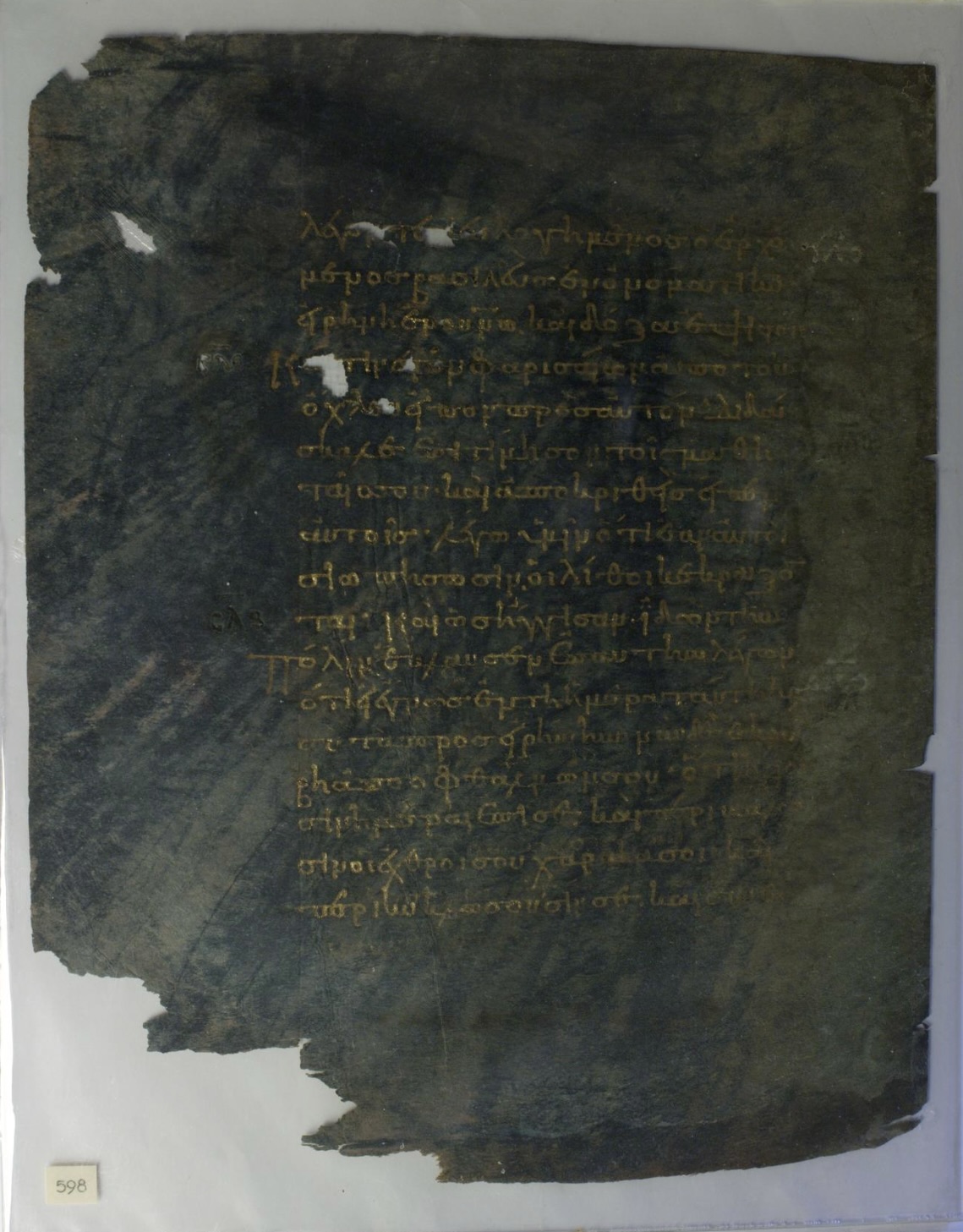
Codex Beratinus 2 (GA 1143), usually dated to the end of the 9th century, is written in gold minuscule and also called Codex Aureus Anthimi (“The Golden Codex of Anthimos”), a name given in honor of Anthimos Alexoudes. It contains the four Gospels, Eusebian apparatus, ornamental headings, and portraits of the evangelists (although Matthew’s portrait is now lost except for its frame).

Together, these two manuscripts belong to a rare group of luxury Gospel codices written on purple parchment including five uncials—GA 022, 023, 042, 043, and 080, two minuscules—GA 565 and 1143, and one lectionary—ℓ46.2
The survival of the Berat codices is quite remarkable. Already in the medieval period there are stories of protecting these artifacts during periods of violence and instability. A record preserved at the Church of St. George in Berat recounts that, during the Serbian attack on the city in 1356, a cache of luxury manuscripts was rescued and carried into a tower near the castle gate. Among the rescued manuscripts was Codex Beratinus 1, identified by its distinctive silver script on purple parchment.3
Long before scholars began to catalogue and study them, these manuscripts had already been cherished by their communities, functioning as objects of public veneration within the rhythms of ecclesial worship. The sacred status of GA 1143, for example, was reinforced by a local tradition in Berat associating the codex with John Chrysostom. According to tradition, the manuscript preserved writing from Chrysostom’s own hand—a claim that reveals less about its actual authorship than how deeply it was revered. Until the 20th century, this reverence took visible form each year on January 27, the feast commemorating Chrysostom, when the manuscript was displayed for the faithful to venerate by kissing it.4
Curiosity about the Berat manuscripts soon drew the French scholar Pierre Batiffol to Albania. In the 1880s, he visited the Metropolis of Berat to examine its library and study its manuscript treasures firsthand. His publications effectively introduced the Berat manuscripts to a wider audience, but they also left behind a host of questions. Batiffol was able to inspect some of these manuscripts directly, but his publications on others were based on local descriptions or secondhand information. In this sense, he brought the Berat manuscripts to the attention of Western scholars for the first time but also introduced problems that later cataloguers would spend more than a century trying to untangle.5
After Alexoudes and Batiffol, direct study of the Albanian manuscripts entered a long hiatus. Although Hermann von Soden and Caspar René Gregory included Albanian witnesses in their early 20th century catalogues, both depended heavily on earlier reports rather than firsthand examination.6 Thus, even though Beratinus 1 and 2 attracted international attention, the wider Albanian collection is “one of the least known collections of Greek manuscripts in the Balkans,” as Didier Lafleur and Luc Brogly put it.7
War, Concealment, and Communist Rule
The perils that had threatened the purple codices in the 14th century did not end in the modern era. During World War II, the Church Council in Berat reportedly concealed GA 043 and GA 1143 to prevent them from falling into the hands of the Germans. A later Albanian archival account tells the story in dramatic terms: when German forces came to Berat looking for the codices, the church elders refused to disclose where they had been hidden, bound by an oath of secrecy. The confrontation escalated to the point that the elders were placed at gun point at the castle wall. However, before they could be executed, gunfire sounded elsewhere nearby; the soldiers, believing they were under attack, withdrew and left the elders unharmed. After this episode, the codices seem to have vanished from public view and were long regarded as lost.8
After World War II, Albania entered a period of extreme political and cultural isolation under Enver Hoxha’s “long and brutal Stalinist-style reign.” 9
In 1965, an exception to this broader policy of isolation allowed two young Austrian scholars, Johannes Koder and Erich Trapp, to gain access to the Tirana manuscript collection. Their research resulted in the 1968 Katalog der griechischen Handschriften im Staatsarchiv zu Tirana, which introduced the Albanian Greek manuscripts to wider scholarship.10 Importantly, however, the two purple codices were absent from their catalogue because they were not in Tirana at the time of their fieldwork.
The situation in Albania worsened dramatically in 1967, when Hoxha’s regime proclaimed Albania the world’s first atheist state.11 What followed was a systematic state campaign to erase religious life from both public spaces and private memory. Thousands of churches and monasteries were closed, confiscated, damaged, demolished, or converted to secular uses; icons, relics, sacred vessels, and religious books were seized or destroyed. Andi Rembeci recounts that priests and laypeople who lived through this period “came under intense persecution and threats” and were forced to consign some of their manuscripts to the Central State Archive.12 During this upheaval, many of these artefacts were damaged, dispersed, or hidden to prevent seizure; at the same time, some Greek New Testament codices survived by passing into state control in Tirana, where they later formed part of fonds 488.
Beratinus 1 and 2 shared this broader fate, but their path to the centralized archive in Tirana followed a different course. The precise history of their concealment remains uncertain, and it is not entirely clear whether they had remained hidden continuously since World War II. In any case, they came to light only in 1968, when they were rediscovered in a hiding place in Berat, within the walls of the Church of the Dormition of the Theotokos.13

They had been sealed behind stone slabs, wrapped in straw, and enclosed within a metal chest. The conditions of concealment left visible damage: mold, oxidized silver, and discoloration of the parchment.14

In another extraordinary moment in this history, the damaged codices were sent for restoration to the Archaeological Institute of the Chinese Academy of Sciences in Beijing between 1970 and 1972, during Albania’s brief Cold War alliance with Maoist China.15
Amid this precarious moment for the surviving manuscripts, the Albanian Orthodox theologian and art historian Theofan Popa began crucial work on the codices. As the surviving manuscripts were gathered and organized within the archives in Tirana, Popa sought to index the collection and demonstrate its significance, helping ensure that the manuscripts would not be further damaged or destroyed. Thus, Popa contributed decisively to the discovery and rescue of these manuscripts.16 He compiled descriptive index cards for many of them, but because these cards remained largely internal and were not published until 2003, his work had little effect on wider scholarship during his lifetime.
Albania in the 1994 Kurzgefasste Liste
The uncertainty surrounding the Albanian manuscripts is visible on the printed pages of the 1994 Liste. Under Albania four locations are named: Argyrokastro (modern Gjirokastër), Berat, Tirana, and Valona (Vlorë ). Three of them appear in brackets, which were used to denote locations whose manuscript holdings could no longer be securely located.
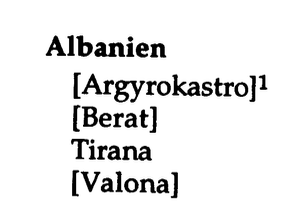
This compact form captures the uncertainty in the early 1990s. Although Albania’s communist regime had collapsed three years earlier, the manuscripts had not yet been systematically examined and decades of restricted access, incomplete cataloguing, and dependence on older reports continued to shape the available evidence. The problem was compounded by the accumulation of overlapping reference systems. Over time, Albanian manuscripts had been described according to local church locations, Alexoudes numbers, Batiffol references, von Soden sigla, Gregory-Aland numbers, Koder-Trapp entries, Tir. gr. designations, and various archival shelfmarks. Determining when these different identifiers referred to the same manuscript is often difficult, particularly when earlier descriptions were incomplete or imprecise.
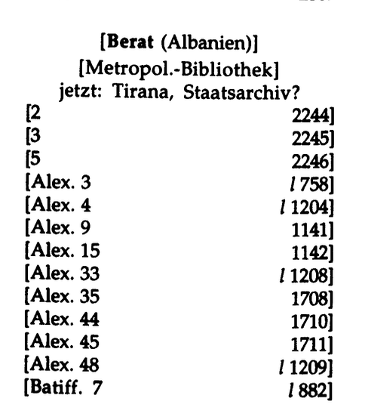
The 1994 Liste registered a total of 30 Greek New Testament manuscripts from Albania.17 Yet the location and identity of many of them remained unclear. Manuscripts formerly associated with Berat, located in Argyrokastro and Valona, had been dispersed during the communist period, and while some were believed to have reached Tirana, the evidence was often insufficient to confirm this securely. In the Liste, this uncertainty was marked by brackets and, in several entries, with “now in the Tirana State Archive?” The location of both manuscripts formerly associated with Gjirokastër and of both from Vlorë was therefore effectively unknown.

Even Berat, which had the largest number of Greek New Testament manuscripts, could only partially be traced. Of the 24 manuscripts formerly associated with Berat, 13 were thought to have been transferred to Tirana, but the evidence was insufficient to confirm their location securely.
Secure Identifications and Omissions
What the editors of the 1994 Liste could state definitively was therefore surprisingly limited. Only a small group of manuscripts could be securely assigned to Tirana. Two of these were the famous purple codices, rediscovered in 1968. The remaining 11 identifications depended on the 1968 catalogue by Koder and Trapp.
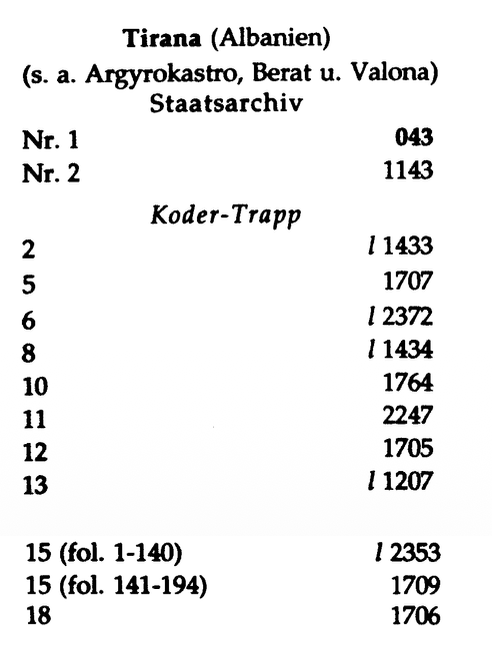
Curiously, the editors of the 1994 Liste used Koder and Trapp rather selectively. Several lectionaries, for example, were not added, even though other entries from the same page were included.
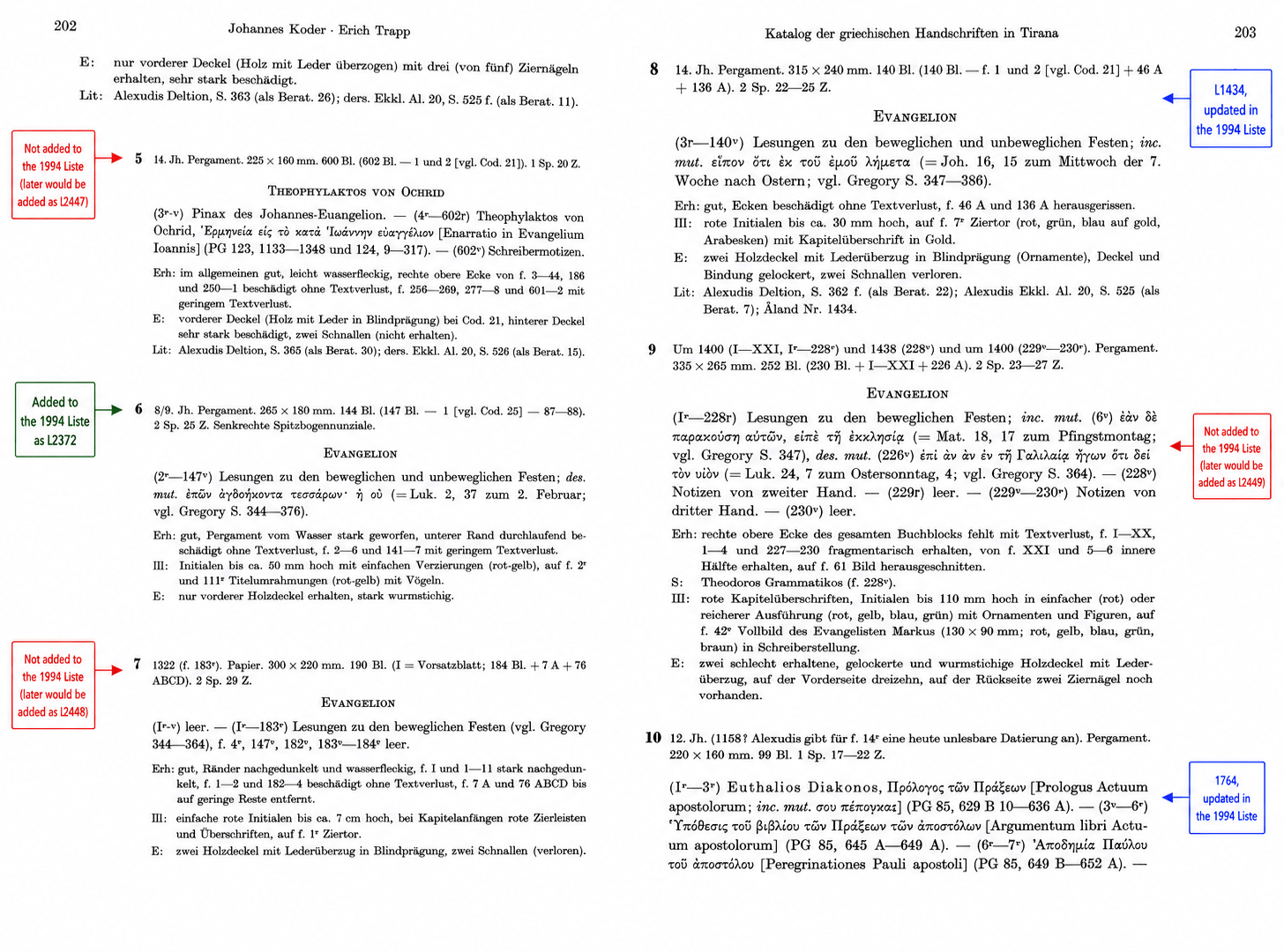
In retrospect, the Albanian entries in the 1994 Liste represent a transitional moment in the history of the collection. The manuscripts had begun to re-emerge from decades of isolation but still bore visible signs of unresolved work and the uncertainties inherited from earlier scholarship.
Albania Since the 1994 Liste
In the decades that followed, renewed international access, direct examination, and systematic digitization began to radically reshape the manuscript inventory.
The 2003 publication of Kodikët e Shqipërisë marked an important step in making Albania’s manuscript holdings more accessible. The volume published Popa’s descriptive cataloguing work for the first time and included Roderic Mullen’s attempt to correlate the archive’s manuscripts with Gregory-Aland numbers. Despite this significant contribution, the information circulated slowly beyond Albania and did not seem to have much of an impact within the wider field.18
CSNTM’s 2007 Expedition
The situation changed substantially only a few years later through the work of the Center for the Study of New Testament Manuscripts (CSNTM). In December 2006, Daniel Wallace wrote to the director of the Albanian National Archives requesting permission to photograph their Greek New Testament manuscripts. Permission was granted in the spring of 2007, and the team arrived in Albania on July 2 expecting to photograph a rather modestly sized collection: the 13 manuscripts indicated by the 1994 Liste.
Instead, they found a body of material more than three times larger. The discovery transformed the expedition: a two-week trip had to be extended by several weeks so that the full collection could be photographed and metadata for the newly discovered manuscripts could be gathered
The word “discovery,” however, requires some nuance. Not all of these manuscripts were entirely unknown, since some had already been described by Popa, Koder and Trapp, and others. Yet much of this material remained only locally catalogued, unpublished, or unverified. As a result, the manuscripts were effectively invisible to many New Testament scholars outside Albania. CSNTM’s 2007 expedition changed that situation in two important respects: it verified manuscripts whose identity or location had remained uncertain, and it brought a large body of previously unregistered material into the Liste—and thus into broader scholarly awareness.
Their efforts ultimately led to the addition of 20 new manuscripts to the Liste: 7 minuscules and 13 lectionaries.19
Reckoning with Older Entries
The scale of the change to Albania’s manuscript landscape is striking, but it cannot be measured by simple addition. While the 1994 Liste registered 30 manuscripts there, the total today is not 50, because 10 entries once associated with Albania have either been removed, relocated outside the country, or are now location unknown.
- GA 1706 was removed from the Liste after being identified as only containing Psalms and Odes.
- ℓ882 and ℓ1209 were removed because their original descriptions were too imprecise to ever be able to identify them again.20

Two entries, GA 1142 and GA 1710, are actually duplicates. It appears that Alexoudes catalogued the same manuscript twice, first as no. 15 and again as no. 44. As a result, GA 1710 was removed; GA 1142 is now housed at Houghton Library in Cambridge, Massachusetts.
Five additional entries have now been moved to location unknown in the NTVMR: GA 1708, GA 1711, ℓ758, ℓ1208, and ℓ1791.21
Reassessing Albania’s Manuscript Count
Once the doubtful older entries are set aside, the effect of CSNTM’s work becomes clearer. Their efforts raised the number of identifiable Greek New Testament manuscripts in Albania from 20 to 40. As a result, the manuscript landscape visible today differs substantially from that of only a generation ago. To my knowledge, no other country in the Liste has seen its manuscript inventory double in this way.
The result was not simply the addition of new witnesses. By gaining direct access to the manuscripts, uncertain identifications could be clarified and detailed metadata for sparsely catalogued and previously unregistered material could be gathered. This allowed the Albanian manuscript evidence to be documented with a level of precision not previously possible.
Each entry in the Liste has now been thoroughly revised on the basis of this metadata and subsequent scholarship, especially Lafleur and Brogly’s 2018 publication on 21 Greek New Testament witnesses and Džurova’s 2011 two-volume study of illuminated Greek manuscripts in Albania.22
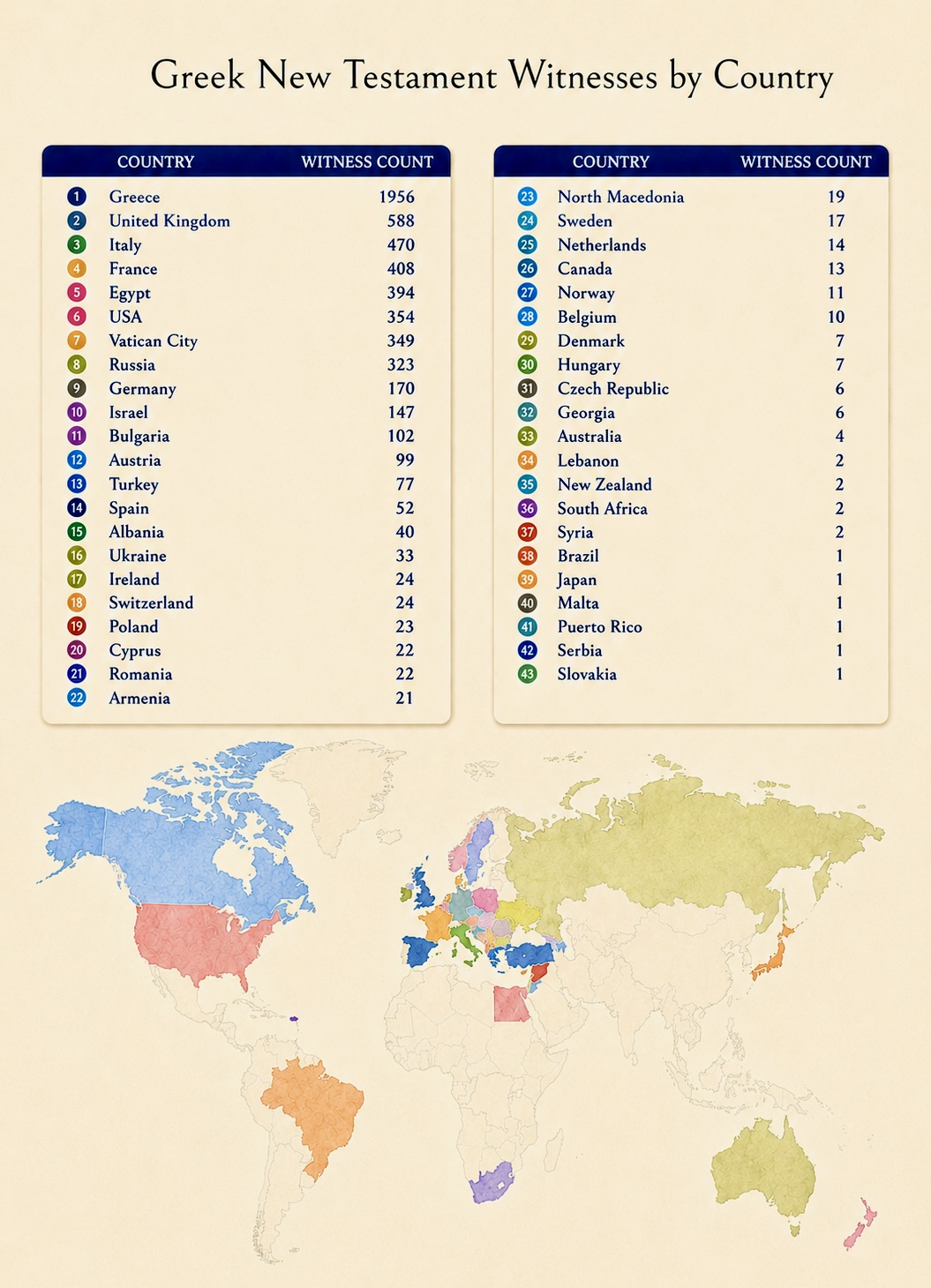
CSNTM’s work also changed Albania’s place on the global map of Greek New Testament manuscripts. Albania now ranks fifteenth worldwide for the number of Greek New Testament witnesses preserved within its borders—a striking position for a collection that, only a generation ago, remained among the least accessible and least studied in the world.
Digitization Status
Before 2007, GA 043 alone was available on microfilm; the rest of the Albanian corpus had no photographic reproductions of any kind. That limitation had not only left its mark on the Liste, but also directly affected the wider use of Albanian manuscripts in textual criticism. For example, when Text und Textwert for the Synoptic Gospels was undertaken in preparation for the ECM, only GA 043 could be included; without images of the rest of the Albanian corpus, the systematic comparison required for such studies was not possible.
CSNTM altered this situation substantially. The team digitized all 40 Greek New Testament manuscripts in Albania, producing more than 60,000 high-resolution images. As a result, Albania is now one of the rarer cases in which the entire known Greek New Testament manuscript inventory of a country has been fully digitized.
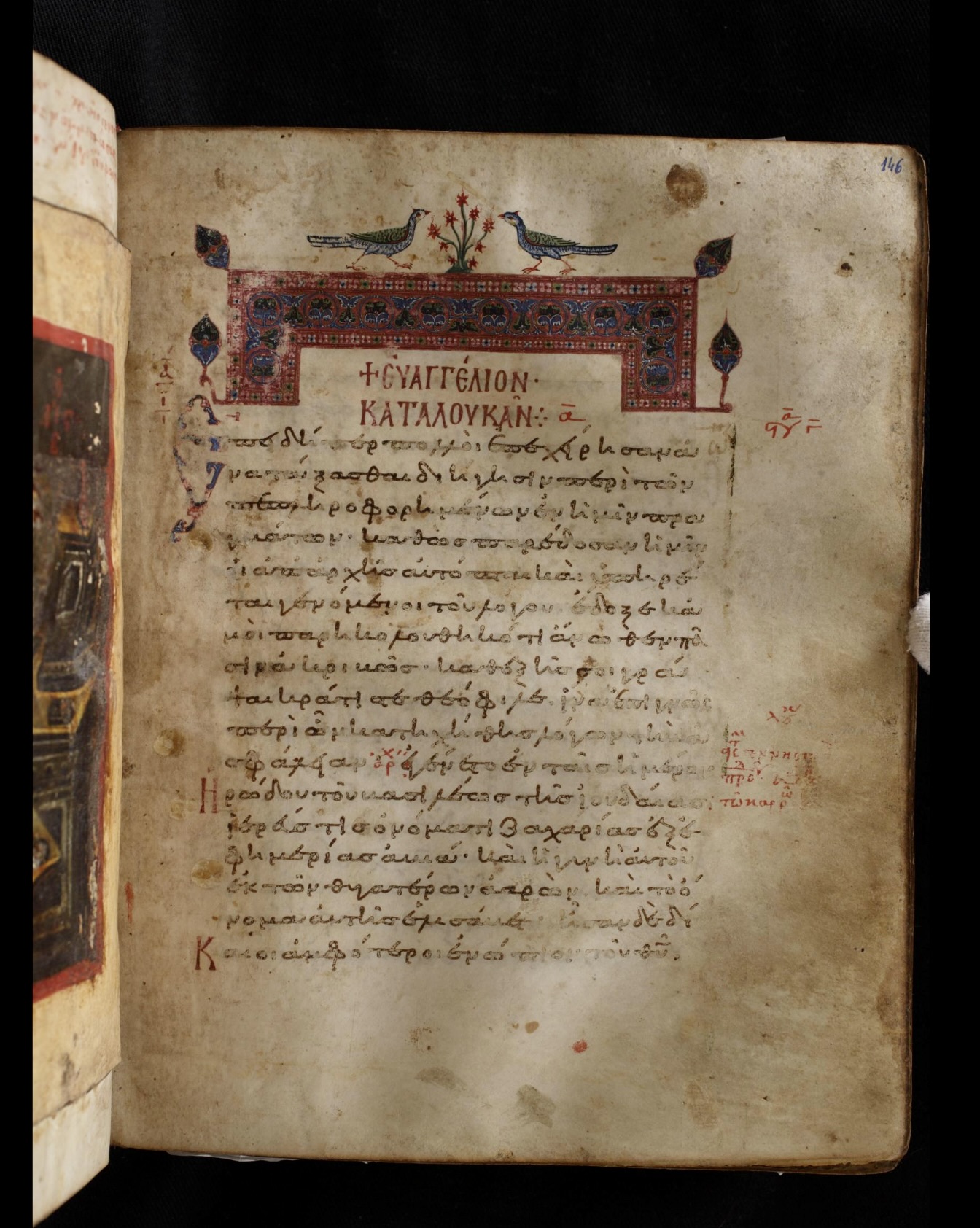
Here is a small sample of some of the manuscripts available in the Albania collection.




The chart below displays the full inventory of Greek New Testament manuscripts in Albania, with links to each item in CSNTM’s digital collection. Although CSNTM’s images are usually freely accessible to the public, in this case the Central Archive in Tirana has stipulated more restricted access. Those who wish to study them may do so by creating an account and requesting access as a registered researcher.23
| GA | Contents | Date | Shelf Number | Digital Images |
|---|---|---|---|---|
| Φ 043 | e:MtMk | VI | ANA 01 | View |
| 1141 | e | XI | ANA 04 | View |
| 1143 | e | IX | ANA 02 | View |
| 1705 | e | ca. 1400 | ANA 38 | View |
| 1707 | eK:J | XIV | ANA 12 | View |
| 1709 | e:J | XII | ANA 19 | View |
| 1764 | aK:Act | XII | ANA 17 | View |
| 2244 | e | XI/XII | ANA 15 | View |
| 2245 | e | XIV | ANA 29 | View |
| 2246 | e | XI | ANA 26 | View |
| 2247 | e | 1312 | ANA 35 | View |
| 2252 | e | XII | ANA 05 | View |
| 2253 | e | XII/XIII | ANA 10 | View |
| 2514 | e | XII | ANA 79 | View |
| 2900 | e | XIV | ANA 85 | View |
| 2901 | e | X | ANA 92 | View |
| 2902 | e | X | ANA 93 | View |
| 2903 | ap | XII/XIII | ANA 98 | View |
| 2908 | e:MtJ | XIV | ANA Frag. 7 | View |
| 2912 | e | XIV/XV | ANA 76 | View |
| 2913 | e | XIV | ANA Frag. 12 | View |
| ℓ1204 | ℓ | 1043 | ANA 06 | View |
| ℓ1207 | ℓ | 1181 | ANA 21 | View |
| ℓ1433 | ℓ | XII/XIII | ANA 22 | View |
| ℓ1434 | ℓ | XIV | ANA 09 | View |
| ℓ2353 | ℓ | XII | ANA 19 | View |
| ℓ2372 | U-ℓ | VIII/IX | ANA 03 | View |
| ℓ2439 | ℓe | XI | ANA 07 | View |
| ℓ2440 | ℓesk | XII | ANA 11 | View |
| ℓ2441 | ℓe | XIII | ANA 13 | View |
| ℓ2442 | ℓ | XIII | ANA 16 | View |
| ℓ2443 | ℓesk | XV | ANA 77 | View |
| ℓ2444 | ℓsk | XIII | ANA 88 | View |
| ℓ2445 | ℓ | XIV | ANA 89 | View |
| ℓ2447 | ℓesk | XI/XIV | ANA 08 | View |
| ℓ2448 | ℓe | XIV | ANA 36 | View |
| ℓ2449 | ℓe | XIII | ANA 24 | View |
| ℓ2454 | ℓ | XIV | ANA Frag. 16 | View |
| ℓ2455 | ℓe | XIII | ANA Frag. 2 | View |
| ℓ2456 | ℓ | XIV | ANA Frag. 5 | View |
Conclusion: The Tenacity of Fragile Witnesses
This story elucidates how profoundly a country’s history can shape the manuscript evidence itself. What we know depends not only on what was copied, but also on what has been preserved. While this is true of all manuscript collections, Albania offers an especially salient example.
That larger story is embodied most clearly in the two purple codices of Berat. Hidden from invaders, lost to scholarship, concealed beneath a church in damp conditions, restored in Maoist China, and now recognized by UNESCO as part of the Memory of the World register, these codices are among the most remarkable Byzantine manuscripts preserved today. Their survival is as extraordinary as their beauty.
The history of Beratinus 1 and Beratinus 2 mirrors the wider history of the Albanian manuscripts in vivid form, witnessing to the tenacious survival of these artifacts amid the vicissitudes of Albania’s history. Their story gathers into a single arc the forces that transformed the landscape of Albania’s Greek New Testament manuscripts: political isolation, one of the most aggressive anti-religious campaigns in modern Europe, rediscovery, conservation, and international collaboration. Survival depended, time and again, on acts of preservation from sheltering and hiding to cataloguing and digitization. These manuscripts therefore bear witness not only to the text of the New Testament, but also to the enduring resolve of those, past and present, who labored against extraordinary odds so that these fragile witnesses would not be lost.
- Two important publications of his include Anthimos Alexoudes, Σύντομος Ἱστορικὴ Περιγραφὴ τῆς Ἱερᾶς Μητροπόλεως Βελεγράδων (Corfu, 1868), 113–15; and “Κατάλογος τῶν ἐν ταῖς ἱεραῖς ἐκκλησίαις τῆς συνοικίας Κάστρου, πόλεως Βερατίου τῆς Μητροπόλεως Βελεγράδων εὑρισκομένων ἀρχαίων χειρογράφων,” Δελτίον τῆς Ἱστορικῆς καὶ Ἐθνολογικῆς Ἑταιρίας τῆς Ἑλλάδος 5 (1898): 352–69. Alexoudes’s catalogue numbers the Berat manuscripts through 46, though at least one entry appears to duplicate another: Alexoudes no. 15 and no. 44 seem to describe the same physical manuscript, later registered separately as GA 1142 and GA 1710. ↩︎
- I also noticed that another 11th century minuscule, GA 2132, at the National Library of Russia contains supplemental purple folios at the beginning of Luke and John and gold lettering at the beginning of Matthew and Mark. See images here. ↩︎
- Axinia Džurova, Manuscrits grecs enluminés des Archives nationales de Tirana (VIe–XIVe siècles): Études choisies, vol. 1 (Sofia: Centre de Recherches Slavo-Byzantines “Ivan Dujčev,” 2011), 21; Andi Rëmbeci, “Through the Pages of Byzantine Albania: Codices—Text—Art,” Art & trashëgimi 7 (2016): 158–59; Didier Lafleur and Luc Brogly, Greek New Testament Manuscripts from Albania, New Testament Tools, Studies and Documents 57 (Leiden: Brill, 2018), 44–48. ↩︎
- Lafleur and Brogly, Greek New Testament Manuscripts, 11–12. Dion Tushi identifies this tradition instead with Beratinus 1 (GA 043) see “The Greek Biblical Manuscripts in Albania: The Purple Codex of Berat and the Golden Codex of Anthimos,” ANGLISTICUM 2, no. 3 (June 2013): 165. ↩︎
- Pierre Batiffol, “Evangeliorum codex graecus purpureus Beratinus Φ,” Mélanges d’archéologie et d’histoire 5 (1885): 358–76, pl. XVI; and “Les manuscrits grecs de Bérat d’Albanie et le codex Purpureus Φ,” Archives des missions scientifiques et littéraires, 3rd ser. vol. 13 (1887): 437–556. For an intriguing but unverifiable report that Batiffol mentioned manuscripts he had not personally examined, including a codex allegedly from the first century once preserved in Gjirokastër and another allegedly from the fourth century, see Shaban Sinani, Kodikët e Shqipërisë (Tiranë: Drejtoria e Përgjithshme e Arkivave, 2003), 14. ↩︎
- Hermann von Soden, Die Schriften des Neuen Testaments in ihrer ältesten erreichbaren Textgestalt hergestellt auf Grund ihrer Textgeschichte(Göttingen: Vandenhoeck und Ruprecht, 1902–1913); Caspar René Gregory, Die griechischen Handschriften des Neuen Testaments (Leipzig: J. C. Hinrichs, 1908), which later laid the foundation for the Gregory-Aland classification system. ↩︎
- Lafleur and Brogly, Greek New Testament Manuscripts, 1. ↩︎
- This account is found in Lafleur and Brogly as well as an English translation of the official Albanian State Archives’ account of the rediscovery of Beratinus 1 and 2 and their restoration in China, including how they were shipped to China and return to Albania; see Greek New Testament Manuscripts, 140–49. For Koder’s brief account, see Johannes Koder, “Zur Wiederentdeckung zweier Codices Beratini,” Byzantinische Zeitschrift 65, no. 2 (1972): 327–28. ↩︎
- Lafleur and Brogly, Greek New Testament Manuscripts, 2. ↩︎
- Johannes Koder and Erich Trapp, “Katalog der griechischen Handschriften im Staatsarchiv zu Tirana,” Jahrbuch der Österreichischen Byzantinistik 17 (1968): 197–214. ↩︎
- This position was later reflected in Article 37 of the 1976 constitution which declared that the state recognized no religion and promoted atheistic propaganda. See Endri Haxhiademi and Fatmir Mehdiu, “Importing Religion into Post-Communist Albania: Between Rights and Obligations,” Religions 14, no. 5, 658 (2023). Some scholars note that earlier communist regimes, especially the Soviet Union, had already functioned as de facto atheist states; the Albanian claim concerns its explicit self-definition and constitutional program of state atheism. ↩︎
- Rëmbeci, “Through the Pages,” 159. This period should not be understood as a neutral preservation program, but as a coercive secularizing project that removed manuscripts from ecclesiastical custody and reframed them as state-controlled heritage. Paradoxically, this period was riddled with destruction and preservation: while the anti-religious campaign devastated Albania’s churches and led to the destruction and disappearance of many manuscripts, the policy of forced centralization also helped preserve some codices that might otherwise have been lost. ↩︎
- Lafleur and Brogly, Greek New Testament Manuscripts from Albania, 67–68; Koder, “Zur Wiederentdeckung,” 327–28. ↩︎
- Tushi, “The Greek Biblical Manuscripts in Albania,” 161; UNESCO Memory of the World nomination dossier, “Codex Purpureus Beratinus and Codex Aureus Anthimi,” 6-7. ↩︎
- Lafleur and Brogly, Greek New Testament Manuscripts from Albania, 141–42. ↩︎
- Rëmbeci, “Through the Pages,” 149. ↩︎
- These were: 043, 1141, 1142, 1143, 1705, 1706, 1707, 1708, 1709, 1710, 1711, 1764, 2244, 2245, 2246, 2247, 2252, 2253, 2514 L758, L882, L1204, L1207, L1208, L1209, L1433, L1434, L1791, L2353, and L2372. ↩︎
- Shaban Sinani, Kodikët e Shqipërisë (Tiranë: Drejtoria e Përgjithshme e Arkivave, 2003). ↩︎
- These are GA 2900, 2901, 2902, 2903, 2908, 2912, 2913, ℓ2439, ℓ2440, ℓ2441, ℓ2442, ℓ2443, ℓ2444, ℓ2445, ℓ2447, ℓ2448, ℓ2449, ℓ2454, ℓ2455, and ℓ2456. ↩︎
- ℓ882 had been listed as “Berat, Metropolitan Library, Batiffol 7,” while ℓ1209 had been listed as “Berat, Metropolitan Library, Alexoudes 48.” Later scholars have suggested possible identifications for both, but the evidence is too thin to verify them. ↩︎
- The most intriguing unresolved case is ℓ758, which may be identical with ℓ2441, though the evidence remains inconsistent. According to CSNTM, the dimensions for ℓ2441, are 250 x 185mm, so 100 mm smaller than ℓ758. Earlier descriptions give conflicting dimensions for ℓ758: Alexoudes recorded 350 × 285 mm, Popa 350 × 377 mm, and Džurova 355 × 275 mm. Lafleur and Brogly appear to treat ℓ758 and ℓ2441 as the same manuscript, but without resolving these discrepancies. For now, whether ℓ758 is indeed the same manuscript as ℓ2441 remains an unsolved mystery. ↩︎
- Lafleur and Brogly, Greek New Testament Manuscripts from Albania, New Testament Tools, Studies and Documents, Volume 57 (Leiden: Brill, 2018). Axinia Džurova, Manuscrits grecs enluminés des Archives nationales de Tirana (VIe–XIVe siècles): Études choisies, 2 vols., Scriptorium Balcanicum 1 (Sofia: Centre de Recherches Slavo-Byzantines “Ivan Dujčev,” 2011). ↩︎
- Access is available at no cost. Users should create a CSNTM account and then email manuscripts@csntm.org with their username to request “Registered Researcher” access. Once approved, the images may be viewed on CSNTM’s website. This process will soon be fully automated. ↩︎
Dear Katie, what a fascinating thriller from Albania, which you describe so vividly: an amazing take-off for the journey on which you announced to take us – through the wide world of NT manuscripts with phantastic pictures! All of it makes me very eager and curious about your next stop! Thank you!!
Dear Katie Leggett, what a wonderful article, congratulations! Things have come a long way since I looked in vain for Batiffol 7 (l 882) in the library at Tirana but, fortunately for me, you did not find it either (it would have meant a lot of extra work for me).
With my very best wishes for your future work,
Sysse Engberg
Dear Sysse, thank you very much for your kind words. How interesting that you were in Tirana. Best Wishes to you,