

This post launches a new series exploring how the landscape of Greek New Testament witnesses has changed over the past thirty years. The Kurzgefasste Liste—the catalogue of all known surviving Greek New Testament manuscripts—is foundational for virtually all scholarly work on the Greek New Testament textual tradition. Drawing on my editorial work on the forthcoming third edition of the Liste, this series will highlight some of the most important developments since the publication of the second edition in 1994. For a broader account of the history of cataloguing Greek New Testament manuscripts, including the earlier catalogues that preceded the Liste, see our post here.
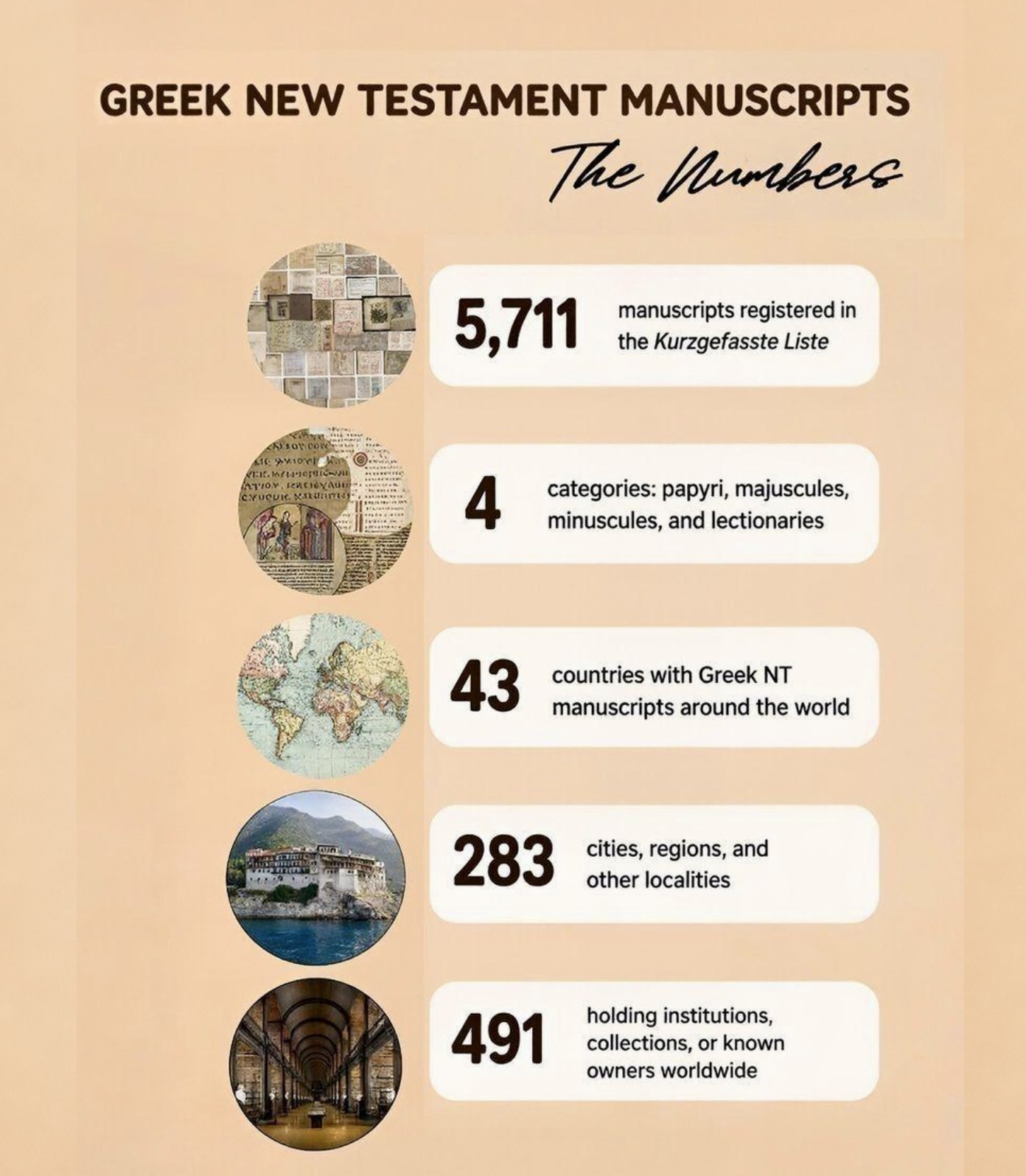
There are currently 5,711 surviving Greek New Testament witnesses dispersed across four broad categories.

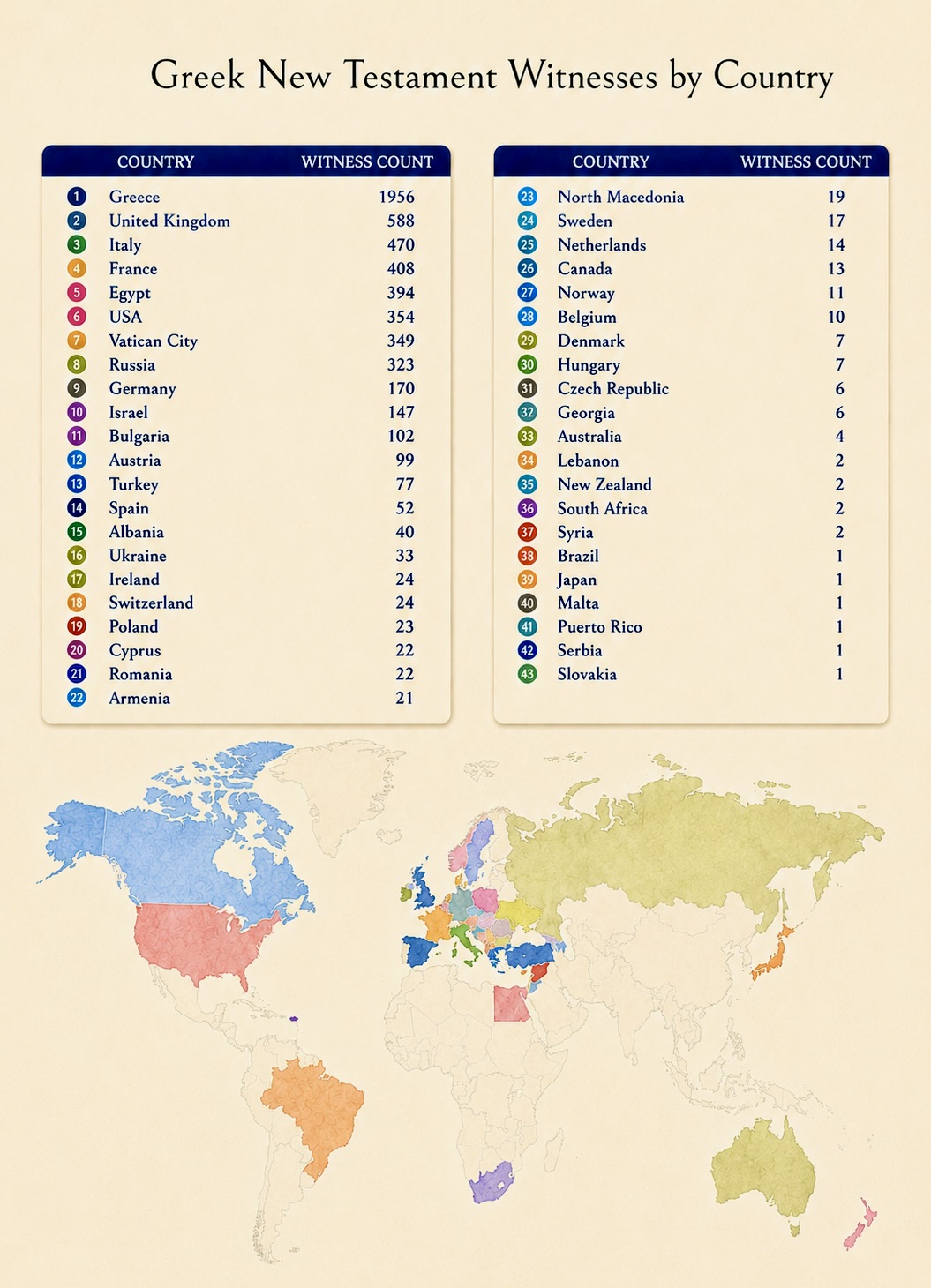
These manuscripts are distributed across 43 countries on six continents.1 Most are concentrated in Europe, with Greece alone preserving about one-third of all registered manuscripts worldwide, followed by the United Kingdom, Italy, and France. Outside Europe, Egypt and then the United States hold the largest number of registered manuscripts. The list below shows how widely some individual witnesses have traveled, residing not only in well-known locations but also in countries less often associated with Greek New Testament manuscripts, such as Japan, Brazil, Australia, New Zealand, and South Africa.
These 5,711 manuscripts are scattered across an extraordinarily wide constellation of repositories and owners including libraries, monasteries, museums, universities, archives, ecclesiastical collections, private collections and individuals. In the NTVMR, they are recorded under 283 distinct “places,” a category that includes not only major cities but also regions, islands, villages, towns, municipalities, and monastic areas. Under the category “Institute” in the NTVMR, we find 491 unique holding institutions or owners worldwide, ranging from major libraries and museums to churches, monasteries, private collections, and individuals.
The following infographic helps visualize these figures at a glance.
Behind these numbers lies a much more complicated story. Over the past thirty years, the landscape of Greek New Testament manuscripts has been transformed by major digitization projects, increased access to previously obscure or inaccessible collections, and the growing availability of scholarly publications, catalogues, and databases. Greater international collaboration through email, social media, scholarly blogs, and online communities has also brought new information to light. As a result, hundreds of previously unknown manuscripts and fragments have been added to the Liste.
Many of these updates are already reflected in the online Liste, but the scope and reasoning behind these revisions are not always clear. Which manuscripts or collections have been updated, and on what grounds? This series seeks to make those changes more transparent by reconstructing the often complicated history behind the present inventory, describing what has changed, which questions are unresolved, and where important work remains to be done.
Each post will trace how the known inventory of Greek New Testament manuscripts in a particular country or region has evolved over time. It will survey the history of cataloguing in that area and highlight notable developments: manuscripts once thought lost that have resurfaced, others whose present location remains unknown, uncatalogued materials added to the Liste, entries removed for various reasons, and collections dispersed, consolidated, or transferred. The series will also summarize the imaging status within each country or region, noting which collections are available on microfilm, which have been digitized, and which have no known images.
Taken together, I hope these posts will help readers see how profoundly the landscape of Greek New Testament witnesses has been reshaped since the publication of the second edition of the Liste in 1994. I hope you’ll join me for the first post in this series, which begins with a country whose manuscript inventory has nearly doubled in size since that edition—one of the most dramatic changes reflected in the current Liste.
- Two NTVMR “country” entries require qualification: Vatican City is a sovereign city-state, while Puerto Rico is a U.S. territory with its own distinct identity, not an independent sovereign state. ↩︎
Thanks for taking us on such an adventurous journey, dear Katie – I am looking forward to staying aboard and being shown the rich landscape of NT manuscripts traveling around the world!
Very important and very difficult-to-obtain information. Magnificent work! Thank you so much for not delaying it until the publication of a specialized article!
Excelente trabalho, irá ajudar mais na pesquisa acadêmica e principalmente uma ajuda na pesquisa da Crítica Textual.
Thank you for this series, making the cataloguing history more transparent is genuinely valuable work.
I’ve been building a small study tool that cross-references the Liste against localization and physical identity data, and your 5,711 figure prompted me to document my own counting methodology carefully.
Starting from 5,867 canonical GA records in my dataset (which includes auxiliary categories like amulets and ostraca), I filter down to 5,761 entries currently visible in the Liste, this is the closest equivalent to your classical four-category count. Restricting further to entries that are localized and not recorded as destroyed gives 5,594. Within those, I identified 59 multi-number groupings where several GA numbers refer to the same physical manuscript, producing 96 redundant records. That yields 5,594 − 96 = 5,498 physically unique artefacts.
So the relationship between the numbers is approximately:
5,711 (INTF classical count, four categories, your figure)
5,761 (Liste-visible records in my dataset, closest match to yours)
5,498 (my estimate of physically distinct artefacts, after deduplication)
The gap between 5,761 and 5,711 likely reflects minor differences in how auxiliary or borderline entries are handled between the dataset and the INTF’s own tallying. The further reduction to 5,498 is purely about physical identity, not about questioning any entry’s validity.
Happy to be corrected!