

For more than a millennium, daily prayers have been offered on Mount Athos. Described as “the spiritual heart of Orthodoxy,” this secluded peninsula in northeastern Greece is regarded by many as one of the most sacred places on earth.1 Few sites have been more significant in the history of the Greek New Testament manuscript tradition. Biblical manuscripts have long been woven into the liturgical, intellectual, and communal life of its monasteries. Today, more than 18% of all known Greek New Testament manuscripts are held on Mount Athos.
This post continues a series that considers these manuscripts as critical texts—not only as invaluable witnesses to the NT text, but also as material artifacts that have been shaped by the people, places, institutions, and technologies involved in their transmission and preservation. Within this broader framework, I focus particularly on changes in the manuscript landscape since the publication of the 2nd Kurzgefasste Liste in 1994, drawing on my years of work revising the Liste for publication.
The previous post focused on Albania: a relatively small corpus of 40 manuscripts with a fascinating history, now transformed by extensive cataloging and digitization. Mount Athos presents a striking contrast. Although the Athonite peninsula is only a little over 1% of the geographic size of Albania, it preserves nearly 26 times as many registered NT witnesses.
A corpus of this scale cannot be treated adequately in a single blog post. What follows, then, is just a beginning: an attempt to sketch the major contours of the Athonite manuscript landscape and recover something of the human history behind it—how these manuscripts were copied and survived, how some were lost or dispersed, and how generations of scholars came to identify, photograph, catalog, and examine them.
A Manuscript World Apart
Roughly 2,000 monks live on Mount Athos, following rhythms of worship, work, fasting, and hospitality inherited from Byzantium. For a pilgrim arriving on Athos, even the hour and date may differ from those outside the peninsula.

Many monasteries still keep Byzantine time, in which the new day begins at sunset rather than midnight. Because sunset shifts with the seasons, clocks are adjusted throughout the year, so midnight falls at a different civil hour in summer than in winter. For worship and feast days, the monks follow the Julian rather than the Gregorian calendar used for civil life in Greece; the two are currently 13 days apart. Monastic life follows the same liturgical rhythm: bells mark the hours, services often begin before dawn, the first meal follows the morning liturgy, and the monks retire after the evening offices. Eating and sleeping are arranged around worship rather than fixed hours. On Athos, time is not simply counted; it is experienced through the daily rhythm of prayer.

The intensity and continuity of Athonite monastic life created a sustained need for books. Manuscripts served churches, chapels, refectories, and individual monks, while monastic communities copied, acquired, and preserved them over generations. Robert Allison’s study of Philotheou Monastery shows how such collections took shape in practice. He argues that much of the collection developed in response to the practical needs of the monastery itself: some books were produced locally, while others were deliberately acquired for use by the community.2 Scribal activity is also documented at major monasteries such as the Great Lavra, Iviron, and Vatopedi.3 The holdings that survive today are therefore the cumulative result of centuries of production, circulation, acquisition, use, repair, and preservation.
Entry to the Holy Mountain is carefully limited. Male pilgrims must obtain a special permit, the diamonitirion, to stay as guests of the monasteries. Under the longstanding avaton, women are not permitted to enter, a restriction bound up with Athos’s identity as a celibate monastic community.4
Yet the same seclusion that has preserved the distinctive life of Athos has also shaped scholarly access to its manuscripts. Athos is first and foremost a living monastic community devoted to prayer and daily work, not a museum or public research library. Access to the collections has therefore remained carefully regulated, shaping not only who can consult the manuscripts but also what can be cataloged, photographed, and studied. Although the broad contours of this remarkable concentration of New Testament manuscripts have been mapped, much remains unknown—and still more remains to be discovered.
The Athos New Testament Inventory
The Liste in the NTVMR currently records 1,037 Greek New Testament witnesses5 across 25 locations on Mount Athos: 20 monasteries, 4 sketes, and the Protaton (main church) at Karyes. These holdings are heavily concentrated in a few repositories. Great Lavra accounts for 260 witnesses and Vatopedi for 193; together, these two monasteries hold nearly 44% of all registered Greek NT witnesses on Athos.
| Location | Majuscules | Minuscules | Lectionaries | Total |
|---|---|---|---|---|
| Great Lavra | 4 | 173 | 83 | 260 |
| Vatopedi | 2 | 135 | 56 | 193 |
| Iviron | 0 | 71 | 30 | 101 |
| St. Panteleimon | 1 | 38 | 50 | 89 |
| Dionysiou | 2 | 48 | 31 | 81 |
| Koutloumousiou | 0 | 31 | 27 | 58 |
| Docheiariou | 0 | 26 | 15 | 41 |
| Philotheou | 0 | 23 | 9 | 32 |
| Esphigmenou | 0 | 16 | 12 | 28 |
| Pantokratoros | 1 | 15 | 7 | 23 |
| Karakallou | 0 | 12 | 9 | 21 |
| Xeropotamou | 0 | 12 | 8 | 20 |
| Stavronikita | 0 | 10 | 7 | 17 |
| Konstamonitou | 0 | 8 | 8 | 16 |
| Protaton (Karyes) | 1 | 3 | 8 | 12 |
| Skete of St. Andrew | 0 | 5 | 6 | 11 |
| Osiou Gregoriou | 0 | 3 | 7 | 10 |
| Agiou Pavlou | 0 | 3 | 2 | 5 |
| Xenophontos | 0 | 0 | 5 | 5 |
| Simonos Petras | 0 | 1 | 3 | 4 |
| Hilandar | 0 | 2 | 2 | 4 |
| Skete of Kavsokalyvia (Lavra) | 0 | 3 | 0 | 3 |
| Zograf | 0 | 2 | 0 | 2 |
| Skete of St. Anne (Lavra) | 0 | 2 | 0 | 2 |
| Skete of Demetrios (Vatopedi) | 0 | 1 | 0 | 1 |
| 11 | 643 | 385 | 1,039 |
Majuscules represent less than 1% of the corpus, while minuscules account for 62% and lectionaries 37%.
These numbers, however, conceal considerable differences among repositories. Great Lavra, Vatopedi, and Iviron together hold 379 minuscules—nearly 60% of all Athonite minuscules. At 8 locations on Athos, lectionaries make up at least half of the New Testament holdings. St. Panteleimon’s 50 lectionaries outnumber its 38 minuscules and constitute the 3rd-largest lectionary collection on Mount Athos. At Xenophontos, all 5 of its registered New Testament witnesses are lectionaries.
Chronological Distribution
The chronological profile is overwhelmingly concentrated in the middle and later Byzantine periods. Of the 1,037 Athonite NT witnesses, 762, or 73.5%, are assigned to the 11th through 14th centuries. Nearly half the entire corpus—484 witnesses, or 46.7%—belongs to the 13th and 14th centuries alone.
| Date | Witnesses |
|---|---|
| 6th century | 1 |
| 7th century | 2 |
| 8th century | 1 |
| 9th century | 24 |
| 10th century | 49 |
| 11th century | 94 |
| 12th century | 184 |
| 13th century | 234 |
| 14th century | 250 |
| 15th century | 75 |
| 16th century | 75 |
| 17th century | 38 |
| 18th century | 9 |
| 19th century | 1 |
| Total | 1,037 |
The number of witnesses rises steadily from the 9th century to a peak of 250 in the 14th, while the chronological midpoint of the corpus falls in the 13th century. This concentration in the 11th through 14th centuries, followed by decline, broadly reflects the surviving Greek NT manuscript tradition as a whole. On Athos, however, the decline is especially sharp: the total falls by 70 percent, from 250 witnesses in the 14th century to 75 in the 15th, and remains at 75 in the 16th. This may partly reflect the difficult conditions of the 15th century, when Ottoman rule, the loss of land and income, and the disappearance of older sources of patronage left the monasteries with fewer monks and fewer resources for copying and acquiring manuscripts. Printed books were entering Athonite collections by the 16th century, but manuscript copying continued alongside them well into the post-Byzantine period, particularly for liturgical, ascetic, and hagiographical texts.6
According to the dates assigned in the Liste, only 4 witnesses on Athos predate the 9th century. The earliest, the 6th-century GA 015, is itself a reminder of how easily older manuscripts could disappear or survive only in fragments. At Great Lavra, the codex was eventually dismantled and its leaves reused as binding material and flyleaves in other manuscripts. At the other end of the chronology stands GA 1775, a commentary on Revelation by Andrew of Caesarea dated to 1847.


Recent discoveries and revisions elucidate how much the Athos manuscript inventory has changed in recent years. To understand why, we need to follow two closely connected histories: the history of the manuscripts themselves—how they survived, were dispersed, and, in some cases, recovered—and the history of how they came to be known more widely through catalogs, photographs, and successive generations of research.
Survival, Loss and Dispersal
For more than 1,000 years, manuscripts on Mount Athos have been shaped by the upheavals of the surrounding world. Their history is not simply one of preservation, but of communities rebuilding after attacks, negotiating with new rulers, replacing worn books, recovering stolen property, and sometimes reclaiming codices that had been carried away.
From the 11th century onwards, in response to rising attacks by pirates, the Athonite monasteries were increasingly fortified, taking on the character of fortresses protected by high walls and towers. Similar defenses were constructed at the monasteries’ landing points, which were vital to the movement of people and goods.7 The clearest evidence that such raids endangered libraries as well as communities comes from Esphigmenou Monastery. A note in Esphigmenou codex 14 records two raids in 1533 by “Agarene pirates” during which monks were abducted, and the monastery’s books were stolen.8

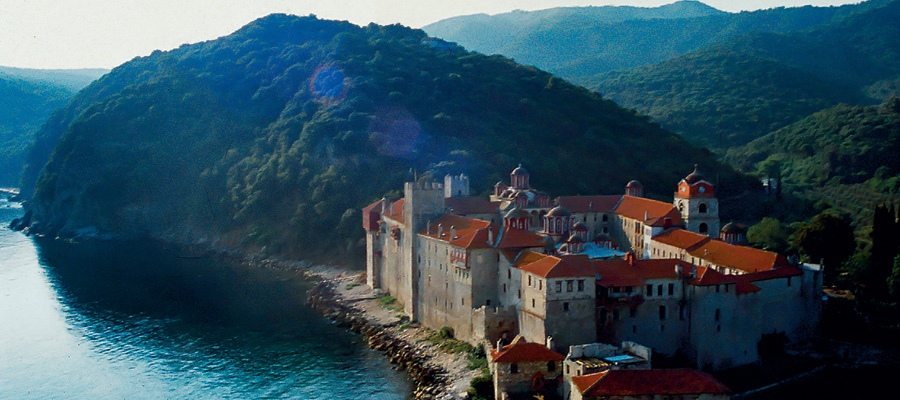
Maritime raiding was only one form of external danger. After the Crusaders captured Constantinople in 1204, Athos came under Latin rule, and its Orthodox monasteries had to defend their lands, revenues, and privileges within the new Latin political and ecclesiastical order. A century later, between 1307 and 1309, the Catalan Company—a mobile army of mercenaries that had turned against its former Byzantine employers—plundered monasteries and their estates in Macedonia and on Athos.9

Under Ottoman rule, the nature of the pressure was often financial rather than immediately military. Sultan Selim II’s confiscation of monastic property in 1568 forced the monasteries to pay to recover or secure their holdings. The stationing of Ottoman troops on Athos after the Greek Revolution of 1821 imposed further costs, interrupted estate revenues, and drove many monks away.10
Even when manuscripts were not seized directly, the loss of property, income, and personnel placed the libraries themselves at risk: without stability, books could no longer be produced, repaired, preserved, or recovered once lost.

Financial hardship could also lead monasteries themselves to part with manuscripts. As Zisis Melissakis has shown, they could serve as financial assets, generating income or helping to meet exceptional expenses. In 1837, Robert Curzon acquired manuscripts from Karakallou, which needed funds to repair buildings damaged during the Greek War of Independence. The same year, at Xenophontos, Curzon says that after 5 hours of bargaining he paid the equivalent of £22 for the cruciform Gospel lectionary now known as ℓ233, while another Gospel manuscript, GA 549, was “thrown into the bargain.” According to his custodial note, ℓ233 had previously belonged to Pantokratoros, where it was displayed on feast days alongside saints’ relics before being transferred to Xenophontos during the war.11

Another example is GA 1049, formerly Koutloumousiou MS 70. Tommy Wasserman notes that Koutloumousiou apparently sold a number of manuscripts in the early 20th century “in order to secure their finances.”12 It was eventually donated to the Nationalmuseum in Stockholm, where it remains today. Its history shows how financial pressures could lead monastic communities to part with books from their libraries. Nor was this an isolated phenomenon: manuscripts left Athonite collections through sale at different points in their history.

Other manuscripts were lost through sudden disaster and gradual decay. Fire was a recurrent danger within monastic complexes and could destroy a collection in a matter of hours. In 1880, Lambros recorded at least 245 manuscripts in the library of Simonos Petras. Just 11 years later, on May 28, 1891, a fire that began in the monastery bakery reached the library, destroying all its manuscripts and printed books. A similar disaster struck the Skete of St. Andrew in July 1958, when a fire destroyed a large part of its manuscript collection. Eleven cataloged Greek New Testament witnesses have subsequently been recorded in the Liste as destroyed in the fire, (although the status of some of these manuscripts is still uncertain). Earthquakes posed another threat: major tremors in 1905 and 1932 damaged buildings throughout the peninsula. Less dramatic but no less persistent was the damage caused by damp, mold, insects, rodents, and corrosive ink, all of which took their toll on codices over time.13
The 19th century saw a more organized and sustained threat as European demand for Greek manuscripts intensified. Western scholars and collectors had sought such books for centuries, but the search was now better financed, more competitive, and closely connected to the growth of classical philology and New Testament textual criticism. Governments and major libraries sponsored expeditions to eastern monasteries as Greek manuscripts became coveted commodities. Athos consequently attracted government agents, private collectors, scholars, and dealers, each approaching its artifacts with different purposes and assumptions about ownership. Books left the Holy Mountain through gifts, purchases, exchanges, disputed agreements, and outright theft—categories that the surviving evidence does not always allow us to distinguish clearly.14

Few figures illustrate this ambiguous world better than Konstantinos Simonides (ca. 1820–1890), a Greek manuscript dealer, scholar, and one of the 19th century’s most notorious forgers. He exploited a belief already widespread in Europe: that eastern monasteries like Athos concealed ancient texts unknown to Western scholarship.
As Tommy Wasserman and Malcolm Choat demonstrate, Athos was particularly useful to him because its manuscript collections remained imperfectly known to Western scholars and could lend plausibility to claims that were difficult to verify. They recount how, from the 1840s onward, Simonides constructed fictitious provenance stories in which manuscripts had supposedly been discovered on Athos by his Uncle Benedict. Some of the manuscripts he handled really were from Athos, which made his fabrications more convincing. 15
His audacity went further still. In 1861 he published Codex Mayerianus, a forgery he had fabricated and passed off as a first-century papyrus containing a purported autograph text of Matthew—before any genuine New Testament papyrus had yet been published.16

He claimed that other scholars “know nothing of the royal libraries in Mount Athos,” presenting himself as the possessor of evidence unavailable to his rivals.17 On March 11, 1853, Frederick Madden rejected 5 scrolls offered by Simonides as forgeries. The following day, Simonides returned with genuine codices that the British Museum later purchased, including 6 Greek New Testament witnesses: GA 502, 503, 640, 644, 1268, and ℓ1053.18 For Simonides, then, Athos was not merely a place from which manuscripts could be obtained; it was also a source of credibility—a remote and largely inaccessible setting that could be used to authenticate manuscripts, including those he had fabricated.
Simonides was not the only 19th-century collector to remove manuscripts from the Holy Mountain. Porphyrius Uspensky (1804–1885), an accomplished Russian paleographer and major manuscript collector, acquired hundreds of manuscripts and fragments during his travels through Athos, Jerusalem, and Sinai. The consequences of his collecting remain visible in the numbering of the Liste. Fragments he took from Athos to St. Petersburg were initially assigned separate GA numbers, but later recognized as leaves belonging to manuscripts already cataloged on Athos. Their numbers were consequently withdrawn, producing the conspicuous gap in the Liste between GA 2152 and 2172.
Porphyrius also brought to Russia a leaf of 6th-century GA 015, which recently made headlines when Garrick Allen announced that multispectral imaging had recovered the text of 42 lost pages from faint impressions preserved on the surviving leaves.19
The consequences of this 19th-century hunt for manuscripts remain visible today, as codices from Athos—and, in many cases, individual leaves from dismembered manuscripts—are now scattered among libraries and collections in London, Paris, St. Petersburg, and elsewhere. Much of this dispersal took place before scholars systematically recorded when, how, or under what circumstances manuscripts left Athos. Yet traces of these histories remain legible in the Liste: divided codices appear under multiple shelfmarks, while withdrawn numbers and revised entries record later attempts to identify and reunite scattered fragments.
Mount Athos during German Occupation
The Nazi German invasion and occupation of Greece in April 1941 brought new dangers and uncertainties to Mount Athos and its manuscripts. The peninsula fell within the German-controlled zone of northern Greece. Amid fears that Bulgarian authorities might be granted jurisdiction over Athos prompted representatives of the 20 ruling monasteries to appeal directly to Hitler as their protector. They asked him “to take this holy place under [his] high personal protection and care” and “to take the place of the Byzantine emperors and their successors,” whom the petition described as the founders and benefactors of Athos.20

Later accounts sometimes claim that Hitler formally accepted the title of protector of Mount Athos, but the surviving records show otherwise. In October 1941, he decided that Athos would receive no special protectorate or new legal status but would remain under the ordinary arrangements of military occupation.21
For the manuscripts, the more consequential development was the access that occupation gave to German scholars and officials. From July 2 to 31, 1941, Munich Byzantinist Franz Dölger led an expedition to 17 monasteries and 1 skete, and his photographer, Karl Kress, oversaw taking roughly 1,900 photographs. The expedition was granted exceptional access to the Tragos, Athos’s earliest surviving charter dating from 972. It was removed from its locked chest in a ceremony attended by representatives of all 20 monasteries, photographed for hours, and then formally returned and resealed.22 Here is a short news broadcast in German showing the visit to Athos.

All across occupied Europe, Nazi agencies—including the Einsatzstab Reichsleiter Rosenberg (ERR)—were systematically identifying and seizing libraries, archives, works of art, and other cultural treasures. At Nuremberg, an American prosecutor later summarized the reach of the ERR in chilling terms: “Nothing of value was safe from the grasp of the Einsatzstab.”23 German scholars and officials had meanwhile gained exceptional access to Athos, photographing its cultural artifacts in extraordinary detail. Given the ERR’s ongoing seizures elsewhere in occupied Europe, the possibility of confiscation could not have been dismissed at the time. What was happening elsewhere made that possibility neither remote nor imaginary: representatives of a regime already stripping cultural collections across occupied Europe had been granted extensive access to Athonite libraries.24

I am not aware of any directive ordering the removal of manuscripts from Athos, nor is there evidence that the photographic survey was intended as some kind of catalog for confiscation. But that is knowledge available only in hindsight. At the time, the expedition placed detailed information about the collections in the hands of a regime with the means, the machinery, and a demonstrated willingness to seize cultural property. The confiscation of Athonite treasures therefore remained a serious possibility.

The German expedition’s principal publication, the lavish 1943 volume Mönchsland Athos, reproduced only 183 photographs—a small selection from the nearly 2,000 images taken. One of the images included (fig. 116 in the book) shows the illuminated New Testament then known as Dionysiou 8, subsequently cataloged as Dionysiou 54 and GA 927. Copied in 1133, the manuscript was reported stolen from Dionysiou in 1960, later entered the Ludwig collection, and was acquired by the J. Paul Getty Museum in 1983.25
In 2014, after the theft came to the attention of the Hellenic Ministry of Culture and Sports, the Getty returned the manuscript to Greece. It has since returned to Dionysiou and resumed its former shelfmark, Dionysiou 8. The 1941 photograph captured the manuscript nearly 2 decades before its removal and subsequent movement through the antiquities market.26

The fate of the remaining photographs from the Nazi-era survey of Athos’s cultural treasures is uncertain. American archives are one possible lead: U.S. forces seized photographic negatives and equipment associated with Kress in 1945, although no Athos material has yet been identified among them. In an ironic postscript, the captured Kress was soon put to work by the U.S. Monuments Men photographing recovered looted art.27
The wealth of manuscripts that has survived on Athos is all the more remarkable in light of its tumultuous history—piracy, fires, financial crises, wars, avaricious collectors, theft, and dispersal. The collection bears the marks of those upheavals, but also of generations who preserved these artifacts. Yet survival is only part of the story. Understanding the collection as we know it today requires knowing about a second history: how these manuscripts were cataloged, photographed, and made accessible.
How the Manuscripts Became Known
Spyridon Lambros: Mapping the Athonite Libraries
The 1st large-scale survey of the Greek manuscript collections of Mount Athos was produced by Spyridon Lambros (1851–1919), a historian and paleographer who later served briefly as prime minister of Greece. Lambros regarded manuscripts not simply as containers for texts but as evidence for the broader history of Greek culture.

His extensive 2-volume Catalogue of the Greek Manuscripts on Mount Athos, published in 1895 and 1900, was based on 2 expeditions to Athos and contained 6,618 numbered entries from 18 monasteries and 4 smaller Athonite libraries. Efthymios Litsas later credited Lambros with bringing “worldwide fame to the great treasure stored up on Mount Athos” through his description of its manuscript collections.28 More than a century later, “Lambros numbers” are still the primary reference numbers used in many monasteries on Athos today.
Lambros’s catalog grew out of a carefully prepared expedition undertaken in the summer of 1880, 15 years before his 1st volume appeared in print. He trained two philology students in reading and transcribing manuscripts, and the expedition also included the Swiss artist Émile Gilliéron, who was responsible for documenting Byzantine art and illuminations.29 Government assistance and letters from the Ecumenical Patriarchate and the Athonite authorities gave Lambros’s party rare unrestricted access to the monastic libraries. His account of what he experienced there is vivid and sometimes scathing,30 recounting manuscripts mixed among printed volumes, piled on floors, or stored in chests, drawers, bundles, and cupboards—one so affected by mold that opening it caused those nearby to cough.31
In Lambros’s published volumes, each codex appeared under 2 numbers: a general, Athos-wide number locating it within his survey as a whole, and a monastery-specific or “special” number identifying its place within the local collection. Lambros brought lithographed labels from Athens, attached them to manuscript spines, and entered the catalog numbers on them so that each codex could be located within the new arrangement.32 His team sought to record every textual unit, including brief additions on otherwise blank pages. They noted the writing material, format, number of leaves, date—whether supplied by the manuscript or estimated from the script—and the contents of each codex.
He distinguished relatively straightforward codices containing 1 principal work from composite manuscripts, which he says medieval Greeks called κουβαράδες, a term he glossed as something like “tangles” or “balls of thread.” He criticized catalogs that identified such manuscripts only by their 1st or most prominent text; for collections as remote as those of Athos, he considered an incomplete description practically useless. Lambros subjected palimpsests to particular scrutiny, examining not only Greek manuscripts but also Slavonic and Georgian parchments whose upper text might conceal an erased Greek text.33
After months of painstaking labor undertaken, as Lambros recalled, “by day and by night”—the cataloging team had filled approximately 2,500 handwritten quarto pages with descriptions of manuscripts in 20 collections. Great Lavra and Vatopedi were not included in the 1880 campaign; Lambros attributed their initial omission to the lateness of the season, exhaustion, and the painful condition of the team’s eyes.34
The work behind his catalog was far more thorough than the brevity of the eventual printed entries might suggest. His project to produce a systematic survey of the Greek manuscript holdings of Mount Athos stretched over more than 2 decades, from training his assistants to the appearance of the 2nd volume. Two intensive field campaigns, followed by years of revision and publication, produced a catalog that remains fundamental to the identification and history of Athonite manuscripts.35

The two significant omissions of Vatopedi and Great Lavra were filled about a quarter-century later through the work of three figures: the Athonite monks Arkadios Vatopedinos and Spyridon Lavriotis, and the scholar Sophronios Eustratiades, formerly Metropolitan of Leontopolis. At Vatopedi, Arkadios, the monastery’s librarian, compiled the manuscript catalogue in collaboration with Eustratiades. At Great Lavra, Spyridon, a monk and physician, compiled the catalogue under Eustratiades’s guidance and subsequently sent the completed work to him for revision and preparation for publication. The resulting Catalogue of the Greek Manuscripts in the Library of the Monastery of Vatopedi on Mt. Athos appeared in 1924, followed by the Catalogue of the Greek Manuscripts in the Library of the Laura on Mount Athos in 1925.36

This division of labor made possible the cataloging of 2 collections that Lambros had been unable to include, but it also shaped the character of the resulting works. Arkadios and Spyridon brought the advantage of sustained access to their monasteries’ libraries, while Eustratiades contributed scholarly and editorial expertise and, particularly in the case of Lavra, substantial guidance and revision. The catalogs nevertheless differ markedly from Lambros’s more systematic descriptions and often provide relatively little paleographical and codicological detail. The consequences are particularly evident in the treatment of NT manuscripts.
The page below from their catalog of Vatopedi shows how sparse many of the descriptions are. For example, GA 1540, a Gospel codex of nearly 300 folios, is characterized simply by the words “The four Gospels.”

Thus, while these catalogs were indispensable starting points for identifying the Greek NT manuscripts of Vatopedi and Great Lavra, they must often be supplemented—and corrected—by later scholarship.37
Caspar René Gregory: A Census of the New Testament Manuscripts on Athos
These cataloging efforts made it possible to locate manuscripts by monastery and shelfmark, but they did not isolate NT manuscripts as a distinct corpus. That next step was taken by Caspar René Gregory (1846–1917), whose work would become fundamental to the identification of Greek NT manuscripts. Gregory’s path to that work was not straightforward. Born in Philadelphia in 1846, he left the US in 1873 for Europe intending to study NT textual criticism under Constantin von Tischendorf in Leipzig.
The timing proved unfortunate: Tischendorf suffered a stroke on May 5, 1873, from which he never recovered; Gregory later wrote that he had never even seen him. Gregory nevertheless continued to Leipzig. Although he never had the opportunity to study with Tischendorf, he became closely involved with Tischendorf’s scholarly legacy, eventually taking responsibility for work left unfinished by the older scholar.38

Gregory’s 1st documented fieldwork on Athos in 1886 preceded the publication of Lambros’s catalog; later visits in 1902 and 1906 show that the two projects overlapped chronologically even though they proceeded according to different principles. Where Lambros sought to describe the holdings of each monastery comprehensively, Gregory asked which books transmitted the NT text and how each witness should be identified within the tradition as a whole. Drawing on several visits to Athos, beginning in 1886, he incorporated the manuscripts he examined into his wider census, above all in the 3-volume Textkritik des Neuen Testamentes, published between 1900 and 1909.39
The fieldwork behind that census remains visible in Gregory’s terse annotations: “G. 23 Aug. 1886,” “G. 27 Aug. 1886,” and “G. 29 Aug. 1886.” Read together, such dates trace his movement through the monastic libraries and mark the moments when individual codices entered the precursor of the Kurzgefasste Liste. His descriptions recorded the features necessary to distinguish one NT witness from another—material, dimensions, foliation, columns, lines, biblical contents, lacunae, subscriptions, and selected textual or paratextual details. They were not intended as full codicological profiles. Rather, their purpose was comparative: to make manuscripts held under local shelfmarks intelligible within a census extending across monasteries, libraries, and national collections. The later Liste descended from this achievement.40
Silva and Kirsopp Lake
The work of Silva New Lake and Kirsopp Lake helped make NT manuscripts on Athos accessible as textual and paleographical evidence, first through editions and collations and later through photography and collaborative publications. Kirsopp’s early work following his 1899 visit to Mount Athos resulted in Texts from Mount Athos (1903), which made selected witnesses, including Codex Ψ (GA 044) and GA 1071, available for detailed textual study beyond the monasteries themselves.41
By the 1920s and 1930s, photographic reproductions allowed this work to be increasingly collaborative and created new possibilities for female scholars who were otherwise excluded from Mount Athos. In 1932 Silva New and Kirsopp Lake co-edited Six Collations of New Testament Manuscripts. Among its Athonite material was Codex Ω (GA 045), collated by Mary W. Winslow from photographs, while Silva herself contributed other New Testament collations to the volume.

Silva’s role became still more prominent in Dated Greek Minuscule Manuscripts to the Year 1200. In 1935, publishing under Silva Lake, she and Kirsopp co-edited the third volume, devoted to manuscripts on Mount Athos and in Milan. Their contribution was the creation of a more systematic corpus of photos through which dated manuscripts could be studied far beyond Athos. The project therefore succeeded in expanding not only access to Athos manuscripts, but also the circle of scholars able to study them, allowing female textual critics who could never work with the manuscripts in situ to examine them closely and apply their expertise to the photographic reproductions.42
Ernest W. Saunders and the Library of Congress
The Library of Congress expedition of 1952–1953, undertaken in cooperation with the International Greek New Testament Project (IGNTP), marked a shift from the cataloging projects that preceded it. Directed on Athos by Ernest W. Saunders, its purpose was not to catalog the monastic libraries anew but to photograph biblical manuscripts for NT textual criticism. The original aim was to film some 350 NT manuscripts. What they accomplished was a bit more modest, however. During 6 months of work at 6 monasteries, Saunders and his team photographed 209 Greek and Georgian manuscripts in full, together with selected portions of another 44 containing apocryphal and patristic texts.43
The expedition also belonged to the wider postwar expansion of manuscript photography. As Jennifer Knust has shown, it acquired a fascinating Cold War dimension as well. Alongside his scholarly work, Saunders was asked by the Library of Congress to report on Russian activity in the Athonite monasteries. He later suggested that a stronger American presence on Athos might counter renewed Russian influence. Textual criticism thus intersected, however briefly, with the messiness of Cold War politics and American strategic interests in Greece.44

The work itself was painstaking. Saunders and his Greek assistant, John E. Keshishoglou, divided the daily tasks: Saunders described the manuscripts and deciphered scribal colophons, while Keshishoglou operated the camera and produced the microfilms. At night they developed test strips by kerosene or candlelight before sending the exposed film through Thessaloniki and Athens to Washington. Monastic librarians were indispensable, helping them locate manuscripts and correct earlier descriptions. Although the expedition ended on May 23, 1953, as time and funds were exhausted, Saunders regarded it as a “pilot mission” that paved the way toward a more ambitious photographic project of the Athonite libraries.45
The resulting 1957 Descriptive Checklist organized the films by monastery and supplied the information needed to identify and utilize them. For text critics unable to travel to Athos, the microfilms made it possible to collate readings, inspect corrections, and verify earlier descriptions, bringing a substantial body of manuscript evidence into the wider work of the IGNTP. The films are now available digitally through the Library of Congress.
Recent Cataloging Efforts
Recent cataloging has proceeded unevenly across Mount Athos. Panagiotis Sotiroudis cataloged Iviron MSS 1–100 (1998) and 1387–1568 (2007), only a small portion of a collection with shelf numbers extending beyond 2,100; Erich Lamberz cataloged Vatopedi MSS 1–102 (2006) out of a library of roughly 2,000 manuscripts; Zacharias Xeropotaminos and Sotiroudis published a supplement for Xeropotamou MSS 426–557 (2012); and Sotiroudis cataloged essentially the whole current Greek collection of about 200 manuscripts at Simonos Petras in 2012. These are the main modern published catalogs I am aware of, and, apart from Simonos Petras, they cover only portions of their respective collections. For several other monasteries, modern cataloging remains sparse or absent, leaving researchers dependent on catalogs compiled a century or more ago. As a result, some Athonite witnesses in the Liste could be checked against detailed modern descriptions, while many others still depend on much older information.46
Digital Access and the Mount Athos Repository
A related development has been digital access. The Mount Athos Repository was launched in February 2020 as part of a much larger program to digitize the cultural heritage of the Holy Mountain. It reports approximately 3,300 manuscripts, comprising more than 900,000 digital records.

The value of this new access became apparent almost immediately: in March 2020, Dora Panella identified 7 Greek NT manuscripts (here and here) on the newly launched Repository that had not yet been registered in the Liste. In 2024, I identified 2 more.
Navigating the repository, however, was not always straightforward. In 2022, Annette von Stockhausen offered a practical solution to one of the repository’s main difficulties: shelfmarks could not be searched directly in the original interface. She decoded the numerical monastery identifiers hidden in the Repository’s record titles and then wrote a very helpful Python script to extract the manuscript shelfmarks and URLs into a CSV file that could be searched independently.
Eight of the 20 monasteries—Great Lavra, Iviron, St. Panteleimon, Koutloumousiou, Philotheou, Esphigmenou, Konstamonitou, and Hilandar—were not represented in the Repository at all, nor were any of the 4 sketes. Particularly significant was the absence of Great Lavra, Iviron, and St. Panteleimon, 3 of the 5 largest NT collections on Athos.
Only a small portion of the known Greek NT corpus is currently represented on the repository. In 2024, I systematically checked for known GA numbers and was able to identify only 63 witnesses.
| Monastery / Repository | Total | GA numbers |
|---|---|---|
| Xeropotamou | 1 | 1081 |
| Vatopedi | 3 | 1591, ℓ1689, ℓ2512 |
| Dionysiou | 0 | |
| Agiou Pavlou | 0 | |
| Docheiariou | 7 | 979, 1104, 1105, 1106; ℓ626, ℓ661, ℓ738 |
| Zograf | 3 | 987, 988, ℓ1325 |
| Stavronikita | 17 | 1110, 1111, 1112, 1113, 1114, 1116, 1390, 1864, 2259, 2286; ℓ744, ℓ745, ℓ746, ℓ747, ℓ873, ℓ1054, ℓ2357 |
| Xenophontos | 7 | ℓ709, ℓ710, ℓ711, ℓ712, ℓ713, ℓ1203, ℓ2561 |
| Protaton | 8 | 1097, 2974; ℓ729, ℓ731, ℓ734, ℓ735, ℓ872, ℓ2207 |
| Karakallou | 10 | 1033, 1034, 1037, 1038, 1041, ℓ689, ℓ691, ℓ741, ℓ2516, ℓ2462 |
| Gregoriou | 3 | 923; ℓ619, ℓ2515 |
| Simonos Petras | 3 | ℓ2513, ℓ2514, 3021 |
| Pantokratoros | 1 | 2973 |
| TOTAL | 63 |
While it is certainly possible that I missed some, these 63 witnesses represent only about 6% of the 1,037 witnesses currently registered on Athos. Thus, while the repository marked a substantial step toward wider digital access, its value is currently modest for Greek NT witnesses.
As stated above, however, even this limited window into the collections brought 9 witnesses to light that were not registered in the Liste. What fuller digital access might reveal for our field remains an exciting open question.
Unfortunately, in recent months the repository seems to have stopped working again. It is hoped that access will be restored soon.
Litsas estimated that Mount Athos preserves approximately 15,873 Greek manuscripts. Of these, 12,671 appeared in some form of catalog while about 3,202 remained entirely uncataloged. And even that “cataloged” figure is potentially misleading, since it includes many manuscripts known only through brief, outdated, or otherwise inadequate descriptions. In his calculation, more than 10,000 codices still required cataloging or recataloging according to modern standards. Although he regarded Lambros’s work as generally dependable, his judgment of the Lavra and Vatopedi catalogs was highly critical; their entries often amounted to little more than lists of contents, and he estimated that more than half of the information they supplied was incomplete and, in a number of cases, incorrect.47 As Litsas had put it in an earlier assessment, this enormous body of material “cannot be properly studied until it is fully and satisfactorily catalogued.”48
I hope this survey has made clear that our knowledge of Athos manuscripts rests on successive layers of documentation—catalogs, photographs, microfilms, digital projects, and the work of librarians and scholars. Incomplete or incorrect descriptions can themselves become inherited problems in work on the Liste, so revising the Athos entries has often meant tracing the source of earlier information and checking it against later evidence. The following examples show some of the concrete ways this work has changed the landscape of the Athos inventory.
What Has Changed Since the 1994 Liste?
Additions to the Liste
Since the publication of the 1994 Liste, 67 additional New Testament witnesses on Athos have been registered: 30 minuscules and 37 lectionaries.49 These new additions stem from several collections, especially Vatopedi, Iviron, Great Lavra, and Simonos Petras. Some are previously unregistered witnesses, while others are distinct witnesses within codices already known in 1994.


ℓ2561 at Xenophontos with readings from the Gospel of Mark, image © Athos Repository
As already mentioned, 9 new registrations resulted from discoveries on the Athos Repository. Newer printed catalogs were also very valuable. The monastery of Simonos Petras kindly sent me a copy of its catalog so that its NT holdings could be incorporated into the Liste.50 I found several additional witnesses in Sotiroudis’s 2007 catalog of Iviron, which was supplemented by information from Fr. Theologos, particularly concerning manuscripts in the skeuophylakion.51 Articles such as Stefec’s study of fragments in Vatopedi led to the inclusion of 3 New Testament witnesses.52 Other witnesses were pointed out by scholars working on the material, including Georgi Parpulov, Maxim Venetskov, and Garrick Allen. There are also several dozen manuscripts still waiting to be evaluated for inclusion in the Liste.
Many older entries had to be removed or corrected. One significant area of revision concerns manuscripts formerly classified as lectionaries. In a 2026 article, Georgios Andreou argued that manuscripts under the siglum Lit should not be treated as lectionaries in the strict sense. Although these codices may contain selected NT readings, they are primarily Byzantine liturgical books. Their continued inclusion therefore blurs the distinction between NT witnesses and broader liturgical books. Following Andreou’s proposal, 22 liturgical manuscripts held on Mount Athos have been removed from the Liste.53
Other Athos manuscripts have been removed for different reasons. For example, GA 1027 was removed because it is a commentary manuscript in the form of a Kyriakodromion rather than a continuous New Testament witness. GA 1776, GA 1777, and GA 2664 were removed after they were identified as copies of printed editions. GA 2887 was removed because its text was abridged; GA 2910 was removed because it proved to be an erroneous entry connected with GA 1668 and GA 2909.
Combining and Separating Witnesses
Sometimes two entries needed to be combined; in other cases, a single witness in the Liste had to be separated.
One of the clearest examples involves GA 1016 and GA 1150. Iviron 222, fols. 1–409, and Taphu 466 originally formed a single manuscript. At a later stage, Iviron 222 received a 16th-century supplement, now fols. 410–626. Somehow this supplement was subsequently dropped from the Liste, probably because its contents closely resembled those of the original manuscript, while GA 1150 was combined with GA 1016. The supplement has now been reinstated as GA 1016, while the original codex—Iviron 222, fols. 1–409, together with Taphu 466—has been restored as GA 1150.54
A different problem occurred with GA 1668, GA 2909, and GA 2910, all associated with Panteleimonos 15. GA 1668 consists of fols. 39–221, while GA 2909 designates the supplementary material on fols. 1–38 and 222–317. GA 2910 appears to have been created in error: it had no separate shelfmark and duplicated information connected with the other 2 entries. It has therefore been deleted from the Liste.
GA 2568 has now been combined with GA 2831. The opposite was necessary for Vatopedi 898: fols. 1–211r remain GA 1543, while fols. 211v–237 are now registered separately as GA ℓ2548. At Xenophontos. GA ℓ712 was removed from the Liste because the manuscript is a liturgical book not a lectionary. Within the same codex, however, 3 leaves belonging to a genuine lectionary were identified and registered separately as GA ℓ2561. Thus, although ℓ712 itself was removed, the NT witness contained within it remains represented in the Liste.
Correcting the Status of Manuscripts
Another major task has been correcting information about whether manuscripts still exist and where they are now. At Dionysiou, Fr. Gabriel, the monastery librarian, reported that GA 930 was destroyed by fire in 1960; the NTVMR now records the manuscript as destroyed. At Iviron, GA 1002 was reported as missing both in Sotiroudis’s catalog and by Fr. Theologos.
At Xenophontos, GA ℓ1203 had long been listed as missing and was already reported as untraceable in Fortsetzungsliste VII. Digital images in the Mount Athos Repository, however, confirmed that the manuscript is still in the collection and also allowed its previously unknown folio count to be established.55 Two other Xenophontos manuscripts, GA 1681 and GA 2828, were reported by Aland as not found in the monastery in 1964. Since no present shelfmark can be established for either manuscript, they are now recorded as location unknown.
A particularly striking case is Simonos Petras. The 1st edition of the Liste noted that most of the monastery’s manuscripts had been destroyed in the fire of 1891 and that Gregory had consequently removed them from his list in 1909. The 1994 Liste had no witnesses at Simonos Petras. By the time of Sotiroudis’s 2012 catalog, however, a manuscript collection was again established at the monastery, and the catalog together with the Mount Athos Repository made it possible to register four manuscripts there.
Litsas and the Shelfmarks in the 1994 Liste
A particularly persistent issue concerned the shelfmarks used for the Athos manuscripts. Efthymios Litsas pointed out that, although the 1st edition of the Liste had largely followed the monastery-specific or “special” Lambros numbers, the 1994 edition mixed 4 different systems of identification: (1) the special Lambros numbers for each monastery, (2) Lambros’s general catalog numbers, (3) the monasteries’ own internal numbers, and (4), in some cases, even microfilm numbers from the Patriarchal Institute for Patristic Studies in Thessaloniki. (Xeropotamou Monastery introduced still another sequence, the catalog numbers of Douroundakis.) More seriously, these various numbers were not used consistently from one monastery to another.56
For Litsas, this was not simply a matter of presentation: “All these different numbering systems, which did not exist in the first edition of the Kurzgefasste Liste, cause confusion and misunderstandings, which can also be the source of considerable practical inconvenience.”57 He therefore argued that the special Lambros numbers—the identifiers most familiar to scholars—should serve as the main shelfmark for the Liste.
The problem can be seen clearly at Dionysiou, where the 1994 Liste placed the monastery number before the Lambros number. GA 926, for example, appears on the old microfilm as 7 (41), with Lambros 7 noted 1st and the monastery number 41 coming 2nd. The 1994 Liste, however, recorded it as 41 (7), placing the Lambros number 2nd.

What is unusual is that earlier evidence consistently had Lambros 7 as the main shelfmark. The 1963 edition of the Liste cited GA 926 simply as Dionysiou 7; the manuscript’s library label places 7 before 41, and the old microfilm on the NTVMR likewise records 7 (41). The 1994 Liste reversed this order, giving 41 (7). In the revised Liste entry, Lambros 7 has been restored as the main shelf number and Monastery 41 is the secondary number, placed in parentheses.
Elsewhere the inconsistencies took different forms. At Iviron, the number in parentheses was normally the special Lambros number, but Litsas found several preceding numbers that could not be identified in the catalogs. Philotheou placed Lambros’s general number before the special Lambros number, while Xeropotamou combined the special Lambros number with a number from Douroundakis’s catalog.58

A possible source of the confusion is the way Lambros numbers were described in Library of Congress cataloging records, now accessible online. In many entries they are labeled simply as “old” numbers, which may have encouraged the impression that they were obsolete. GA ℓ627, for example, is listed as Dionysiou 90 alongside “old 1.”
The complexity becomes especially clear at Karakallou Monastery, where successive catalogs had left several different numbers attached to the same manuscripts. GA 1033 offers a particularly revealing example. An early monastery catalog, already in existence when Lambros visited Athos in 1880, assigned it the number 17. Lambros subsequently cataloged it as Karakallou 20, while Ioannes Papagerakes gave it the number 38 in his preliminary catalog of 1958.
Papagerakes reorganized the collection again around 1970, assigning GA 1033 the general monastery number 293, by which the codex is now arranged. He also gave it a taxinomikos number, 35, that identified how it was arranged within the parchment manuscripts. The number 35 appears in the old microfilm documentation—both on Karakallou’s descriptive note and on the microfilm card as “1033 35”—but 293 does not.


This helps explain why the 1994 Liste gave the manuscript as 20 (35). The Lambros number was correct, but a number belonging to Papagerakes’ classification system was reproduced as the secondary shelfmark, while the monastery number 293 was omitted. The revised entry therefore gives Lambros 20 together with Monastery 293.
GA 1034 provides another example of how complex cataloging systems are on Athos. An early monastery catalog assigned the codex the number 18; Lambros later cataloged it as Karakallou 31; and Papagerakes assigned it 39 in his preliminary catalog of 1958, a number still visible on the flyleaf but subsequently crossed out. To make the sequence easier to follow, I have annotated the photographs below.59

When Papagerakes reorganized the collection, GA 1034 received 2 further numbers: 294, the monastery number by which the codex is now arranged, and 43, the taxinomikos (Τάξιν.) classification number. The latter appears on an opening flyleaf and on the binding.


The 1994 Liste nevertheless recorded the manuscript as 31 (43). Lambros’s number 31 was appropriate, but 43 belonged to Papagerakes’ classification system for the parchment manuscripts, not to the monastery’s current shelfmark, 294, which was omitted altogether. The revised entry therefore gives Lambros 31 together with Monastery 294.
Taken together, GA 1033 and GA 1034 show how shelf numbers became confused. For GA 1033, the parchment-classification number 35 entered the Liste as a shelfmark while the current monastery number 293 was omitted. For GA 1034, the 1994 Liste likewise gave the parchment-classification number 43 instead of the monastery number 294 by which the manuscript is actually identified in the collection.
This problem had remained unresolved in the Liste for more than two decades. Litsas’s concordances provided the essential starting point for correcting these inconsistencies, but resolving them required checking the Athos shelfmarks monastery by monastery against newer catalogs, manuscript images and old microfilms, as well as Pinakes, and, where necessary, direct correspondence with the monasteries themselves. The monastery-specific Lambros number—or its later catalog equivalent—is now given 1st in the Liste whenever one exists. Current monastery numbers are retained when they are used, but are identified as “Monastery” and placed 2nd (and in parentheses). General Lambros numbers and old film-archive numbers are no longer used, and reversed numbers and later catalog identifications have been corrected or incorporated where necessary. A smaller group—Agiou Pavlou, Zograf, Iviron, Dionysiou, and Karakallou—uses both the Lambros number and an internal monastery number. Later additions at Iviron and Dionysiou require slightly different treatment.
This means that the shelfmarks for hundreds of manuscripts on Athos have now been corrected in the Liste. These changes have practical consequences for citation and identification, since older publications may use erroneous shelfmarks inherited from the 1994 Liste. While there will certainly be more to correct in the future, it is hoped that these efforts will bring more consistency and transparency to how Athos witnesses are identified in the Liste.
Conclusion
Mount Athos possesses the largest concentration of Greek New Testament manuscripts in the world; nearly 1 in every 5 known Greek NT manuscripts is held on this small peninsula. While the sheer size of this collection is remarkable, these numbers tell only part of the story. These manuscripts survive within a living monastic community in which books have been copied, read, used in the liturgy, circulated, repaired, and handed down for more than a millennium. At the same time, that history has never been one of simple continuity. Manuscripts have been destroyed by fire, removed from the Holy Mountain through sale or theft, dismembered and dispersed among distant collections, recovered and returned, and sometimes lost altogether. The collection preserved today has itself been shaped by that history.
Two histories are important for understanding these artefacts. The first is the story of the manuscripts themselves: what survived, what disappeared, what left Athos, and what eventually came back. The second is the story of how scholars came to know what about them. Lambros and Gregory approached the collections in different ways; the Lakes studied and photographed individual manuscripts; Saunders and the Library of Congress made hundreds of manuscripts available on microfilm; later catalogs corrected and expanded earlier descriptions; and digital images have opened another part of the collections for research. Each stage has brought more of these witnesses into view, but significant gaps remain. Some manuscripts today can be examined in detail from anywhere in the world, while others are still known in fragments, primarily through catalog descriptions written more than a century ago.
It is hoped that this post has brought into sharper focus both the extraordinary richness of the NT evidence preserved on Athos and the extent of what remains to be discovered, disentangled, and documented there. Registering new witnesses, refining the corpus, recovering manuscripts thought missing, reuniting fragments, and resolving long-standing uncertainties are all invaluable for understanding the manuscripts that survive on Athos—and for illuminating more fully the New Testament text they preserve
- Graham Speake, A History of the Athonite Commonwealth: The Spiritual and Cultural Diaspora of Mount Athos (Cambridge: Cambridge University Press, 2018), 9. ↩︎
- Robert W. Allison, “The Libraries of Mt Athos: The Case of Philotheou,” in Mount Athos and Byzantine Monasticism: Papers from the Twenty-Eighth Spring Symposium of Byzantine Studies, Birmingham, March 1994, ed. Anthony Bryer and Mary Cunningham (Aldershot: Variorum, 1996), 136, 144–45. ↩︎
- Allison, “Libraries of Mt Athos,” 143–44. ↩︎
- In Athonite tradition, the avaton is also associated with the Holy Mountain’s dedication to the Virgin Mary, who is regarded as its patron and protector, and with Athos as her “Garden.” See Georgios Alexopoulos and Kalliopi Fouseki, “Gender Exclusion and Local Values versus Universal Cultural Heritage Significance: The Avaton Debate on the Monastic Community of Mount Athos,” European Journal of Post-Classical Archaeologies 6 (2016): 235–54, esp. 239. ↩︎
- Here “witness” does not necessarily mean a single physical codex. A GA number designates a distinct paleographical and codicological instantiation of the New Testament text: one witness may now be dispersed across several physical artifacts, while a single codex may contain more than one separately registered witness. See Katie Leggett and Greg Paulson, “How Many Greek New Testament Manuscripts are There REALLY? The Latest Numbers,” INTF Blog, Sept. 29, 2023. ↩︎
- On the broader chronological distribution of surviving Greek New Testament manuscripts, see Kurt Aland and Barbara Aland, The Text of the New Testament: An Introduction to the Critical Editions and to the Theory and Practice of Modern Textual Criticism, trans. Erroll F. Rhodes, 2nd rev. and enl. ed. (Grand Rapids: Eerdmans; Leiden: Brill, 1989), 82. On the economic and demographic pressures facing Athos in the 15th century, including the loss of land, income, and older sources of patronage, see Kostis Smyrlis, “Mount Athos in the Fifteenth Century: Crisis and the Beginning of Recovery,” in Το Άγιον Όρος στον 15ο και 16ο αιώνα. Πρακτικά ΣΤ΄ Διεθνούς Επιστημονικού Συνεδρίου Αγιορειτικής Εστίας (Θεσσαλονίκη: Αριστοτέλειο Πανεπιστήμιο Θεσσαλονίκης, 2012), 33–55. On the coexistence of printed books and continued manuscript production on Athos, see Γιάννης Καράς, Τα ελληνικά έντυπα της Ι. Μονής Σίμωνος Πέτρας (Αθήνα: Κέντρο Νεοελληνικών Ερευνών, Εθνικό Ίδρυμα Ερευνών, 1989); Kriton Chrysochoidis, “Manuscripts,” in Simonopetra, Mount Athos, ed. S. Papadopoulos (Athens: ETBA, 1991), 295–99. ↩︎
- On Athonite defenses, see Rosemary Morris, “The ‘Life Aquatic’ on Athos in the Tenth and Eleventh Centuries,” in Italy and Early Medieval Europe: Papers for Chris Wickham, ed. Ross Balzaretti, Julia Barrow, and Patricia Skinner (Oxford: Oxford University Press, 2018), 372–83. ↩︎
- On the 1533 raids at Esphigmenou and Akakios’s recovery of 100 manuscripts, see Zisis Melissakis, “Manuscripts as Part of the Wealth of Athonite Monasteries,” in Medieval Mount Athos between Wealth and Poverty, ed. Zachary Chitwood et al. (Leiden: Brill, 2025), 264–78, at 271 and nn. 26–27. A monk named Akakios later bought back 100 manuscripts and returned them to Esphigmenou. The note does not say whether he returned the manuscripts as a gift or in exchange for compensation, and the detailed inventory may depend on a separate document now lost. ↩︎
- George E. Demacopoulos, Colonizing Christianity: Greek and Latin Religious Identity in the Era of the Fourth Crusade (New York: Fordham University Press, 2019), esp. 49–72 and 123–30; B. Hendrickx, “The Policy of Pope Innocent III on Monasteries in the Latin Empire of Constantinople,” Acta Patristica et Byzantina 16 (2005): 223–32. ↩︎
- On Selim II’s 1568 confiscation of monastic property, see Eugenia Kermeli, “Central Administration versus Provincial Arbitrary Governance: Patmos and Mount Athos Monasteries in the Sixteenth Century,” Byzantine and Modern Greek Studies 32, no. 2 (2008): 189–202; for the later Ottoman period and the Greek Revolution, see Graham Speake, A History of the Athonite Commonwealth. ↩︎
- On Curzon’s 1837 acquisitions at Xenophontos and the provenance of GA ℓ233, see Robert Curzon, Visits to Monasteries in the Levant, 2nd ed. (London: John Murray, 1849), 408–12; British Library, Add MS 39603 (GA ℓ233); and British Library, Add MS 39592 (GA 549). ↩︎
- On GA 1049, formerly Koutloumousiou MS 70, see Tommy Wasserman, “The Greek New Testament Manuscripts in Sweden with an Excursus on the Jerusalem Colophon,” Svensk Exegetisk Årsbok 75 (2010): 77–108 at 101. ↩︎
- On the manuscripts of Simonos Petras before the 1891 fire, see Spyridon P. Lambros, Catalogue of the Greek Manuscripts on Mount Athos, vol. 1 (Cambridge: Cambridge University Press, 1895), 114–29. The 11 witnesses believed to have been destroyed at the Skete of St. Andrew are GA 907, 908, 1433, 1527, and 1529, and lectionaries ℓ580, ℓ581, ℓ582, ℓ1119, ℓ1121, and ℓ1122; they remain in the Liste with the status “manuscript destroyed.” On deterioration and the conservation of Athonite codices, see Ephorate of Antiquities of Chalkidiki and Mount Athos, “Conservation of Parchment, Paper and Loose-Leaf Codices.” ↩︎
- On 19th-century missions and the removal of manuscripts from Athos, see Henri Omont, “Minoïde Mynas et ses missions en Orient (1840–1855),” Mémoires de l’Institut national de France 40 (1916): 337–421; Zisis Melissakis, Η διασπορά χειρογράφων του Αγίου Όρους σε βιβλιοθήκες του εξωτερικού: Η περίπτωση του Κωνσταντίνου–Μηνά Μηνωίδη (PhD diss., Democritus University of Thrace, 2002). On Curzon’s purchases from Karakallou, see Kelsey Jackson Williams, “The Dispersal of Monastic Libraries in the Early Nineteenth Century: Buxheim and Karakallou,” Library and Information History 40 (2024): 144–58. ↩︎
- Tommy Wasserman and Malcolm Choat, “The Cable Guy’: Constantine Simonides and Codex Mayerianus,” Bulletin of the American Society of Papyrologists 57 (2020): 191. ↩︎
- Wasserman and Choat, “The Cable Guy,”177, 183. ↩︎
- Wasserman and Choat, “The Cable Guy,’ 210. ↩︎
- Wasserman and Choat, “The Cable Guy,” 191 n. 51. As further evidence that Simonides handled genuine material from Athos, British Library Add MS 19391 consists of 21 parchment leaves formerly at Vatopedi; Simonides acquired them in 1852, and the British Museum purchased them from him on 12 March 1853. See British Library, Add MS 19391. ↩︎
- On the dispersal of Codex H from Great Lavra, see Jean Duplacy, “Manuscrits grecs du Nouveau Testament émigrés de la Grande Laure de l’Athos,” in Studia Codicologica (Berlin: Akademie-Verlag, 1977), 159–78, esp. 164–65, 173, 176; Garrick V. Allen and Kimberley Fowler, “The Story of Codex H (GA 015): Manuscript Migration and Primary Sources in Biblical Studies,” Journal of Biblical Literature 144, no. 1 (2025): 167–96. On the recovery of 42 lost pages through multispectral imaging, see University of Glasgow, “42 Lost Pages of the New Testament Manuscript Discovered,” 24 April 2026. ↩︎
- For the collective petition to Hitler see Andreas Müller, “‘Eine stille Märcheninsel frommer Beschaulichkeit mitten in dem alles mitreißenden und alles wandelnden Strome der Geschichte’? Der Athos im Zeitalter des Nationalsozialismus,” in Orthodoxie im Dialog: Historische und aktuelle Perspektiven, ed. Reinhard Flogaus and Jennifer Wasmuth (Berlin: De Gruyter, 2015), 357–58. ↩︎
- On Hitler’s decision not to grant Athos a special protectorate or new legal status, see Müller, “‘Eine stille Märcheninsel’,” 357–64; Claudiu Ionuţ Boia, “The Nazi Protectorate of Mount Athos: Between Illusion and Reality,” Studia Universitatis Babeș-Bolyai Theologia Orthodoxa 69, no. 1 (2024): 83–97, esp. 84–86. ↩︎
- On the expedition’s itinerary, photographic work, and access to the Tragos, see Müller, “‘Eine stille Märcheninsel’,” 347–51. ↩︎
- Trial of the Major War Criminals before the International Military Tribunal, vol. 4 (Nuremberg: International Military Tribunal, 1947), proceedings of 18 December 1945, 87. ↩︎
- On the ERR and systematic cultural plundering across occupied Europe, see Trial of the Major War Criminals before the International Military Tribunal, vol. 4 (Nuremberg: International Military Tribunal, 1947), proceedings of 18 December 1945, 80–90, esp. 83–89. ↩︎
- Franz Dölger, Edmund Weigand, and Anton Deindl, Mönchsland Athos (Munich: F. Bruckmann, 1943); Pierre Nasturel, review of Mönchsland Athos, Revue des études byzantines 4 (1946): 279–80. On the expedition’s scholarship and propaganda, see Müller, “‘Eine stille Märcheninsel’,” 345–47. ↩︎
- For the 1941 photograph of Dionysiou 54 (GA 927), see Dölger, Weigand, and Deindl, Mönchsland Athos, fig. 116. For its identification in the 1952–1953 survey, see Ernest W. Saunders, A Descriptive Checklist of Selected Manuscripts in the Monasteries of Mount Athos: Microfilmed for the Library of Congress and the International Greek New Testament Project, 1952–53 (Washington, DC: Library of Congress, 1957), under Dionysiou 54. On the manuscript’s theft in 1960, its subsequent provenance, and the rediscovery of the contemporary theft report in 2014, see Georgi Parpulov, “To Whom Do Manuscripts Belong?,” Manuscript Studies, Research Group on Manuscript Evidence, 26 May 2024. On its restitution by the Getty in 2014, see also J. Paul Getty Museum, “Getty Returns Byzantine Illuminated New Testament to Greece,” 7 April 2014. ↩︎
- The expedition’s report and diary survive in the Bundesarchiv, but no complete group of Athos negatives has yet been identified in a publicly cataloged collection. See Bundesarchiv, NS 15/639, “Athos-Expedition des Einsatzstabes Reichsleiter Rosenberg, 1941–1944.” On Karl Kress, ERR photographic negatives, their seizure by U.S. forces in 1945, and his subsequent work for the U.S. Army’s Monuments, Fine Arts and Archives branch photographing recovered looted art, see Greg Bradsher, “Karl Kress: Photographer for the ERR and the Third U.S. Army MFA&A Special Evacuation Team,” The Text Message, U.S. National Archives, 21 August 2014. ↩︎
- Efthymios K. Litsas, “The Mount Athos Manuscripts and their Cataloguing,” Polata Knigopisnaia 17–18 (December 1987): 106–18, at 112. ↩︎
- For Lambros’s 1880 expedition and the composition of his team, see Spyridon P. Lambros, Ἔκθεσις Σπυρίδωνος Π. Λάμπρου πρὸς τὴν Βουλὴν τῶν Ἑλλήνων περὶ τῆς εἰς τὸ Ἅγιον Ὄρος ἀποστολῆς αὐτοῦ κατὰ τὸ θέρος τοῦ 1880 (Athens: Τυπογραφεῖον τοῦ Αἰῶνος, 1880). Page references below are to August Boltz’s German version, Die Bibliotheken der Klöster des Athos (Bonn: Eduard Nolte, 1881). ↩︎
- On official support for the expedition and the Athonite circular granting access to the libraries, see Lambros, Die Bibliotheken der Klöster des Athos, 9–14. ↩︎
- Lambros, Die Bibliotheken der Klöster des Athos, 15–18. Because his account was written to demonstrate the difficulty and value of his publicly supported undertaking, these highly critical passages should be treated cautiously rather than as a uniform description of all Athonite libraries. ↩︎
- On Lambros’s labels and numbering, Die Bibliotheken der Klöster des Athos, 18–19. ↩︎
- On Lambros’s cataloging methods and his attention to palimpsests, see Lambros, Die Bibliotheken der Klöster des Athos, 19–20, 22–25, 28–30. Lambros notes that monks assisted in counting the leaves and that the palimpsest undertexts he could identify were predominantly ecclesiastical and liturgical. ↩︎
- Lambros, Die Bibliotheken der Klöster des Athos, 20–21. ↩︎
- The 1880 expedition was not the end of the project. Lambros returned to Athos for 2 months in the summer of 1895 with a partly new team. He completed or revised work on Iviron and St. Panteleimon, cataloged the 2 libraries at Kafsokalyvia and added supplements for Gregoriou and Karakallou. Great Lavra and Vatopedi nevertheless remained outside the finished catalog: Lambros reported that both monasteries declined to permit him to catalog their libraries because they intended to undertake the work themselves. When the 2 volumes appeared in 1895 and 1900, they contained 6,618 numbered entries. See Lambros, Catalogue of the Greek Manuscripts on Mount Athos, vol. 2 (Cambridge: Cambridge University Press, 1900), preface, v–vii. ↩︎
- For the Vatopedi and Great Lavra catalogs and the collaborators’ respective roles, see Sophronios Eustratiades and Arcadios of Vatopedi, Catalogue of the Greek Manuscripts in the Library of the Monastery of Vatopedi on Mt. Athos, Harvard Theological Studies 11 (Cambridge, MA: Harvard University Press, 1924); Spyridon of the Lavra and Sophronios Eustratiades, Catalogue of the Greek Manuscripts in the Library of the Laura on Mount Athos: With Notices from Other Libraries, Harvard Theological Studies 12 (Cambridge, MA: Harvard University Press, 1925). Eustratiades identifies Arkadios as a former classmate at the Theological School of Halki whom he enlisted during his 1914 visit to Athos. ↩︎
- On the limitations of the early Vatopedi and Great Lavra catalogs see Efthymios K. Litsas, “The Mount Athos Manuscripts and their Cataloguing,” 112–14. ↩︎
- Gregory’s teacher Ezra Abbot had originally directed him toward Tischendorf and NT textual criticism. See Karl Josef Friedrich, Volksfreund Gregory: Amerikaner, Pfadfinder, Urchrist, deutscher Kämpfer, 2nd ed. (Gotha: Friedrich Andreas Perthes, 1920), 14, 18; Ernst Barnikol, “Gregory, Caspar René,” Neue Deutsche Biographie 7 (1966): 27–29. ↩︎
- Caspar René Gregory, Textkritik des Neuen Testamentes, 3 vols. (Leipzig: J. C. Hinrichs, 1900–1909); cf. Saunders, Descriptive Checklist, xi–xii. For Gregory himself, an extensive archive is located at Harvard Divinity School with 141 boxes of writings, sermons, correspondence, diaries, scrapbooks, artwork, photographs, and other materials. ↩︎
- For Gregory’s dated Athos annotations, see Gregory, Textkritik des Neuen Testamentes, 1:939–41. On the Gregory numbering system and its continuation in the later Liste, see Caspar René Gregory, Die griechischen Handschriften des Neuen Testaments (Leipzig: J. C. Hinrichs, 1908), 1–5; Greg Paulson, “What Is the Kurzgefasste Liste?” INTF Blog, 18 August 2018. ↩︎
- Kirsopp Lake, “Texts from Mount Athos,” in Studia Biblica et Ecclesiastica: Essays Chiefly in Biblical and Patristic Criticism, vol. 5 (Oxford: Clarendon Press, 1903), 89–185. The study concludes with a catalogue and descriptions of the biblical manuscripts examined during his 1899 visit. See also Lake, Facsimiles of the Athos Fragments of Codex H of the Pauline Epistles, Photographed and Deciphered (Oxford: Clarendon Press, 1905). ↩︎
- Kirsopp Lake and Silva New, eds., Six Collations of New Testament Manuscripts, Harvard Theological Studies 17 (Cambridge, MA: Harvard University Press; London: H. Milford, Oxford University Press, 1932), esp. 3–25; Mary W. Winslow is identified in the volume as “Mrs. Frederick Winslow.” See also Kirsopp Lake and Silva Lake, Dated Greek Minuscule Manuscripts to the Year 1200, fasc. 3, Manuscripts in the Monasteries of Mount Athos and in Milan (Boston: American Academy of Arts and Sciences, 1935). ↩︎
- Ernest W. Saunders, A Descriptive Checklist, v, vii, xi–xiii. For Saunders’s contemporary account, see “Operation Microfilm at Mt. Athos,” The Biblical Archaeologist 18, no. 2 (May 1955): 22–41. ↩︎
- Jennifer Knust, “The New Testament Apparatus and the Rise of the American Cold War,” Philological Encounters (2026): 1–35, esp. 6, 18–20. Knust situates the expedition within both the postwar expansion of American NT textual criticism and the Library of Congress’s investment in manuscript microfilming. ↩︎
- Saunders, “Operation Microfilm,” 23, 27, 29–30; Knust, “New Testament Apparatus,” 20. On Saunders’s description of the expedition as a “pilot mission,” see Saunders, Descriptive Checklist, xii–xiii. ↩︎
- Panagiotis Sotiroudis (Παναγιώτης Σωτηρούδης), Ἱερὰ Μονὴ Ἰβήρων. Κατάλογος ἑλληνικῶν χειρογράφων. Τόμος Α΄ (1–100) [Holy Monastery of Iviron: Catalogue of Greek Manuscripts, vol. 1 (1–100)] (Karyes–Hagion Oros, 1998); idem, Ἱερὰ Μονὴ Ἰβήρων. Κατάλογος ἑλληνικῶν χειρογράφων. Τόμος ΙΑ΄ (1387–1568) [Holy Monastery of Iviron: Catalogue of Greek Manuscripts, vol. 11 (1387–1568)] (Hagion Oros, 2007). Erich Lamberz, Katalog der griechischen Handschriften des Athosklosters Vatopedi, Band 1: Codices 1–102 [Catalogue of the Greek Manuscripts of the Athos Monastery of Vatopedi, vol. 1: Codices 1–102] (Thessaloniki: Patriarchal Institute for Patristic Studies, 2006). Monk Zacharias Xeropotaminos (Ζαχαρίας Ξηροποταμηνός) and Panagiotis Sotiroudis, Συμπληρωματικὸς κατάλογος ἑλληνικῶν χειρογράφων Ἱερᾶς Μονῆς Ξηροποτάμου Ἁγίου Ὄρους (426–557) [Supplementary Catalogue of the Greek Manuscripts of the Holy Monastery of Xeropotamou, Mount Athos (426–557)] (Thessaloniki: Centre for Byzantine Research, 2012). Panagiotis Sotiroudis, Ἱερὰ Μονὴ Σίμωνος Πέτρας. Κατάλογος ἑλληνικῶν χειρογράφων [Holy Monastery of Simonos Petras: Catalogue of Greek Manuscripts] (Thessaloniki–Hagion Oros, 2012). ↩︎
- Efthymios Litsas, “The Study of Mount Athos Manuscripts: Problems and Suggestions,” in A Catalogue of Byzantine Manuscripts in Their Liturgical Context: Challenges and Perspectives, ed. Klaas Spronk, Gerard Rouwhorst, and Stefan Royé (Turnhout: Brepols, 2013), 201–214, esp. 208. A lower figure of 13,248 manuscripts at 29 Athonite monastic libraries appears in Athina Almpani and Agamemnon Tselikas, “Manuscript Fragments in Greek Libraries,” Fragmentology 2 (2019): 87–113, 92–93, table 1. ↩︎
- Litsas, “The Mount Athos Manuscripts and Their Cataloguing,” 106. ↩︎
- These are: minuscules GA 2869, 2870, 2871, 2872, 2873, 2874, 2875, 2876, 2877, 2887 (now removed, abridged text), 2909, 2922, 2923, 2927, 2930, 2947, 2948, 2949, 2950, 2951, 2967, 2968, 2969, 2973, 2974, 3013, 3018, 3021, 3022, 3024. Lectionaries: GA ℓ2419, ℓ2420, ℓ2422, ℓ2423, ℓ2424, ℓ2425, ℓ2426, ℓ2427, ℓ2428, ℓ2429, ℓ2430, ℓ2431, ℓ2432, ℓ2435, ℓ2446, ℓ2461, ℓ2462, ℓ2507, ℓ2512, ℓ2513, ℓ2514, ℓ2515, ℓ2516, ℓ2535, ℓ2536, ℓ2548, ℓ2559, ℓ2560, ℓ2561, ℓ2568, ℓ2569, ℓ2570, ℓ2571, ℓ2576, ℓ2577, ℓ2578, ℓ2579. ↩︎
- Sotiroudis, Ἱερὰ Μονὴ Σίμωνος Πέτρας. Κατάλογος ἑλληνικῶν χειρογράφων. Περιγραφὴ Π. Σωτηρούδης (Ἅγιον Ὄρος, 2012). ↩︎
- On additional Iviron witnesses and later shelfmarks, see Sotiroudis, Ἱερὰ Μονὴ Ἰβήρων: Κατάλογος Ἑλληνικῶν Χειρογράφων, ΙΑ΄ (1387–1568) (Karyes–Mount Athos, 2007). For later Iviron material, including manuscripts in the skeuophylakion, see S. Kadas, Τα εικονογραφημένα χειρόγραφα του Αγίου Όρους, Βυζαντινά Μνημεία 15 (Thessaloniki, 2008), together with information supplied by Fr. Theologos of Iviron and recorded in Pinakes. ↩︎
- Rudolf Stefec, “Zwei Fragmentmappen des Athosklosters Vatopedi,” Codices Manuscripti & Impressi 91/92 (2013): 57–64. ↩︎
- Georgios Andreou, “Liturgical Manuscripts and the Siglum Lit in the Kurzgefasste Liste: Classification and Transmission,” Ex Fonte: Journal of Ecumenical Studies in Liturgy 5 (2026): 123–163, especially 157–158. Mount Athos manuscripts removed are: Chilandariou: GA ℓ737; Dionysiou: GA ℓ577, GA ℓ1061; Docheiariou: GA ℓ1362, GA ℓ1363; Esphigmenou: GA ℓ1361; Gregoriou: GA ℓ733; Ivēron: GA ℓ681, GA ℓ693, GA ℓ1790; Panteleimonos: GA ℓ1477; Philotheou: GA ℓ736, GA ℓ755; Protaton: GA ℓ1475, GA ℓ1558, GA ℓ1559; Vatopediou: GA ℓ1142, GA ℓ1556; Xenophontos: GA ℓ712, GA ℓ713; Xeropotamou: GA ℓ721; Zographou: GA ℓ1325. ↩︎
- The revised Athos entry in the Liste explains that Iviron 222, fols. 1–409, and Taphu 466 originally formed one manuscript. ↩︎
- Kurt Aland, “Die griechischen Handschriften des Neuen Testaments. Ergänzungen zur ‘Kurzgefasste Liste’ (Fortsetzungsliste VII),” pages 1-53 in Materialien zur neutestamentlichen Handschriftenkunde 1, ed. Kurt Aland (Berlin: De Gruyter, 1969), 18. ↩︎
- Efthymios K. Litsas, “The Mount Athos Manuscripts in the Kurzgefasste Liste der Griechischen Handschriften des Neuen Testaments,” Κληρονομία 32 (2000): 245–50. ↩︎
- Litsas, “Mount Athos Manuscripts in the Kurzgefasste Liste,” 247. ↩︎
- Litsas, “Mount Athos Manuscripts in the Kurzgefasste Liste,” 246–249, for more on the erroneous or inconsistent numbers at Dionysiou and the differing practices at Iviron, Philotheou, Xeropotamou, and Karakallou. ↩︎
- For assistance making sense of the numbering systems at Karakallou Monastery for GA 1033 and GA 1034, I am very grateful to Maxim Venetskov, who checked the monastery catalogs and consulted Father Philippos, librarian of Karakallou; personal correspondence, May 2024. See also S. Royé, “The Γενικὸς Ἀλφαβητικὸς Κατάλογος: The Handwritten Catalogue of the Collection of Byzantine Manuscripts of Hiera Mone Karakallou (Mount Athos),” Sacris Erudiri 49 (2010): 439–536. ↩︎
What a wonderful posting about this trove of witnesses. Thank you for your hard work.
Thank you Mike
While agreeing with the decision to eliminate the “Lit” lectionaries from the Liste, I should note that one (only) of these (L-1477) has a particular significance in that it contains the Pericope Adulterae (Jn 8:3-11) as the 1 April reading for Mary of Egypt.
That’s very interesting about L 1477. Thank you, Professor Robinson.
What a fascinating story, dear Katie – I admire how you managed to untangle that complex ball of threads! And thanks for bringing researching women back into our focus on your way!
Thank you, dear Annette
May I quote several paragraphs from this article on Christianity.Stackexchange.com? I would like to make smart young minds aware of the need!
Yes certainly
Thank you so much!
Sorry for another question: how many manuscripts overall, not just at Athos, are still awaiting cataloguing? I’ve been searching for that information to no avail. Tyia.
Thank you for your question. I’m not aware of any reliable global figure for this. There’s no central database that tells you the cataloging status of each Greek New Testament manuscript or one that keeps track of which ones have been digitized. So the number really has to be worked out collection by collection, country by country—which is one of the things I’m hoping these blog posts can contribute toward.